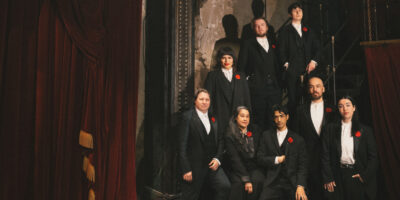
Costume and scenic designer Clint Ramos—Tony-nominated last season for Best Costume Design of a Musical for the Tony-winning Maybe Happy Ending—may be one of the busiest artists currently working in New York.
The Tony-winning designer is also the producing creative director for the New York City Center Encores! series as well as Lincoln Center's Artist-in-Residence for the next two years. Born and raised in the Philippines, Ramos also serves on the Advisory Board of the American Theatre Wing and is a co-founder of Design Action and Theatre Group Asia (who produced a production of Into the Woods this past summer starring Lea Salonga).
Maybe Happy Ending marked the seventh Tony nomination for this multitalented and multifaceted artist. He won the Tony for Best Costume Design of a Play in 2016 for his work on Danai Gurira's Eclipsed, making history as the first person of color to win in that category. Ramos was subsequently Tony-nominated in 2018 (Best Costume Design of a Musical for Once on This Island), 2019 (Best Costume Design of a Play for Torch Song), 2020 (Best Scenic Design of a Play for Slave Play and Best Costume Design of a Play for The Rose Tattoo), and 2023 (Best Costume Design of a Musical for KPOP).
Ramos, who has designed more than 200 theatre, opera, and dance productions around the world, was also a lead producer of Broadway's Here Lies Love. Among his screen credits are production design for Isabel Sandoval's Lingua Franca for Netflix and costume design for the Aretha Franklin biopic Respect.
Ramos, who resides in New York with his husband and daughter, is also the recipient of two OBIE Awards—including one for Sustained Excellence in Design—three Lucille Lortel Awards, a Drama Desk Award, an Outer Critics Circle Award, two American Theatre Wing Henry Hewes Awards, the TDF Irene Sharaff Young Master Award, a Helen Hayes Award, and a Craig Noel Award, among others. He is also a two-time recipient of the Ani ng Dangal Presidential Medal for Dramatic Arts from the President of the Philippines.
In the interview below for the Playbill series How Did I Get Here—spotlighting not only actors, but directors, designers, musicians, and others who work on and off the stage to create the magic that is live theatre—Ramos shares how sobriety affected his life, how global warming influenced his designs for Once on This Island, and why "Broadway is broken, but it is not irreparable."

Where did you train/study?
Clint Ramos: I began my journey in the arts through street theatre in high school. For my undergraduate studies, I attended the University of the Philippines, earning a double major in Theater Arts and Sociology and then pursued advanced training at NYU’s Tisch School of the Arts, where I received my Master of Fine Arts.
Was there a teacher who was particularly impactful/helpful? What made this instructor stand out?
There were a couple of teachers who really made an impact. The first theatre teacher who really influenced me was my high school drama teacher, Chris Millado. He was the first person who taught me that theatre is indeed political. The second teacher was my long-time mentor, national artist, Antonio Mabesa at the University of the Philippines. He taught me that if things in my practice become comfortable, then indeed to change things up. That comfort is the enemy of art.
There are many more teachers in grad school that influenced me, but one teacher that really made his mark was Paul Steinberg at NYU. He taught me how to essentialize aesthetics and to break away from that essentialism.
How did you settle on a more modern look for the costumes of Maybe Happy Ending versus something stereotypically sci-fi?
I landed on a more modern look because the team wanted the future to be familiar, as opposed to something that was 100 percent imagined. We took a lot of cues from the mid-century presence embedded in the piece, grounding much of the costume design in the aesthetics of the mid-20th century.

How much did the show being set in Korea factor into your thought process of choosing the characters’ costumes?
The Korean setting of the show greatly influenced the designs. We looked at Korea in the present as a template, as well as in the past. As a matter of fact, the yellow raincoat that Oliver wears is rooted in traditional Korean raincoats. We really looked at this idea of what modern Korea, more specifically Seoul, looks like and used it as a foundation to create an imagined future that carries a familiarity to the present.
Your theatre company [Theatre Group Asia] recently presented Lea Salonga and Arielle Jacobs in Into the Woods. Were there any aspects of the show that resonated differently or more strongly with an all-Asian cast? Are there any plans for a U.S. mounting?
There were many things that resonated differently with an all-Asian cast. Since it was performed in Manila with an all-Filipino cast, we were able to drive home a lot of points in the musical’s fairy-tale themes and find parallels in the Philippine context. Filipinos love to tell stories; we as a people believe in supernatural and magical realism. In terms of the way we wove these things through without changing a single piece of text or music, we were able to make these particular woods uniquely Filipino defined for ourselves.
Right now, there are no plans for a U.S. mounting of the production.
Can you discuss what your role as producing creative director for New York City Center Encores! entails and one of your goals for the long-running series?
I am the producing creative director for New York City Center Encores! I work closely with Jenny Gersten, the artistic director, and Mary-Mitchell Campbell, the music director. We together program the seasons, find the artists, and build the community that would fit for that particular season from designers to actors to directors. We also work closely with the estate of these musicals, or if the authors are living, to collaborate in bringing new life to these works of musical theatre. There are seasons that I lead a couple of projects, and there are seasons we all collaborate on.
I’ve been with the series for five years now, and I think our biggest goal is creating a wider embrace and a wider audience for Encores!, which we continue to meet. I think my long-term goal for Encores! is to continue to be limber, to move with the times, to listen to the zeitgeist on what of the past we may want to investigate and revisit so that our present makes more sense, hence we are able to plan for the future.

Not including Maybe Happy Ending, if you were asked to put one of your costume designs in a time capsule, which would you choose and why?
I would probably choose the costumes from Once on This Island, particularly the gods. I leaned heavily into this idea of global warming; the costumes stemmed from an ecological devastation point of view and made out of found materials. I would be interested in putting those in a time capsule. As we know, climate change is ratcheting up, and I'd be curious to see how we would emotionally respond to those costumes and their concept decades from now.
Tell me about programming the upcoming season of American Songbook. Are there any genres or artists you are particularly excited about presenting in the series?
As part of my artistic residency at Lincoln Center, I am programming the Songbook series for 2026. We’ve titled the series “Echos of an Inheritance.” I wanted to look at both the canon of work and the artists whose work we include in what we as Americans deem to be the American Songbook. I wanted the invited artists to look at the Songbook not as a catalog, but more as a question and what other questions does it prompt. I am excited about the range of artists and genres we are engaging with, including opera, club, pop, gospel, and musical theatre. While I can’t announce who the artists are, I’m more excited about the collusion of these genres and the reinterpretation of particular canon of songs.
Tell me about a time you almost gave up but didn’t.
Oh, many times. I’ve been sober for 25 years now, and I owe a lot of where I am and what I have achieved today because of that sobriety. I would say early on, before I got sober, those were dark times, and I couldn't really see where my life would lead. That was the time where I think I almost gave up but didn’t, and I think it's important that as artists that we take care of both our mental health as well as our physical health. I was young and when I got sober, it was during a time when the importance of mental health was not strongly stressed as it is today.

What do you consider your big break?
Oh boy, my career is full of big breaks really. I think my initial big break was when George Wolfe invited me right after grad school to design at The Public Theater. That was a milestone. I also think my first Broadway show, The Elephant Man, was a milestone, and Eclipsed was a big break for me. Having been nominated for a Tony Award and having won that year being the first person of color to have won that category. I think that was a big break.
Is there a person or people you most respect in your field and why?
I respect everybody. This is a hard field to practice in, but having worn many hats in the theatre, I have such respect for costume designers. Simply through the amount of time and work that goes into what costume designers do is often immeasurable. A lot of costume designers say this, but I think it falls on deaf ears. For me, being a costume designer, a scenic designer, a producer, and on not-for-profits leadership teams, I can tell you that what costume designers are saying is true.
Tell me about a job/opportunity you really wanted but didn’t get. How did you get over that disappointment?
Oh gosh, a lot. I really wanted to design the costumes for The Color Purple film. I was up for it, and I was close, but I understand the reasons why I didn’t get the job. I had a great time meeting with the director. We hit it off aesthetically, and I have such a deep respect for him at that job.
In the theatre, there are too many to mention, but I am grateful for all the opportunities. It is immensely cliche, but if one door closes, many more will open, and I think there is truth to that. To get over the disappointment, the next steps are to focus on the next target.
What advice would you give your younger self or anyone starting out?
Find your people. Go where the love is. You may be physically hungry, but at least if you find your people, you will always be spiritually fed.
What do you wish you knew starting out that you know now?
That Broadway is indeed broken, but it is not irreparable. That the problem lies among all of us. There isn’t one entity to point a finger at. It's not just one institution or one person, it lies in all of us, and it is amongst all of us with which a solution lies.
In such difficult times in this country and around the world, how do you think theatre can play a positive role, either for yourself and/or the community at large?
I've always believed that the theatre is a venue for thought. When we think of the reasons for audiences to go to the theatre, yes, they go to be entertained, and yes, it is to experience something visceral. I also feel that it should be a place where they can think. Perhaps coming out of what they've just seen is that we’ve shifted a point of view or made us think about matter twice, and we've succeeded if we opened brain space or heart space with new ways. We walk into things believing we’ve fully defined who we are. The theatre being a venue of thought makes you meditate on your own definition about your identity and existence.
What is your proudest achievement as a costume designer?
My proudest moment as a costume designer is not attributed to a particular show, but rather it is when my work contributes to this glorious ephemeral thing that is only emotionally tangible. I think I’m really proud when the appearance of the character makes complete sense of the mission statement of whatever the production is.


Helen J Shen and Darren Criss in Maybe Happy Ending

Helen J Shen and Darren Criss in Maybe Happy Ending

Helen J Shen and Darren Criss in Maybe Happy Ending

Helen J Shen and Darren Criss in Maybe Happy Ending

Darren Criss and Helen J Shen in Maybe Happy Ending

Helen J Shen and Darren Criss in Maybe Happy Ending
Helen J Shen and Darren Criss in Maybe Happy Ending

Darren Criss in Maybe Happy Ending

Helen J Shen and Darren Criss in Maybe Happy Ending

Marcus Choi and Darren Criss in Maybe Happy Ending

Helen J Shen and Darren Criss in Maybe Happy Ending

Helen J Shen and Darren Criss in Maybe Happy Ending

Helen J Shen in Maybe Happy Ending

Dez Duron in Maybe Happy Ending

Dez Duron in Maybe Happy Ending

Darren Criss and Helen J Shen in Maybe Happy Ending

Darren Criss and Helen J Shen in Maybe Happy Ending

Darren Criss in Maybe Happy Ending

Helen J Shen in Maybe Happy Ending

Helen J Shen and Darren Criss in Maybe Happy Ending

Darren Criss in Maybe Happy Ending