*This article has been updated to reflect a new statement from Maybe Happy Ending lead actor Helen J Shen.
Tony Award-winning musical Maybe Happy Ending has been the topic of avid industry conversation the past week. Last week, the musical announced that Andrew Barth Feldman would take over the show in the lead role of Oliver, following the departure of actor Darren Criss. The decision has led to widespread outcry, due to the role of Oliver having been currently, and previously, played by actors of Asian descent—Feldman is white.
Now, in response, the show's creators Hue Park and Will Aronson have taken to Instagram. In a statement published at around 1 AM July 31, the two jointly explained the rationale behind their decision, saying they wanted Maybe Happy Ending to be "comfortably performed by anyone, anywhere—yet distinctly set in Korea."
Continued the statement: "At the same time, we understand that for many in the AAPI community, the makeup of our opening night cast became a meaningful and rare point of visibility. We’ve heard how strongly people connected to that representation, even if it wasn’t our original intent, and how this casting decision has re-opened old wounds."
"Throughout the American development, we tried various approaches to casting. At some points along the journey, we cast the roles explicitly as Asian, thinking that it might help make the setting more quickly apparent. However, on seeing that, we also were not satisfied. To say that seeing *any* Asian actor on stage 'quickly suggests Korea' seemed not only like a stretch, but regressive, or even offensive to the uniqueness of Korean culture." It should be noted that the Broadway production, as well as previous productions of Maybe Happy Ending, had always cast Asian actors in those lead roles.
Park and Aronson then pointed out that other roles on Broadway that were originated by white performers have seen Asian performers step into them in recent years, such as in Dear Evan Hansen, Hadestown, Cabaret, and Oh, Mary! (which has an Asian American performer—Conrad Ricamora—playing Abraham Lincoln). "Leading roles for Asian performers have long been painfully scarce, and these shows excitingly made gestures toward universality with expansive casting, and rightly gave opportunities to actors from identity categories who previously had few options. With Maybe Happy Ending, we wanted to write a show in which every role could be played by an Asian performer, but without the intention that the robot roles always would be."
One of the show's standbys, Christopher James Tamayo, also posted on Instagram in support: "I fear the online discourse has lost the plot. In trying to highlight a larger issue, it is inadvertently undermining the very thing that we want to hold dear and preserve for opportunities for all of us." Tamayo, as well as the rest of the show's standbys and understudies, are all of Asian descent.
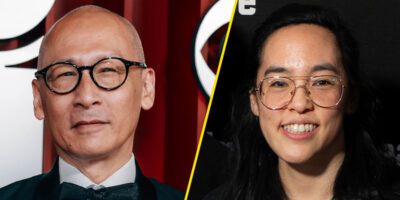
At around 4:30 pm July 31, Maybe Happy Ending's lead actor Helen J Shen posted a statement on her Instagram, where she expressed her own mixed feelings about the situation. Shen currently plays Claire, also a robot, in the show. Andrew Barth Feldman is her boyfriend. "I acknowledge that we can't control how the show is received and the impact that it has had. The vacuum of A/PI stories that don't center around pain or tropes wanted to be filled by our show from our community. I have and continue to be extremely proud to look the way I do and to co-lead this Broadway show. I know the hurt that people feel because growing up, I would have found a beacon of hope in seeing our show on tv on the Tony Awards. A part of me is mourning that along with the community."
Continued Shen: "This has been an immensely challenging moment within my home with Andrew, and in this building filled with A/PI folks to say the least. I don't know what's forward, but to have this opportunity to play opposite my favorite actor in the world for 9 weeks, who happens to be PERFECT for the role is a huge moment of joy for me. Every perspective on this situation contains truth."
Maybe Happy Ending's casting decision has led to numerous responses throughout the industry. In response to Park and Aronson's statement, actor Telly Leung (Aladdin) posted a statement on Facebook: "During awards season, the show leaned into its Asian excellence narrative. That's why our community felt pride and ownership in MHE.—and why this decision hurts so deeply now ... It shows a lack of awareness, a lack of accountability, and, frankly, feels like a betrayal—especially to a community that's long been excluded from Broadway stages. Their statement not only failed to acknowledge that—it effectively gave future productions permission to erase the Asian representation they once celebrated. That's not progress. That's erasure."
The Tony-winning Asian American Performers Action Coalition, an advocacy organization, released a statement yesterday saying: "If the intent has been to show the story’s 'universality,' we are reminded that though we have long been expected to view white stories populated by only white actors as 'universal,' stories about people who look like us that are populated by people who look like us are rarely considered universal enough."
Meanwhile, Tony-winning actor BD Wong is collecting signatures for an open letter, while Oh, Mary's Ricamora has started a scholarship aimed at male actors of Asian descent pursuing a degree in performance.
Wrote Wong: "There was a subtle attempt to characterize a non-Asian actor playing this role as an example of 'inclusion.' A 'now, anyone can play it!' spin, because 'anyone' sounds so 'expansive.' This almost mocks the struggle for opportunities of the marginalized! It ignores the statistical dominance of white actors in musical leading roles (MHE was a glorious, rare exception to this). It undermines the effort to discuss yellowface and appropriation. It also seemed unaware of its potentially negative optics. I know nobody takes casting decisions lightly. This 'pivot' unfortunately retracts the validation and celebration that MHE lent the Asian community. This is agonizing to witness and to feel in my heart. Nobody is winning."