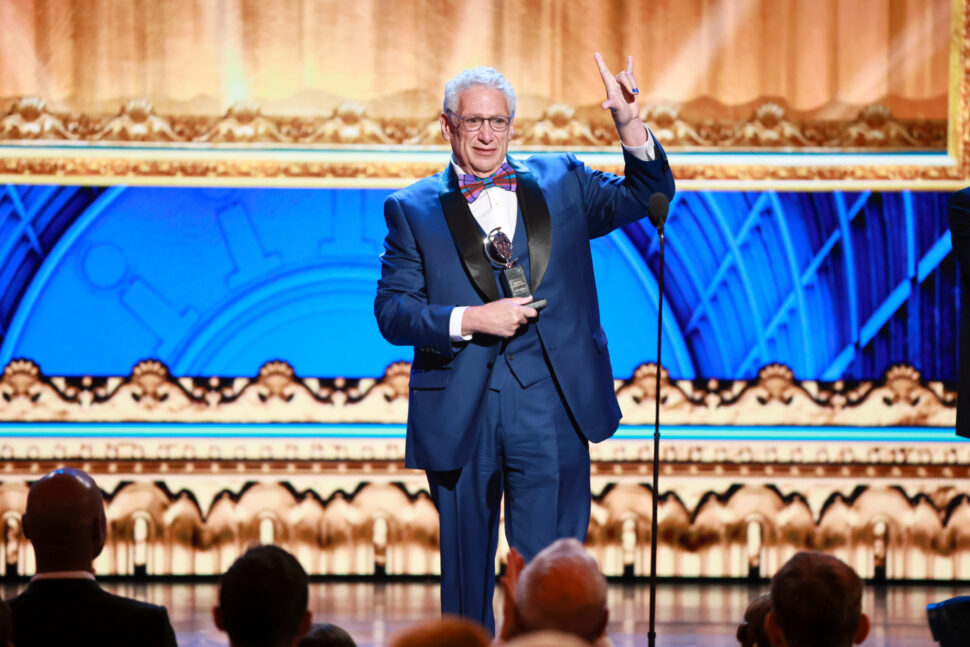
Harvey Fierstein is an Artist—capital A—to put it mildly. In his long and storied Broadway career, he’s won four Tony Awards, two as an actor (for Torch Song Trilogy and Hairspray) and two as a writer (for Torch Song Trilogy and La Cage Aux Folles).
Then this past June, the living Broadway legend was honored with a Lifetime Achievement Tony Award. And while accepting the accolade onstage at Radio City Music Hall, Fierstein hinted at the larger breadth of his artistry. “This has all happened by accident,” he said in his speech. “See, if it had gone to plan, I should now be a retired high school art teacher.”
Yes, reader, theatre is actually just the other thing Harvey Fierstein does. You know, when he finds the time. He’s been making art—drawing, painting, sculpting—since childhood, and as he said in his Tony speech, had thought he’d devote his life to teaching kids to do the same. Becoming a household name and beloved entertainer was never the plan.
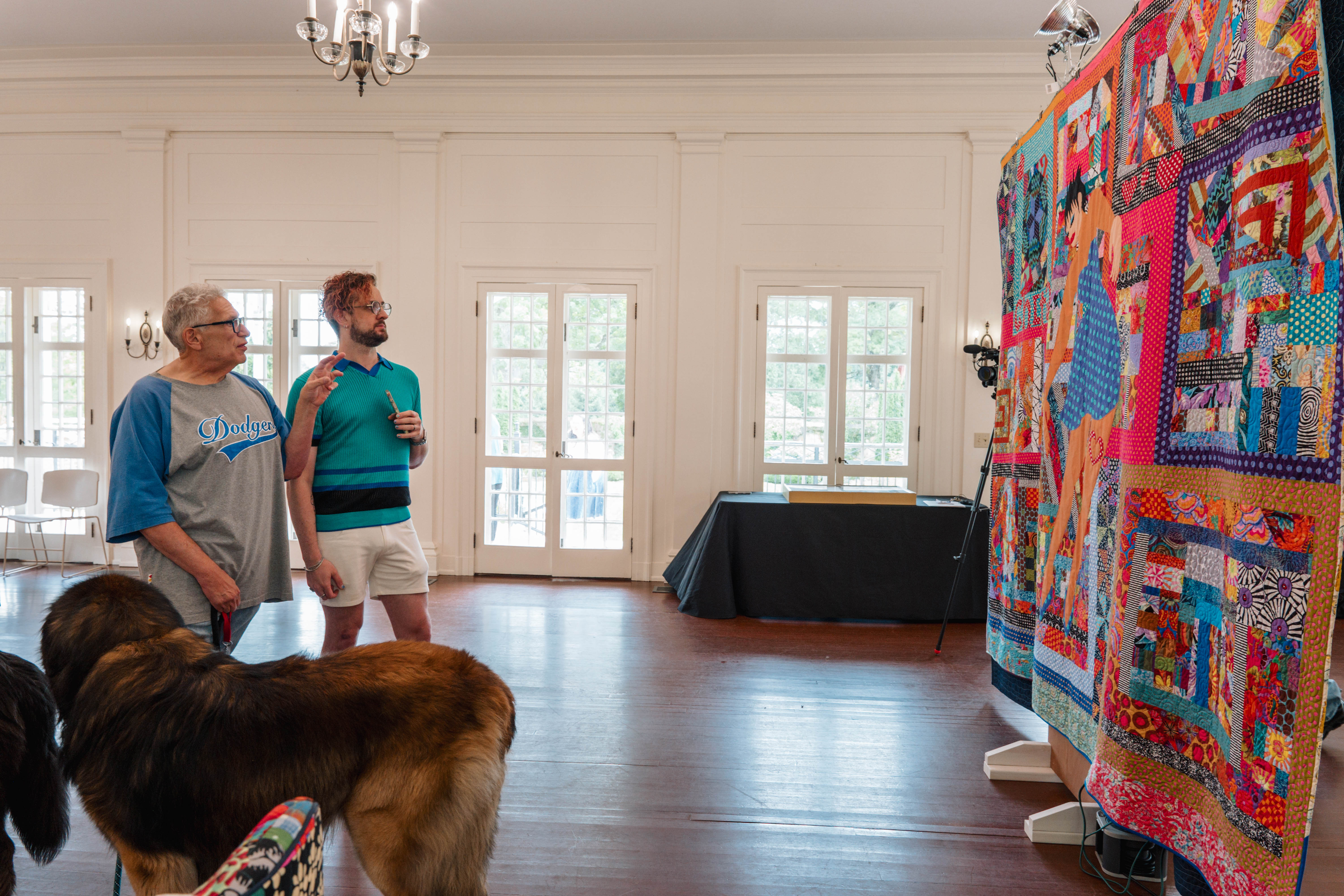
And now, in his hometown of Ridgefield, Connecticut, a different facet of Fierstein’s artistry is on exhibition, at Keeler Tavern Museum. A new show, open to the public July 25-27, is putting Fierstein’s quilts front and center. Yes, you may know Fierstein best for his plays and legendary stage performances, but Fierstein can also sew a mean quarter-inch seam.
But how did Fierstein go from visual art to theatre to sewing? That’s all part of the legend's unique outlook on life: “It’s easy to say no, because you’re scared. But I’ve always been a ‘sure, whatever. Why not,’” Fierstein tells me, walking through the Keeler Tavern Museum as docents ready his quilt exhibition. Fierstein was surveying the work, accompanied by his two comically large dogs, BoBo and Charlie.
But that "why not" sentiment, Fierstein says, makes it so one’s life is never a tidy, straight line [insert obligatory gay joke here].
That same outlook is what landed Fierstein in the theatre, too. A friend’s mother started a community theatre and needed someone to make posters. Enter the young Fierstein, who ended up finding his people there. Before he knew it, they had him acting, too. And that’s why it didn’t seem like such a crazy idea to head to an open audition at experimental theatre company La MaMa. He was actually there because he wanted to meet his art idol, Andy Warhol, who was holding calls for what would become his sole stage play, Pork. Fierstein ended up being cast, and Warhol thought to get him in drag—the beginning of another lifelong facet of Fierstein’s art. And La MaMa would end up being where Fierstein cut his teeth in the professional theatre, presenting the earliest versions of what would become his career-making Torch Song Trilogy.
The quilting, Fierstein says, is an extension of his visual art. In fact, he says the writing and the acting really is, too—he doesn’t think of them as separate things. He got into quilting via a TV show on ‘90s-era HGTV (“before they became 24/7 real estate porn,” he says, rolling his eyes). It seemed like something that would be fun to learn, and once he did, he was hooked.
But just as Fierstein’s theatrical output has been anything but ordinary, his quilts are not exactly what you expect to see on your grandmother’s loveseat. Fierstein’s lifelong eye for color has made him a big fan—not to mention personal friend—of fabric designer Kaffe Fassett, who works almost exclusively in vibrant, sometimes unusual color pairings. Fierstein started his quilting journey making what’s known as “crazy quilts,” which eschew the more traditional, symmetrical block patterns for irregular, almost improvisatory fabric shapes.
Just as Fierstein found community in theatre, he found community in quilting. Even though it involves heavy machinery, it tends to be a uniquely communal experience, whether it’s meeting fellow quilters at the local quilt shop or holding “stitch and bitch” sessions, as Fierstein calls them. His particular journey ended up leading him to Erin Byrne, a former advertising CEO who runs Cotton Candy Fabrics, a quilt shop in Brookfield, Connecticut.
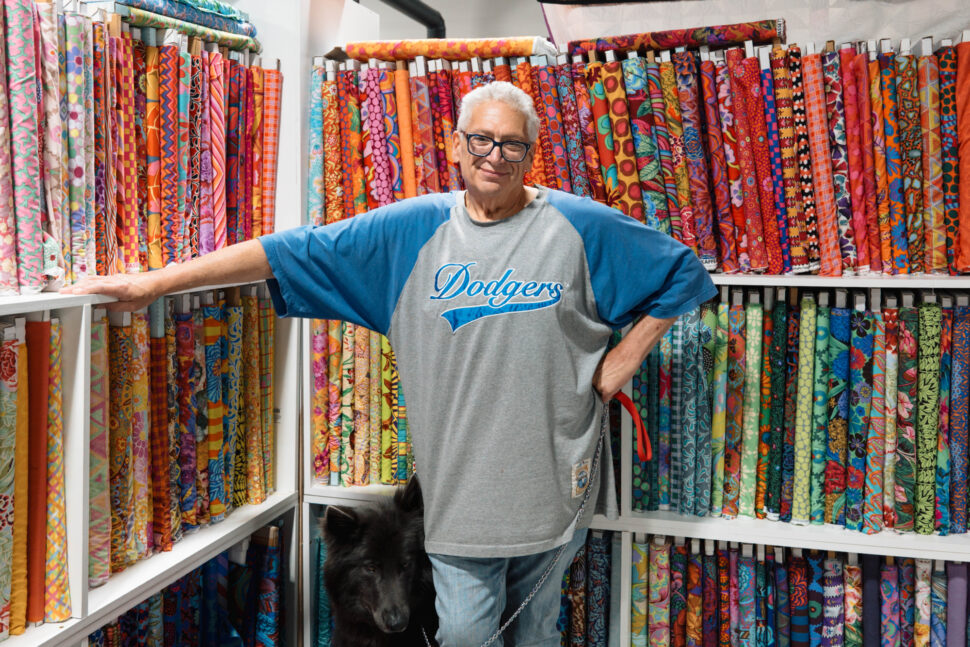
Byrne says making quilty friends is one of the best parts about getting into the craft. “You can go to any quilt shop and have a conversation with anyone that you’ve never met before,” she says. “You all speak the same language, when you all have the same mindset about community, and giving a piece of yourself with the things that you make.”
The two started out as friends, but before long, Byrne had Fierstein at Cotton Candy learning to use a longarm, a large and specialized sewing machine made specifically for the quilting process. Fun fact: When most people talk about quilting, they’re actually describing piecing a quilt top. The actual quilting comes in when the quilt top, batting, and quilt backing (collectively the “quilt sandwich”) get sewn together.
Like many quilters, Fierstein had been sending his quilts out to be quilted by other people—it’s a difficult process to do on a regular home sewing machine. Learning to longarm—which involves stretching your three quilt layers out on a large frame that stays stationary as the sewing machine moves, the opposite of how a normal machine works—is what kicked Fierstein’s quilting artistry up a notch.
“Suddenly he had the technique, the know-how, but also the artistry, the eye for color—and his brain for storytelling,” Byrne says. “It all came together and added up into something on a whole other level.”
And that’s why Fierstein’s quilts, a craft he started doing with ladies at his local quilt shop, are now hanging on the exhibition walls of the Keeler Tavern Museum. His work is, within the world of quilting, uniquely artistic, the fabric becoming the canvas, the thread his paint. These days, he tells us, he tends to construct a background, either by piecing various fabric pieces together crazy-quilt style or just large pieces of fabric. Then he’ll turn drawings into appliqué templates, cutting his shapes out of fabric and sewing them on top of the background layer. And, he says, he always lets the piece itself tell him what it wants to be. If he's unhappy with a quilt, it just means it’s not finished yet.
He also likes to continually learn new techniques, new skills to put in his proverbial quilting toolbox. “Every quilt has to be completely different, or have at least one technique that I’ve never tried before,” he says. His most recent addition is couching, a method of sewing yarn onto fabric. The result is almost like he’s drawn on his quilts with a 3D yarn pen, outlining his shapes.
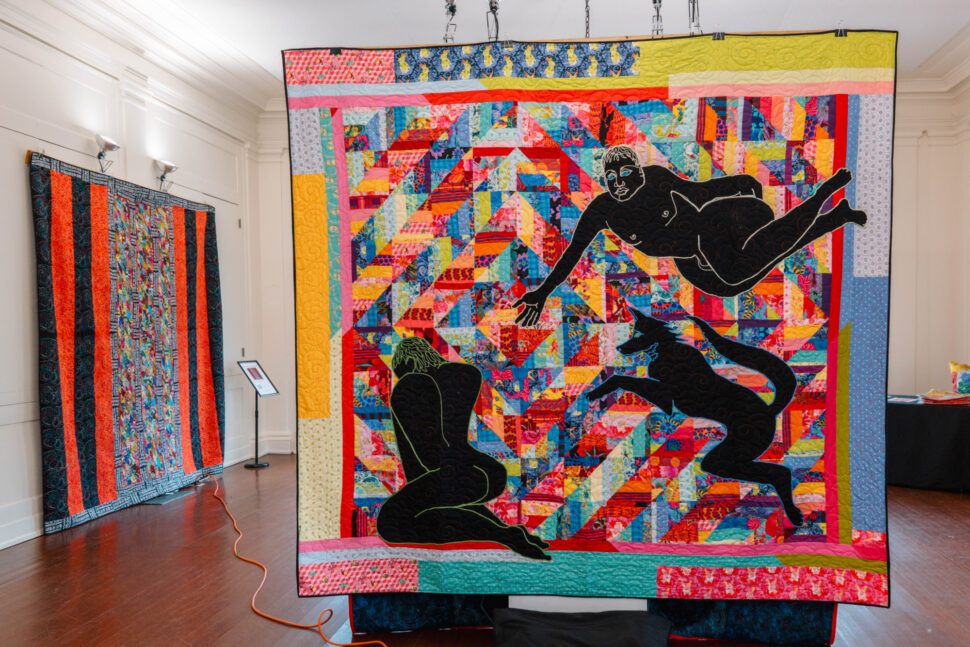
Perhaps unsurprisingly, Fierstein is no stranger to combining his theatrical and quilting lives, something that is on display at Keeler. Amongst the quilts in the exhibition are pieces dedicated to two of his late friends and stage colleagues, Gavin Creel and Chita Rivera. Both quilts, he says, were his way of processing his grief. “When somebody you know, you love dies… and Gavin was so young, and nobody knew. Well, I didn’t know he was sick, until the end,” he shares. “What do you do with those feelings? Gavin’s gone, but we’re left with all these feelings.” Making a quilt, he says, is so personal. “It’s you and the machine. There is nothing more meditative.”
Creel’s quilt feels like it lives on two planes. Its background is colorful, vibrant Kaffe Fassett fabric—characteristic of Fierstein’s other quilts. The foreground is somber figures in solid black: Creel, kneeling and with his back turned; Fierstein and his dog, BoBo, reaching out. “Isn’t that Gavin?” he remarks. “Gavin was life. Gavin was laughter. And he was very sexy, a wild energy. That’s him. [The somber figure in the quilt] wasn’t him. When you get sick, that becomes you. It became me and BoBo reaching out to Gavin, saying ‘Come to us. Why didn’t you tell me?’”
Fierstein is auctioning the quilt off, with proceeds to go to Celia Keenan-Bolger and Sara Bareilles’ newly founded Gavin Creel Fellowship, an initiative that will provide $25,000 grants to emerging theatre actors.
See photos from Fierstein's process making his Gavin quilt in the gallery below:


Fierstein's sketch representing Gavin Creel

Fierstein's sketches of Gavin Creel and himself

Fierstein's sketch for his quilt honoring Gavin Creel

The Gavin quilt details

The Gavin quilt details featuring Kaffe Fassett fabric

Charlie in front of Fierstein's quilt honoring Gavin Creel


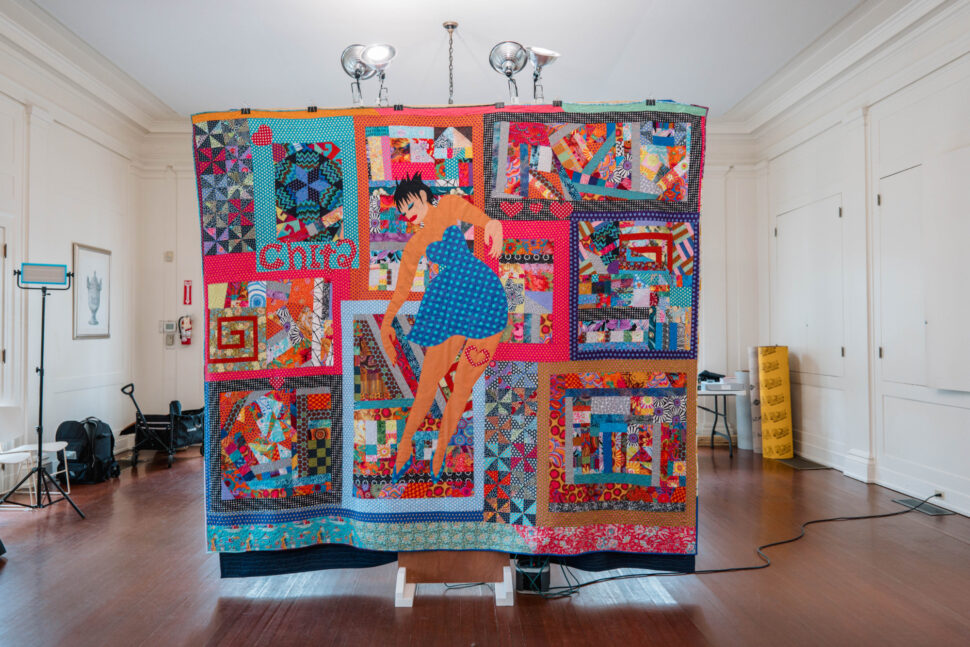
His Chita quilt is more colorful, with Rivera pictured in a blue polka-dot dress doing one of her signature dance moves from Sweet Charity.
“Everyone thinks of her as West Side Story, but [Sweet Charity] was more her to me,” Fierstein says of his longtime friend and fellow Tony-winning Broadway legend. Fierstein has also included an appliquéd heart on Rivera’s leg, an homage to Charity’s iconic tattoo. Or as a way of commemorating the horrific 1986 car accident that nearly ended Rivera’s dancing career with a catastrophic leg injury? He can’t remember which, for sure. “And she has the short, cropped hair. That was the real Chita.”
Fierstein’s art, he says, can almost always be a method for turning pain into beauty, an idea he explores more comically in the exhibition, too. One of the items on display is an armchair from his parents’ home. It was, he explains, his parents’ punishment chair. You got sat down in it when you did something naughty, and with mom or dad directly in front chewing you out, there was physically no way to escape. When Fierstein’s mom died, nobody wanted the chair, but nobody wanted to get rid of it, either. Fierstein had it re-upholstered using one of his quilts.
“As a history museum with a commitment to connecting past and present, [we’re] excited for the opportunity to showcase Harvey’s quilting creativity and to provide audiences with perspective on quilting’s long history of artistic expression and social commentary,” says Keeler Executive Director Hildegard Grob. That Fierstein is a recognizable name in a completely different artform is actually what made the idea of exhibiting his quilts seem so appropriate for the museum. Grob says the special exhibit is a great showcase of not merely Fierstein’s quilts, but rather the full breadth of his artistry.
You’ll even see Fierstein himself on display. The exhibition opens with a large showcase piece of Fierstein seated with his beloved dogs flanking him—you can get this one on a special commemorative tote bag, too. And there’s another quilt dedicated to drag artists, with Harvey’s Tony-winning Edna Turnblad right in the center. Look close and you’ll find quilty versions of RuPaul’s Drag Race stars, Fierstein’s friends and fellow artists, and more, including 2025 Tony winner Cole Escola, Jinkx Monsoon, Monet X Change, Alaska Thunderfuck, Trixie Mattel, and more.
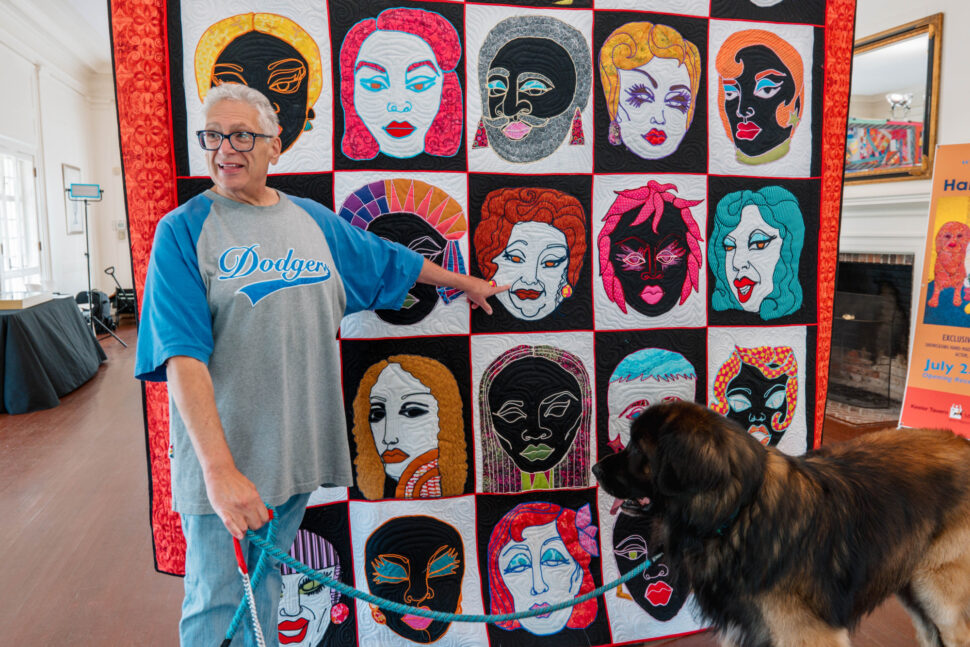
But just like when he has a new show on Broadway, we can’t say Fierstein doesn’t have his critics. “Bianca Del Rio… she does not like how I did her,” he says, eyes campily wide. Yes, in this showcase of the full spectrum of an artist’s work, the Drag Race winner reminds us that subjectivity is part of art, too. The library is open—officially.
“You Made That?” The Quilting Adventures of Harvey Fierstein is on display at Keeler Tavern Museum and History Center in Ridgefield, Connecticut July 25-27. Fierstein will be on hand for a meet and greet July 27 4-5 PM. Timed tickets to the exhibition, along with tickets to the meet and greet event, are available at KeelerTavernMuseum.org.


Harvey Fierstein and Logan Culwell-Block

Harvey Fierstein and BoBo in front of a selection of Kaffe Fassett fabrics at Cotton Candy Fabrics

Fierstein and BoBo in front of a selection of Kaffe Fassett fabrics at Cotton Candy Fabrics

Fierstein and BoBo in front of a selection of Kaffe Fassett fabrics at Cotton Candy Fabrics

Harvey Fierstein at his local quilt shop, Cotton Candy Fabrics in Brookfield, Connecticut
“You Made That?” The Quilting Adventures of Harvey Fierstein is on display at Keeler Tavern Museum

Logan Culwell-Block in front of Fierstein's quilt featuring himself with dogs BoBo and Charlie

“You Made That?” The Quilting Adventures of Harvey Fierstein is on display at Keeler Tavern Museum

Harvey Fierstein's quilt "DRAG"

Fierstein as Edna Turnblad at the center of his quilt "DRAG"

Fierstein as Edna Turnblad at the center of his quilt "DRAG"

Cole Escola featured on Fierstein's quilt "DRAG"

Fierstein's "DRAG" quilt

Fierstein's re-upholstered armchair from his parents’ home

Details on the armchair
Fierstein's quilt dedicated to late Tony-winning Broadway actor Gavin Creel.
The Gavin quilt details
The Gavin quilt details featuring Kaffe Fassett fabric

Harvey Fierstein and Logan Culwell-Block
Charlie in front of Fierstein's quilt honoring Gavin Creel

Fierstein's Chita Rivera quilt

Harvey Fierstein and Logan Culwell-Block

The Chita quilt details

The Chita quilt details

The Chita quit details

One of Fierstein's quilts on display at the Keeler Tavern Museum

One of Fierstein's quilts on display at the Keeler Tavern Museum

Harvey Fierstein and Charlie

Fierstein's quilt "Blue Boy"

"Blue Boy" quilt details

Fierstein's self-made quilted shoes

Harvey Fierstein with BoBo and Charlie