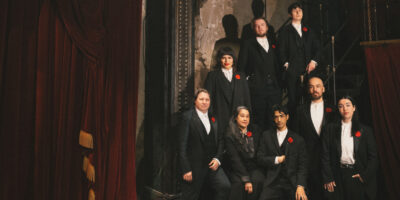
Hell's Kitchen has been bringing audiences to their feet at the Shubert Theatre since March 28, 2024. But before the hit musical came to the stage, and won two Tony Awards, it was just an idea from the head of Grammy Award-winning singer-songwriter Alicia Keys—who wanted to tell the story of a girl coming-of-age in New York in the '90s.
In Hell's Kitchen: Behind the Dream , Keys and co-writer Lise Funderburg dig into the creation process of the hit musical, including the "frustration" that inspired it and behind-the-scenes stories from the show's 13-year journey to Broadway. Read an exclusive excerpt below. Hell's Kitchen: Behind the Dream will be released by Penguin Random House November 11.

Alicia Keys: The main spark for Hell's Kitchen was frustration, because in the early 2000s, what I was seeing on Broadway and television and film was quite distant from life as I knew it. It was annoying. I kept wondering, Where are the stories of people that I know? To be clear, I'm not just talking about Black people, but I am talking about theater being more diverse. There should also be brown people, Asian people, differently colored people who have unique stories and voices that aren't generalized and stereotyped. Obviously, that was a while ago, it was pre-Hamilton, and I do truly feel that things have evolved from that spot. But coupled with the frustration I felt at that time, people were asking me, "Would you write a musical? Would you do a musical film?" I thought, I guess, but how, when, where? I didn't know how that would start or what that would look like.
One glimmer of a way forward came from Stick Fly, Lydia Diamond's play about a Black family on Martha's Vineyard, which debuted on Broadway in 2011. Alicia composed the incidental music for the play, which took on issues of class, race, and gender.
Alicia Keys: Stick Fly was riveting. The way it communicated what the family was going through and feeling. I had never seen anything like that before. That was around the same time I founded my company, AKW Productions.
The slogan of AKW is "the business of inspiration. Through film, television, theater, and music, I wanted to create diverse stories, preferably stories you havent quite seen and haven't quite heard. They'd give a different perspective, something that makes you realize, Wow, I never looked at it like that before.
One day, it landed on me that Manhattan Plaza, where I grew up, was the richest soil for this kind of story. Thinking about Manhattan Plaza and my experience there brought me to what a unique neighborhood Hell's Kitchen is, which brought me to all the different people that I knew there. I was also thinking about what success is or feels like or should be. It took me a long time to have a healthy relationship with success. A lot of times I would find myself in rooms and feel like, I don't even know why I'm here. How did I even get here?
All of that together created the desire to tell this story of this girl, this building, this community. From day one, I was very clear that you would see the main character only in the seventeenth year of her life. It would not go beyond that. You had a sense, Man, something is brewing, but you had no idea what would come. I wanted to focus on the very everyday yet special experience of this girl with this unheard story, and that was the spark that started the dream.

THE (REAL) ROOTS OF THAT UNHEARD STORY
It makes sense that many theatergoers come to Hell's Kitchen expecting a storyline that perfectly parallels Alicia Keys's childhood. In fact, it's only loosely based on her experiences growing up in NYC: In the show, as in Alicia's life, a single mother and her daughter live on Manhattan's West Side. The mother is white and the father is Black, and the mother does everything she can to protect her strong-willed child from harm. It's the 1990s; the neighborhood is debilitated by drugs and prostitution, but it's also a place where people watch out for each other and family can be built and chosen.
Beyond these foundations, Alicia and seventeen-year-old Ali, the protagonist of the show, have countless differences in the details of their lives: Alicia actually began learning piano a decade earlier than Ali, for example, and Alicia's father was not a jazz musician. Still, they share concerns for community, artistry, identity, love, and becoming. Alicia wasn't interested in staging an autobiography but, at the same time, she recognized that she had a well of experiences the show could draw upon, starting with the story of her mother, Terria (Terri) Joseph.
Alicia Keys: My mom came to New York from Toledo, Ohio, at nineteen. She came to attend New York University [NYU], and she was very excited. She had grown up in a super small town, and coming to New York to study theater and acting and dancing was a big dream.
Terria graduated from NYU in 1971 and enmeshed herself in the city’s theater scene. As an emerging artist she struggled to make ends meet, so when an innovative affordable housing project opened up, she set her sights on living there—even though it was in Hell's Kitchen, a downtrodden neighborhood between the Midtown theater district and the Hudson River. Manhattan Plaza consisted of two residential towers that were designated specifically for artists, senior citizens, and people who already lived in the neighborhood. But mostly artists.
Terria Joseph: I had to work really hard to get in there. I did all the paperwork, and thought, Oh, I’m next. Everybody was getting apartments, but they must have lost my application. They didn’t know me from Adam’s tomcat. But in 1978, a year after it opened, they finally gave me the last studio on the top floor of the Tenth Avenue building.
A few years later, Terria was in a casual relationship with a flight attendant named Craig Cook, and when their birth control failed, she became pregnant. Terria knew Craig wasn’t ready to be a father. She briefly considered terminating the pregnancy but decided that she could manage raising the child on her own. As she has said, “When people want to come through, they come through.”
Terria Joseph: Up until this point, I had been temping as a paralegal. My good friend Alicia, who had all kinds of jobs, including being a Playboy Bunny, was doing the hiring for a law firm. She said, “We’ve got a big case coming up. You can get all the hours you want, all kinds of overtime.” I had just told her I was pregnant. She said, “You gotta save your money now.” We did a little behind-the-scenes mischief, and she got me a job. My Alicia was named after her.
Terria raised her daughter on paralegal wages and made a home for her in Manhattan Plaza (eventually moving from the studio apartment to a one-bedroom), where Terria would live for a total of twenty-six years. Terria worked—a lot—and continued to pursue acting roles when she could, but she dedicated most of her time and resources to her daughter.
Terria Joseph: I used to take Alicia to classes to keep her busy. I was always taking her somewhere. She went to gymnastics, but I had to take her out because she was afraid to flip over. For quite a while, Alicia would get up at 6:30 to swim with Manhattan Plaza’s swim team. At some point she said, “Mom, I want to sleep a little later before I go to school.” I said, “You got it.” It wasn’t about torturing her.
Hell’s Kitchen abuts Times Square, which at the time was chockablock with porn theaters and peep shows and had no shortage of sketchy characters. Not the easiest place to raise a kid.
Terria Joseph: I went everywhere with her until she got savvy. When she was nine or ten, I asked her to take me to her dance class. She had to take me every step of the way. I acted like I didn’t know how much money it was, like I didn’t know what a red light was. I said, “Is this where it is?” She said, “Oh, you’re so stupid.” I said, “I just want to know that you really know. The only way I’ll know is if you take me and I act like a dumbbell.” Years later, I made Alicia’s boyfriend sit with me in our living room and have a conversation, and then I took a little picture of him. I said, “In case she never comes home, at least I can show the police what you look like.”
You don’t know how things are going to turn out for your kids. She began piano at seven years old, but at one point, she wanted to stop lessons. I said, “Well, I’m paid up until a couple of months from now, so not until you work out that payment plan.” Of course, she’d forgotten about it by the time that came. I talked about it with her piano teacher, Margaret Pine, a really nice person who lived in the building and taught her everything in the beginning. Margaret said, “Please don’t let her stop. She has a talent and a musicality.” So I figured it was worth a try to keep her in that. I was trying to find out what her muse was, and I thought, That’s the best I can do. I didn’t know what else to do besides give her all the chances I could, keep her close to home, and keep her busy so she didn’t get involved in some crazy group or something. And it worked out pretty good.
Hell's Kitchen: Behind the Dream will be released November 11.