When Sweet Smell of Success opened on Broadway in 2002, it closed just after three months. Now, NYC choral ensemble MasterVoices—under the direction of Tony winner Ted Sperling—is readying to give the Marvin Hamlisch, Craig Carnelia, and John Guare an NYC return. The company is presenting a concert of the 2002 musical November 21-22 at Jazz at Lincoln Center's Frederick P. Rose Hall, with a cast led by Raúl Esparza (Company) as J.J. Hunsecker and Lizzy McAlpine (Floyd Collins) as Susan (tickets are at Jazz.org).
It's a long overdue return for the musical. Its failure in 2002 was something of a surprise, given the pedigree of the people involved. Guare, a Tony winner and Pulitzer finalist, had penned the book from the 1957 cinema classic by Ernest Lehman and Clifford Odets, itself adapted from Lehman's novella. The songs came from composer Hamlisch, a Tony winner for the seminal A Chorus Line; and lyricist Carnelia, a legendary composer-lyricist in his own right.
The cast was no small potatoes, either. John Lithgow created the role of Hunsecker onstage, and even won a Tony Award for the performance. In supporting roles were then-relatively new faces like Kelli O'Hara and Brian d'Arcy James. What could go wrong?
Well, for starters, 2002 was quite the time in the entire world, and certainly New York. A Broadway still reeling from the terrorist attacks of 9/11 was suddenly very fixated on bubbly, happy diversions like Mamma Mia! and The Producers. Sweet Smell, on the other hand, was a deeply cynical story about some of NYC's seemliest underbelly.
The story follows an ambitious press agent, Sidney Falco, who develops an unlikely friendship with an incredibly powerful and influential gossip columnist, J.J. Hunsecker, whose daily column is the primary target for all of Falco's clients. Hunsecker was a character Lehman created fairly closely in the image of the real-world figure Walter Winchell, who used his own intensely influential column and radio program, combined with close relationships with many in the world of politics, namely J. Edgar Hoover, to wield a shocking amount of control over American media, entertainment, and politics. Winchell could make or break everyone from a young Broadway hopeful to a seemingly powerful politician, usually with little more than a few keys on his typewriter. As you can imagine given his connection to Hoover, he was a huge part of McCarthyism (that senator was another close associate) and the general concept of silencing voices he didn't like.
In Sweet Smell, Hunsecker enlists Falco to break off a relationship between his sister, Susan, and a young jazz musician, tangling Falco up in his sinister, self-dealing web in the process. The story is a biting critique on the, at that point, "real" New York—if not American media on the whole. In the days after 9/11, audiences were not super receptive to that, regardless of the pedigrees of the musical's writers.
But, Guare and Carnelia tells Playbill, that's not the full explanation for Sweet Smell's initial failure, at least in their minds. Beyond esteem for seeing the show come back at all (Hamlisch considered the musical amongst his finest work), the team says the concerts afford them an excellent opportunity to revisit the troubled project, a chance to bring the musical back closer to their initial impulses, eliminating some changes made on the way to Broadway that they now regret making.
To find out more, we caught up with Guare, Carnelia, and MasterVoices Artistic Director (and this concert's director and conductor) Sperling during rehearsals. The conversation has been edited for length and clarity.

Ted, how did Sweet Smell of Success become your pick for MasterVoices?
Ted Sperling: I always try to find something that feels like it speaks to our moment. It’s a little tricky, because you have to decide a year in advance, and you have to predict what that moment is going to feel like. But with everything that’s going on with social media, and particularly the censorship of the press, this feeling like the government may be targeting people … It just felt like this McCarthy-era story was more relevant than ever. And I always look for things that have a large role for the chorus since we have 150 people in our chorus. The chorus is a very big piece of Sweet Smell of Success. They’re the voices inside Sidney’s head—whispers, they’re called in the script. They’re whispering advice, criticism, commentary, passing rumors. So they are, in a way, the web of society that perpetuates and amplifies these rumors that can start in a newspaper column or a radio program.
This feels like, in terms of this group’s musical theatre performances, one of the more active chorus situations you’ve found.
Sperling: It is. Usually they’re on choir stands at the back of the stage, but for this, we’re putting them in what is sometimes used as audience seats that surround the stage on different levels. They’ll be in boxes, each a scenario. There will be people at nightclubs, people at ballgames, people gathered around a radio, people at the hair salon. It’s a new way of treating the chorus less as a monolithic entity, but as real people in real time, giving a cross section of New York nightlight in all strata that are all plugged into the news and all interested in the gossip. From a hair salon, they can whisper to Sidney: “Be careful.” We’re going to have 30 of them as an onstage ensemble as well. We’re really pushing them. They’re doing more choreography than usual and playing some of the samller roles.
Let’s go back to when this show premiered. John, Craig—how did this come about?
John Guare: It all started because Garth Drabinski had asked me to write a treatment of how I would do it, so I wrote a scenario and he hired me. I love the story. This was in 1999, and I thought it was still very vital—it spoke to me. I remember we’d gone to Nick [Hytner] originally to direct, and he said no. And then Princess Diana died. The week after that, Nick called me and said, “Do you still need a director for Sweet Smell? It’s all I’ve been thinking about since Princess Diana died, and the press. I think I have to do it.” We had a wonderful workshop in 2000. People were throwing money at us to let them be a part of the show. We opened in Chicago a year later, and by then 9/11 had happened.
Craig Carnelia: The post-2001 audience did not want it. They just didn’t want to hear it, the critics didn’t want to. I don’t think the show really ever recovered from Chicago. I loved the show. And obviously, John got a Tony nomination for it. But it ran for three months [on Broadway] and then vanished until now. People didn’t know what to do with it. And then came Ted.
Hear Noah J. Ricketts and McAlpine sing the score's "Don't Know Where You Leave Off" in rehearsal for the MasterVoices concert below:
Were you happy with how the show ended up on Broadway?
Carnelia: It’s hard to even say. That workshop was just splendid, and we were off and running with a show that was not only highly workable, but seemed to really pull the audience in and hold them throughout the show. We had a year off because John Lithgow had to finish a TV commitment, and then we started up again with an even better version of what we had the year before. We had done some really good work based on things we had learned. I would say the show we opened in Chicago was a great version of what we had in 2000. And then based on response, both from the feeling we got from the audience and its critical response, we began making decisions based on those responses, which is what people usually do. But it’s possible that timing was the issue more than just random mistakes that were made. But mistakes were made. We went in the wrong direction. By the time we got to New York, the show was really not recognizable, and what we had was something that some of us didn’t wholly believe in. What we’ve done with Ted, the opportunity he’s given us is to retrace our steps and do some archaeology through the files and through the different versions of the show.
Guare: Luckily, Craig throws away nothing.
Carnelia: I don’t throw away anything. It’s actually a character flaw. Marvin was of the moment. He would throw out something he wrote yesterday, and there’d be no record of it unless I took it from the trash can, which I did. So we pieced together, and then John and I did some more work with Ted’s guidance to make a great version of the show that represents our initial concept and feelings about the project. John had written this wonderful treatment based on extraordinary work by both Ernest Lehman and Clifford Odets. John and I are both word men, and those guys were undeniably word men. It was an extraordinary process. And now we have the show that we had always wanted to do.
What do you think Marvin would think about re-visiting this?
Guare: Marvin felt it was his best score. He loved it, and was very disappointed by the reaction. I think Marvin would not be surprised at all. He’d just say, “About time!”
Carnelia: When Marvin and I met, we hit it off instantly, artistically. The thing he said to me in our first meeting was he wanted to write another serious score. He felt Chorus Line and Sweet Smell were by far his best, and they were both written with people who also write music! Which isn’t to suggest for a moment that I wrote a note of the music—I didn’t. But I think having a lyricist in those two cases who also wrote music informed not only the lyric writing, but also, what Marvin was able to do. He was truly brilliant, a great composer and so fluid. Stephen Sondheim used to talk about what it was like working with Jule Styne and how the melody just flowed out of him. Marvin was like that. It was thrilling to be in the room with him. He had a visceral, animal connection to why people sing, and that’s what you hear in that music, be it for film or theatre.
So what were the main changes you made for Broadway that you’re now walking back?
Carnelia: There were three biggies. First is the opening, which also changed the end of the show, which was vastly different. There was also a wonderful piece for Susan and Dallas in act two, and it got cut and replaced with a trifle, a reprise of a song that really was nothing much except a period put on the end of their relationship. So with Ted’s guidance, we have made yet another opening that is a combination of the slippery, insinuating opening that we had in 2000 and the more character-driven opening we had on Broadway. And we’ve completely gone back to a version of the ending that is actually totally new, a combination of a number of different versions we had done. And we restored that wonderful song for Susan and Dallas.
Sperling: When we started, I was really pushing hard for it to be a one-act again, because a lot of people involved with the original production told me it was better that way. But I came to the conclusion that we had a choice between a very long one act or a sort of brisk, to-the-point act two with an intermission. I felt that the one act was putting so much pressure on the last 20 minutes or so of the show that I didn’t think it was worth it. We’re restoring the intermission, and I think it gives us breathing room to enjoy every moment of the evening. It’s still going to be a shorter show than it was on Broadway.
What has it been like coming back to this decades later, with 2025 eyes?
Guare: Mostly I’ve been trying to restore my 2000 eyes. I’ve been trying to get over disagreements with some of the producers, and go back to the treatment that I wrote originally in that last century. It’s as simple as that. My 2025 eyes have too much information. I have to get back to where we were when we started the show.
Carnelia: My 2025 eyes have the same common sense and sense of theatre that my 2000 eyes had. It’s a pleasure to be not just restoring, but revisiting this vivid and vital piece of work based on a film that we’ve all loved. I loved that film for years before I got involved in writing the musical, and I’m just very grateful for the opportunity to come back to this thing.
MasterVoices' Sweet Smell of Success will feature choreography by Andrew Palermo, scenic design by Ryan Howell, costume design by Tracy Christensen, lighting design by Isabella Byrd, and sound design by Scott Lehrer. The musical features orchestrations by William David Brohn and dance arrangements by Ron Melrose. Bonnie Panson will serve as production stage manager, Cambra Overend is production supervisor, and David Lai is the orchestra contractor. The production is being presented by special arrangement with Concord Theatricals.
Along with Esparza and McAlpine, the cast includes Ali Louis Bourzgui as Sidney Falco, Ricketts as Dallas, and Aline Mayagoitia as Rita. The company will also include an actor ensemble featuring Clarisse Austin, Brian Binion, Ben Cherington, Brandon Leffler, Colby Q. Lindeman, Viviana Rincon, Brian Vaughn, Clyde Voce, and Jayme Wappel. Craig Burns of The Telsey Office served as a casting consultant.
Tickets are at Jazz.org.


Noah J. Ricketts and Lizzy McAlpine

Noah J. Ricketts and Lizzy McAlpine

Ted Sperling, Lizzy McAlpine, and Mike Stapleton
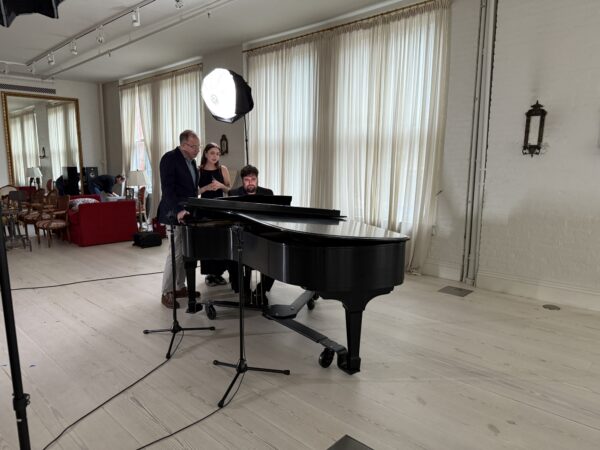
Ted Sperling, Lizzy McAlpine, and Mike Stapleton
Ali Louis Bourzgui and Raúl Esparza
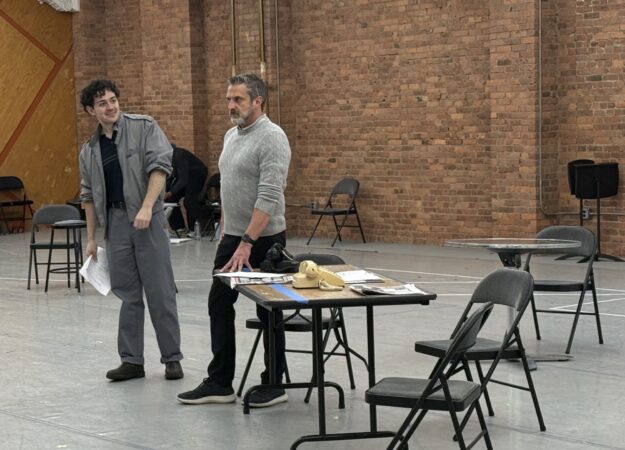
Ali Louis Bourzgui and Raúl Esparza

Ali Louis Bourzgui and Raúl Esparza

Ali Louis Bourzgui