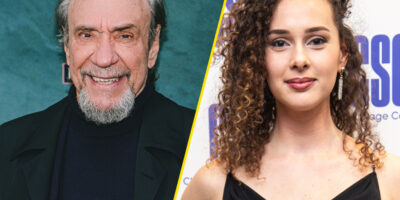
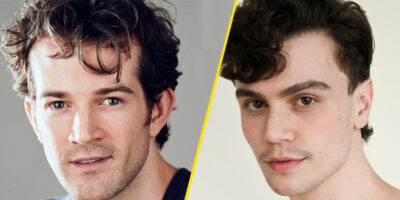
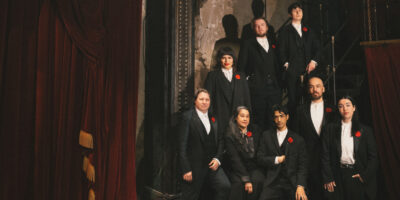
As one of musical theatre’s most haunting characters, the titular role of The Phantom of the Opera has distinct characteristics: one must be dark, but enchanting; threatening, but alluring; and, most of all, tragic, but beautiful. Beyond this, the Phantoms of Masquerade, a new immersive staging of Andrew Lloyd Webber’s hit musical, all have their own methods of enchantment. Two years after the musical’s closure on Broadway, a new iteration has emerged Off-Broadway, where not one, but six men play the Phantom every night.
“The six of us are as different as it gets—we’re different ages, types, ethnicities, we’re even different vocal types, and, no doubt, we’re going to bring our own originality and unique perspective to it—but it’s all in service of [director] Diane Paulus’ very unique vision,” says Telly Leung, who leads the show’s second performance of the night—which the production refers to as “pulses.” There are six performances every night for audiences of 60, spaced 15 minutes apart. Adds Leung: “We all found that vision together in a lot of ways, and even backstage, we call it ‘The Brotherhood of Phantoms.’”
This club name rang true throughout conversations with three of the show’s six Phantoms: Leung, Hugh Panaro, and Clay Singer, all of whom could not resist enthusing about their fellow Phantoms. When Nik Walker was brought up to Singer, he raved about Walker’s performance, which he described as “Tim Burton-esque.” When Singer was mentioned to Leung, he spoke highly: “He’s all of 30 years old and is a rising star…a leading man we’ll hear from for many years, and he’s coming at it with completely fresh eyes.”
Singer, one of the youngest men to ever take on the role globally, admits to having initially felt nervous about living up to preconceived expectations about the character. “I knew going into it, I didn’t have that [age gap] dynamic, that father dynamic. I sort of had to let it go and just bring exactly myself to it and let my work and my process speak for itself, and present what I have. The feedback I’ve gotten is that in this dynamic, the younger energy does work.”

Phantom of the Opera is known for its love triangle between a disfigured composer who lives beneath the Paris Opera House, a young woman with undiscovered operatic talent still mourning the death of her father, and the opera’s newest patron. While the original musical production, which first opened in 1986, is still running in London’s West End and in tours around the world, this new iteration in New York has a radically re-conceived concept from Tony winner Diane Paulus. Instead of audiences sitting in a theatre, they are now led through four floors located at 218 W. 57th Street, with actors all around regaling them (with song) the story of the Phantom.
For however seamless the experience feels for audience members, the cast, creative team, and crew all play a part in a meticulously designed machine of moving pieces, people, and places. The cast, who all navigate the space with so much precision they seem as though they'd be able to do so with their eyes closed, didn’t even arrive at the venue (formerly Lee’s Art Shop) until a few weeks before previews. “We were working with just tape on the ground, trying to imagine what traversing through a jungle like Lee’s Art Shop was going to be like, so we had a lot to learn from the transition from the rehearsal space to the venue,” shares Singer. “I think this is a technical masterpiece. There’s six full-on musicals happening at one time, all these characters are mic’ed, and the sound system is genuinely trailblazing because this sound system has never been used before."
“This has been a project of Diane’s for years,” says Leung. “Ever since they knew that this was going to be the building, she knew every nook and cranny of it. On day one of rehearsal, she gave a two hour-long Powerpoint presentation about every moment in the show, every room in the show, every audience experience, how it differed from the original Hal Prince production—but also what parts of that we were going to be paying homage to.”
Though the production still uses most of Richard Stilgoe’s original book with Charles’ Hart’s original lyrics, Masquerade has surprised long-time Phantom fans (also known as “phans”) with new material that dives deeper into the Phantom’s past. A new song and scene were penned by Andrew Lloyd Webber for the project, highlighting the Phantom’s youth, where he was caged as a carnival act. This moment serves as the heart of the show, with much introspection about the Phantom’s inner child. And for the first time on the stage, Masquerade even gives the Phantom a name: Erik.
“So much of what makes this production different from the Hal Prince production is the childhood trauma of the Phantom, and leaning into the carnival sequence where you’re witnessing the young Phantom in the cage, building off of what that trauma looked like, and bringing that into the Phantom’s body with the animalistic nature of his childhood,” says Singer.
But with that disturbing backstory, the six Phantoms have also had to dig deep into the dichotomy of the character: he has his moments of animalistic ferocity, but he’s also so characteristically defined by his refined demeanor. With a childhood spent in a cage, there’s a gap to fill as to how he found that kind of poise. Singer suggests, “I thought about the way that Madame Giry carries herself, and I think this is where the Phantom starts to learn his grace, his elegance, his posture, and you see this transition begin. To be in the sewers of an opera house and watch its patrons move through the space, you get to see what chivalry and charisma look like and what the etiquette of opera is.” Not only is the Phantom able to learn these manners from observing the opera artists and their wealthy patrons, but he’s also further reminded how inner darkness does not spare the upper class—it only conceals it. “The Paris Opera House was a beautiful place in the 1800s, but also disgusting, and the patrons were taking advantage of these ballerinas. The cruelty that the Phantom saw as a child in that cage really extended even into the highest elegance. The cruelty was always surrounding him,” says Singer.
“That darkness lives in all of us,” Leung concurs. “That anger, that frustration, that feeling of being hurt and dealing with that hurt by hurting others is something we all feel. We repress that to live in a civilized society, but it’s human. And it’s our job as actors to embrace all of that."
After a lifetime of cruelty and isolation, Singer hypothesizes that the Phantom’s feelings for Christine—a woman both pure in heart and voice—go beyond mere affection, as she becomes a source of solace for him. “In this cruel, horrible world that the Phantom felt so isolated by, he heard her voice and it felt like the only form of comfort that he could actually relish in. I think we can agree that the Phantom is neurodivergent and as soon as he hears that voice, that’s where the hyperfixation starts,” posits Singer.

Singer’s introspective musings on the character have been generously shared amongst the other Phantoms, who all pitch each other their own ideas without any sense of entitlement or ownership. “We’ve gotten to watch each other and steal from each other. I’m not above stealing!” Panaro quips. “Clay is a smart, smart actor. I could go on about every different dude in this part. Everyone brings something different to the table, and they’re all magnificent. You can take six dudes and put them in the same prosthetic, same tuxedo, same blocking, and you’re going to get six completely different versions. We’ve had a lot of folks that have come back to the show multiple times because they want to see six different interpretations,” Panaro shares.
Panaro—a true legend of Phantom history, as Singer notes—played the titular role on Broadway countless times, earning a loyal cult following of “phans” who adored his electric, highly expressive (and in the final scene, almost feral) interpretation of the character. During his original run as the Phantom, he even went so far as to study not only the original novel by Gaston Leroux, but a phan-favorite book: Phantom by Susan Kay, a devastatingly dark and disturbing recounting of the Phantom’s life from early childhood. In it, he is born to a mother who scorned his very existence from the moment he was born, refusing to even name him due to her vehement disgust, and ultimately lets the priest who baptized him name him “Erik” after himself. Throughout the years, young Erik forms a close bond with his dog, Sasha, in lieu of any affection or attention from his mother.
Recalls Panaro: “It became my Bible purely because I wanted to be a veterinarian. Animals are my soul, I love them more than anything. One of the things that resonated was when Erik’s mother rejected him, and you know how they’ve done studies that babies will die if they don’t have human touch? The thing that kept Erik alive as a child in this novel was his cocker spaniel named Sasha would give him warmth, would curl up next to him. When I read that, I was like, okay, I’m in.”
Throughout the 2010s in fandom spaces online, Panaro became notoriously celebrated amongst phans for his dedication to understanding Erik’s character and bringing every morsel of information he could to the role. In rehearsals for Masquerade, he revisited Kay’s novel once again, and even recommended it to his fellow Phantoms. “I told my Phantom brothers in one of our first table reads about this book, I was like: there’s no pressure…but if you wanna read it,” he smiles with a chuckle. “It’s not everyone’s cup of tea, but it gives a lot of backstory for those of us who want it.”
For all the dramatic edge and thrilling madness Panaro used to embody in the role, his Masquerade interpretation now relies more on Erik’s somberness. He refers to one specific moment in the show's Final Lair scene where, in his Broadway years, he infamously delivered a line in a seething, biting sort of tone. But for the first time, in Masquerade, he delivers it with tenderness: “‘That fate which condemns me to wallow in blood has also denied me the joys of the flesh’ in Hal’s direction was very visceral and in Christine’s face. Diane gave me this great idea that that’s actually a confession. He is sharing something so deep with Christine in that moment. That was like a little key that set me free and gave me a whole new take.”
Phans were quick to note Panaro’s new interpretation, and he’s thrilled to see his and Paulus’ new vision be acknowledged. “I love how the phans have picked up on that,” he says. “They still feel the essence of my Erik, but it’s much more intimate and vulnerable. The Final Lair is all about interpretation. I went back and looked at some YouTube videos of my old Final Lair, and it’s so different now, and I love both.”
A decade after his last performance in Phantom, operating under a different directorial vision for something so cemented in his body was a thrilling challenge. “I’m proud to say, you can teach an old dog new tricks!” Panaro jests. “I wanted to make sure if I was going to do Phantom, it had to be something new. I let Diane be my new fearless leader. I don’t feel like I’m being disloyal at all to Hal Prince. I feel like if anything, he’s up in heaven being like, rock on with this new vision.”

The show breaks the mold of its predecessors in many ways—prominently in direction and dramaturgy—while still being the story audiences love. Leung particularly celebrates the show’s diverse casting. “The diversity in this production is something I’m very proud to be a part of, and I really have to applaud Diane and the entire team for embracing that by thinking, ‘This is a story that we know and love, and has been loved all around the world. Why can’t the cast represent that?’ Yes, it’s the Paris Opera House…but why don’t we have the diversity onstage be reflective of the diversity in our audiences? What better immersion than that?”
Leung is only the second AAPI principal Phantom New York has seen; Kevin Gray made history as Broadway’s first-ever Asian American Phantom in 1990. Though his turn as the man in the mask was decades ago, he came up conversation with Leung, Panaro, and Singer numerous times, illustrating an invisible thread of Phantom history—and brotherhood between everyone who has worn the iconic half mask. “The late, great Kevin Gray is everywhere in this building,” Leung declares. “I first met him at the Muny when I was still a college student at Carnegie Mellon and I was getting my Equity card and doing all of my summers there. I did one of the first productions of Miss Saigon that was done regionally after it closed on Broadway, and Kevin Gray was the Engineer. As a young Asian actor, of course I knew who he was, because he was that Asian actor that really broke the ceiling for playing roles that were not just Asian roles…he did Miss Saigon, of course, but he also played Raoul in Phantom and Ravenal in Showboat."
In fact: Gray played Raoul prior to taking on the title role...and when it came time for Gray to play the Phantom, Panaro was his Raoul. Enthuses Leung: “One of the best compliments I’ve ever gotten was from Hugh Panaro in the rehearsal room for Masquerade after I did one of my first run-throughs. He said, ‘You know, you remind me of Kevin—the way you were singing and how fearless you are.' That was the best compliment I could have ever received, from someone who played opposite him.”
Even Singer attests to the invisible thread woven by Gray, who he states is his “all-time favorite Phantom.” Like Singer, Gray was on the younger side when he played the Phantom. “He actually grew up in my hometown and was a mentor for the theatre kids in my town, so I knew him growing up," says Singer. "But with the fanbase of Phantom that we have, I got to go through a lot of clips of his performances, and he was heartbreakingly brilliant ... His finale is unbelievable, and something in my mind kind of clicked about the release that happens in that sequence. It’s childlike, there’s a lot of childlike tantrums that are happening, and I did take a lot of inspiration from him, especially because he was one of the younger ones. It showed that it doesn’t always have to be this way older figure to make this show work.”
Besides anecdotes about Gray, Panaro has been a treasure trove of lore for this next generation of Phantom leads. Actor Francesca Mehrotra inquired to Panaro about one of his former leading ladies in the show. Says Panaro: “My first Christine was Rebecca Luker, and my Christine now, Francesca, was recently going down a rabbit hole of videos of Rebecca. And she just texted me yesterday and said, ‘Did I recall right that you did Phantom with Rebecca?’ and I said, ‘Yes, Hal Prince brought Rebecca to read with all five of the Raoul candidates, and lucky for us, we had the chemistry!’”
Though Phantom unites so many performers from Broadway and beyond, actually doing the role can get rather lonely, according to Panaro. But now, with his “OG Brothers,” as he calls them, he no longer has to “Learn to Be Lonely” (as the newly added song, written for the 2004 movie, describes). “Phantom is usually so solitary, and you feel so lonely. On Broadway, you’re the first one in the theatre to get into makeup, and you’re the last one to leave. With Masquerade, I have five brothers that understand the plight of this character, and we’re all in a text thread and we check in with each other. It’s quite beautiful.”
Leung adds that, although the Phantoms do not perform directly together, they do find ways to convene: “Sometimes the timing is so tight that I will pass by the next pulse’s Phantom and we can high five each other.”

It's not just their connection with each other. Their connection with the fans—or phans, to be accurate—is yet another unifying bond that enhances the experience all the more for both parties. “The way that we’re getting to do this, to have the audience and the superfans be there with us, to look into their eyes from a few inches away and feel that connection and get that feedback, it just invigorates the performance,” says Singer.
Panaro shares that phans even interact directly with the characters in their off-time, and though this might typically be a no-no in theatre etiquette, he's touched by it in Masquerade. “During the carnival scene as I’m just a spectator, I’ve had people come up and put their hand on my shoulder and whisper, ‘I’m so sorry they did that to you.’ And they don’t call me Hugh, they call me Erik. It’s profound,” says Panaro.
For the first-time Phantom actors, being exposed to the phandom has been a pleasant surprise, especially the audience members who have now seen the show multiple times. “This is my first experience with p-h-a-n phans,” Leung grins. “I have so much love and admiration for how they have lifted this. The show is a success and has been a global phenomenon for four decades because of them, and because of the fandom, and the love that they’ve shared with the years of revolving casts. I really appreciate when I meet the phans and they say, ‘I saw Phantom of the Opera on Broadway 12 times, or 20 times!’ ... Everyone has wondered what it’s like to be riding in the boat with the Phantom. Well, guess what? Now you’re inches away from it.”


Anna Zavelson and Georgia Mendes in Masquerade

Francisco Javier Gonzalez and Clay Singer in Masquerade

Riley Noland in Masquerade

Company of Masquerade

Company of Masquerade

Company of Masquerade

Company of Masquerade

in Masquerade


in Masquerade

in Masquerade

in Masquerade

Masquerade Off-Broadway

Riley Noland and Clay Singer in Masquerade Off-Broadway

Telly Leung and Haile Ferrier in Masquerade Off-Broadway

Kaley Ann Voorhees and Nik Walker in Masquerade Off-Broadway

Kyle Scatliffe and Eryn LeCroy in Masquerade Off-Broadway

Jeff Kready and Anna Zavelson in Masquerade Off-Broadway

Hugh Panaro and Francesca Mehrotra in Masquerade Off-Broadway

Masquerade Off-Broadway

Masquerade Off-Broadway

Masquerade Off-Broadway

Hugh Panaro, Nik Walker, Jeff Kready, Clay Singer, Telly Leung, and Kyle Scatliffe in Masquerade Off-Broadway