Experimental theatre artist Robert Wilson has died, following a brief illness. News of his passing was confirmed by the Robert Wilson Arts Foundation. He was 83.
Mr. Wilson was a true multi-hyphenate. Known primarily as a director and playwright, he also worked at various points in his career as a choreographer, a performer, a painter, a sculptor, a video artist, a sound designer, and a lighting designer.
Born and raised in Waco, Texas, Mr. Wilson had a difficult childhood. As a young gay boy in an extremely conservative family, he was initially convinced to study business administration by his family before he moved to New York in the early 1960s, changing fields first to interior design and architecture before landing on live performance, inspired by the work of George Balanchine, Merce Cunningham, and Martha Graham. His first efforts involved the beauty of bringing performance to disabled children, first through a ballet for iron-lung patients, and later through therapeutic work with brain-injured and disabled children in New York.
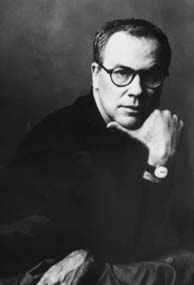
Mr. Wilson's approach to theatre was decisively visual: he considered performance an opportunity for art in motion; to him, stunning visual tableaus were just as important as dialogue and narrative. In 1968, Mr. Wilson founded an experimental performance company, the Byrd Hoffman School of Byrds (named for the dance teacher who helped him overcome his childhood stutter). With the company, he directed his first major works, beginning with 1969's The King of Spain and The Life and Times of Sigmund Freud. While the Byrd Hoffman School of Byrds no longer exists, Mr. Wilson would name another endeavor after his teacher, the Byrd Hoffman Foundation, which has underwritten various projects of his for decades, including the still operating Watermill Center, a 10-acre arts incubator on Long Island’s South Fork.
In 1968, while teaching acting and movement in Summit, New Jersey, Mr. Wilson witnessed an act of brutality between a police officer and a young Black man named Raymond Andrews, who was deaf and mute and unable to advocate for himself. Mr. Wilson intervened, supported Andrews in court proceedings, and ultimately adopted him as his legal son. Two years later, Mr. Wilson collaborated with Andrews, choreographer Andy de Groat, and performer Sheryl Sutton to create Deafman Glance, a "silent opera" rooted in visual storytelling rather than spoken text. The production premiered at the Center for New Performing Arts in Iowa City before traveling to the Nancy Festival in France and the Brooklyn Academy of Music. In Paris, it was seen by the Surrealist poet Louis Aragon, who ardently loved the work. Aragon later published an open letter to the late André Breton, proclaiming Mr. Wilson as the artistic successor they had long imagined for the Surrealist movement.
He continued his work in opera throughout the 1970s, radically reshaping the art form through his avant-garde visual language and collaborative spirit. One of his most groundbreaking works from this period was Einstein on the Beach (1976), created with minimalist composer Philip Glass and postmodern choreographer Lucinda Childs. Eschewing traditional narrative structure and linear storytelling, the four-and-a-half-hour opera unfolds as a hypnotic series of abstract tableaus, numerical sequences, and recurring motifs—all inspired by the image, rather than the biography, of Albert Einstein. The work challenged conventional expectations of opera with its repetitive musical structures, stylized movement, and non-verbal libretto, emphasizing visual rhythm and emotional tone over plot. Though polarizing at the time of its premiere, Einstein on the Beach quickly became a landmark of 20th-century experimental performance, influencing generations of artists in theatre, dance, music, and visual art. Its legacy endures as a daring reimagining of opera as a total art form, blending sound, image, and movement into a meditative and often enigmatic experience.
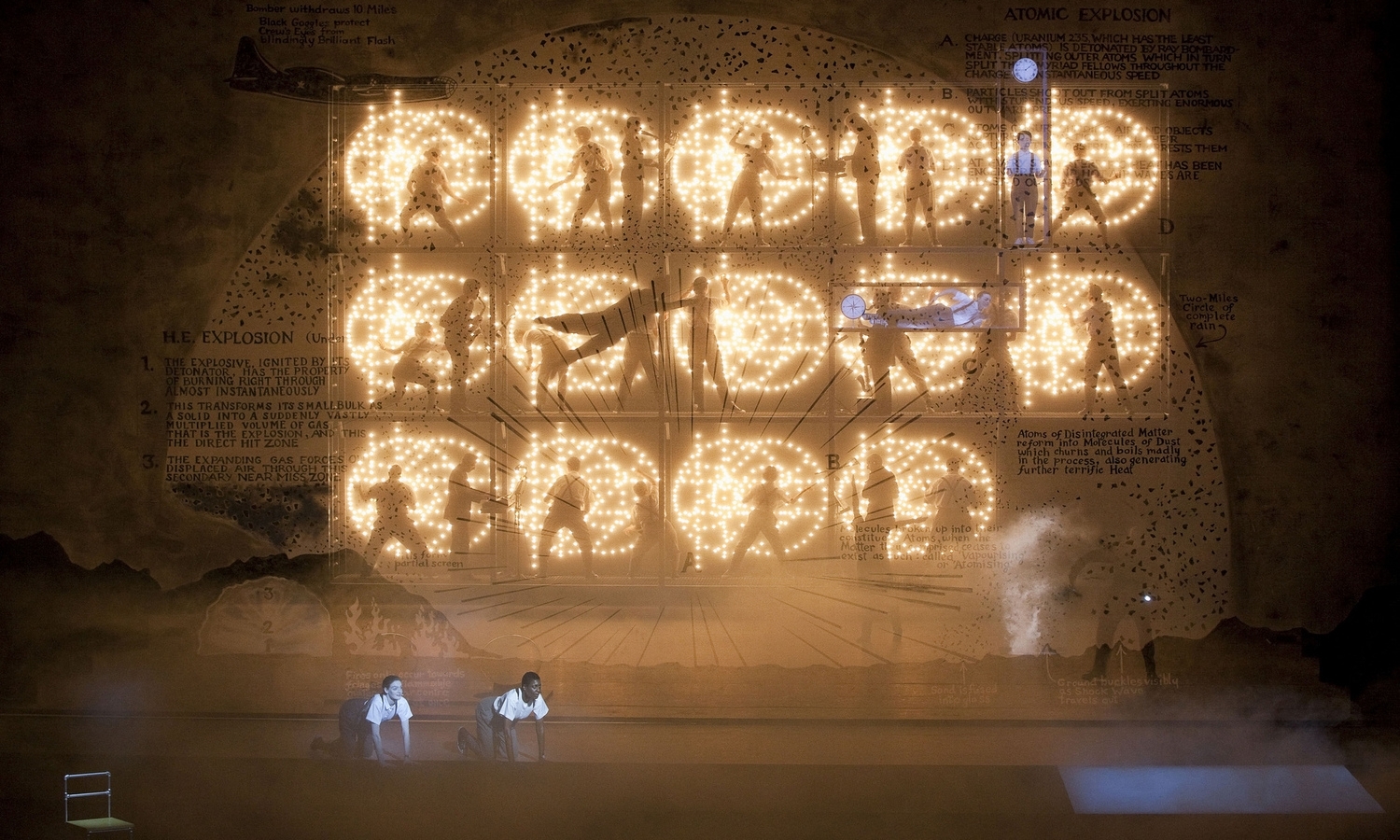
Mr. Wilson and Mr. Glass reunited in the 1980s for the CIVIL warS: A Tree Is Best Measured When It Is Down, a proposed 12-hour opera commissioned for the 1984 Summer Olympics. The full project was never realized due to funding challenges, but it remains one of Mr. Wilson's most ambitious concepts. The Pulitzer jury unanimously voted to award the work the 1986 Drama Prize, but the Pulitzer board overruled the selection and withheld the award that year.
Mr. Wilson and Mr. Glass went on to produce two more operas together, White Raven and Monsters of Grace, both in 1998. In 2022, Mr. Wilson produced H-100 Seconds to Midnight, inspired by physicist Stephen Hawking, with lyrics by Etel Adnan and music by Mr. Glass and Dickie Landry.
While his name did not become immensely famous to the general public, Mr. Wilson was immeasurably influential amongst his fellow artists, including William S. Burroughs, Allen Ginsberg, Tom Waits, Mikhail Baryshnikov, Laurie Anderson, David Byrne, Willem Dafoe, Susan Sontag, Marina Abramović, and many, many more.
The 1990s marked a significant shift in Mr. Wilson's career, leading him to devote the majority of his time to work in Central Europe as he left the United States behind for several decades. In 1990 alone, Mr. Wilson created four new productions in four different West German cities: Shakespeare's King Lear in Frankfurt, Chekhov's Swan Song in Munich, an adaptation of Virginia Woolf's Orlando in West Berlin, and The Black Rider, a collaboration by Mr. Wilson, Waits and Burroughs, in Hamburg.
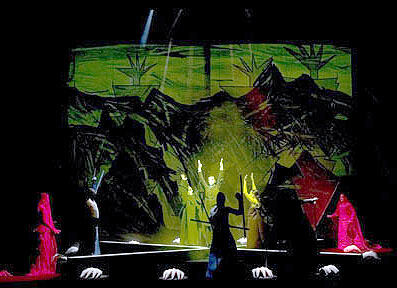
The Black Rider: The Casting of the Magic Bullets was so original an adaptation, that many believed it to be transformed to the point of belonging to Mr. Wilson, Waits, and Burroughs. The collaboration was based on the August Apel and Friedrich Laun 1810 story that inspired Carl Maria von Weber’s opera Der Freischütz, and Thomas de Quincey’s The Fatal Marksman, both of which were hits in the 1820s.
In a review of the production in Opera News, the piece was described as "not a revue or an opera or musical theatre in its more earnest, pretentious form—is in essence Der Freischütz meets Cabaret, with a dash of The Rocky Horror Picture Show on the side. Things keep zooming off on zany tangents, with a Joel Grey-style interlocutor, a campy devil and Burroughs’s equation of soul-selling with heroin addiction.”
The Black Rider ended up being the first in a trilogy of collaborations staged at Hamburg’s Thalia Theater, followed in 1992 by Alice, Mr. Wilson's reconfiguration of the Lewis Carroll Alice in Wonderland stories using the music of Waits, and Time Rocker in 1996, with music by Lou Reed.
And though Wilson's work originated in Europe, he brought them to New York via Off-Broadway venues such as Brooklyn Academy of Music and Park Avenue Armory. Wilson's other notable collaborations included the 2013 The Life and Death of Marina Abramović featuring the eponymous artist and the 2013 play The Old Woman, with Willem Dafoe and Mikhail Baryshnikov.
Aside from his original work, Wilson also put his distinctive style on a number of classic texts, such as The Threepenny Opera (which he directed in German), and three Samuel Beckett plays: Happy Days, Krapp's Last Tape, and Endgame.
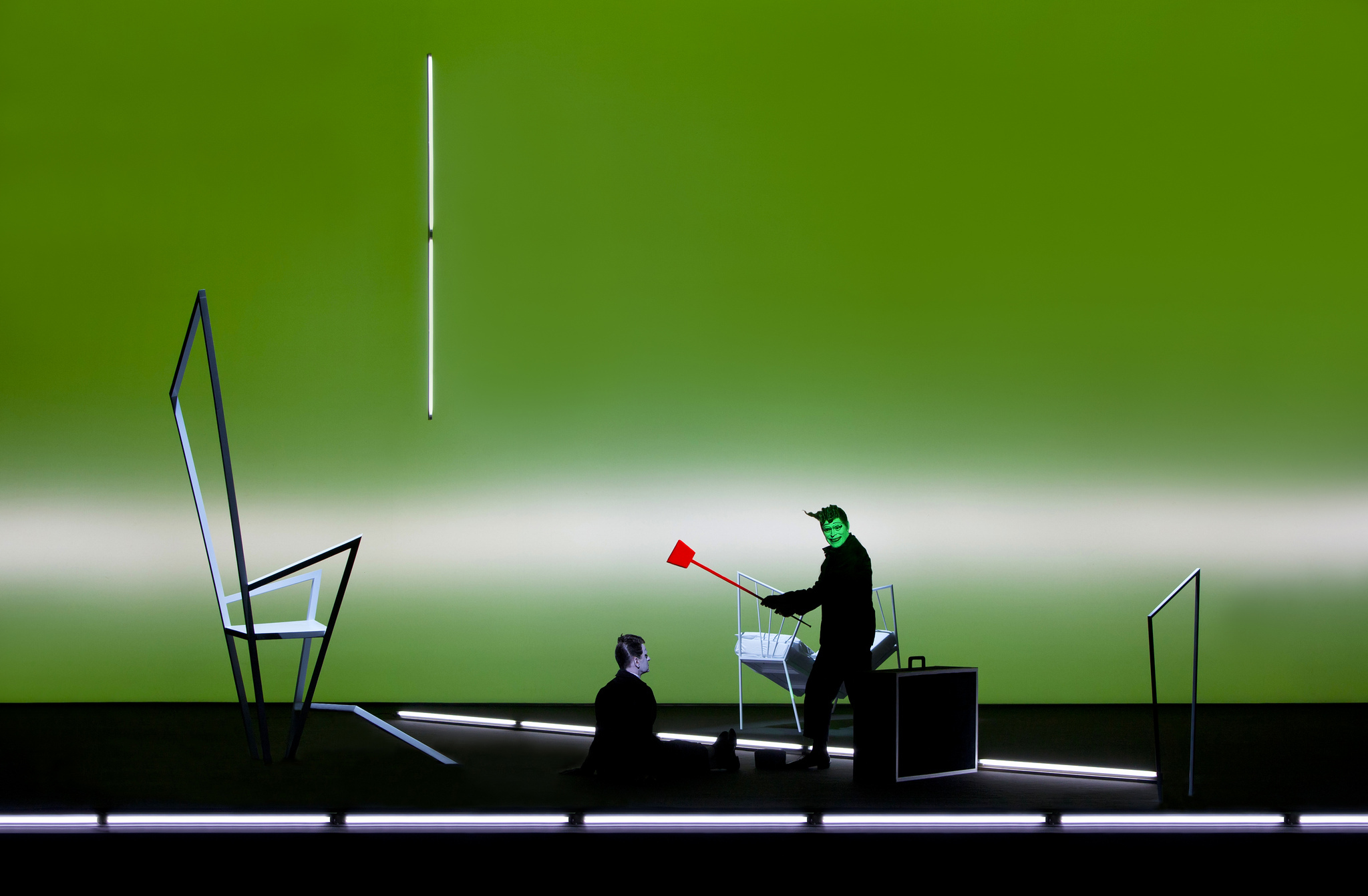
In addition to his work for the stage, Mr. Wilson maintained an extensive career in design, producing immensely successful sculptures, drawings, and furniture designs. He won the Golden Lion at the 1993 Venice Biennale for a sculptural installation, and in 2004, received a residency at LAB HD, producing dozens of high-definition videos known as the Voom, or Video, Portraits. Mr. Wilson's sitters included celebrities, royalty, animals, Nobel Prize winners, and self-described hobos. The series was screened at more than 50 museums and galleries around the world, as well as in Times Square.
In 2011, Mr. Wilson designed an art park dedicated to the Finnish designer Tapio Wirkkala, situated in the Arabianranta district of Helsinki. In 2013, Lady Gaga collaborated with Mr. Wilson as part of her ARTPOP project: he designed the set for her 2013 MTV Video Music Awards performance, she participated in his Portraits series, and the pair eventually produced an exhibition called "Living Rooms." Inspired by his residency as guest curator at the Louvre, the exhibition included two video works: one inspired by Jacques-Louis David's The Death of Marat and another in which Lady Gaga brought to life Jean-Auguste-Dominique Ingres' portrait of Mademoiselle Caroline Rivière. The centerpiece of the residency was a room filled with objects from Mr. Wilson's personal collection, including African masks, a Shaker chair, ancient Chinese ceramics, shoes worn by Marlene Dietrich, and a photo of Mr. Wilson and Philip Glass taken in the early 1980s by Robert Mapplethorpe. Rumors abounded that the exhibition would one day come to an American museum following the completion of the Louvre residency, but as of Mr. Wilson's death, such plans never materialized.
Mr. Wilson was predeceased by his partner of many years, choreographer Andy de Groat, in 2019. He is survived by his legal son, Raymond Andrews, as well as his sister Suzanne, and a niece, Lori Lambert. Information on a public memorial is forthcoming.