Thornton Wilder never wanted his wildly popular play The Skin of Our Teeth to be a musical. But that didn’t stop numerous composers from trying.
In the 1960s, Leonard Bernstein approached the writer about musicalizing Teeth, with Betty Comden and Adolph Green. As Tappan Wilder, Thornton Wilder’s nephew, notes: “My uncle was an extremely fine musician and a very fine piano player. And he moved with the musical times. In fact, you know, he did the libretto for a major opera done in Europe, The Alcestiad.” Plus Hello, Dolly was a very successful adaptation of his play The Matchmaker.
Unfortunately, after the Teeth musical fell apart due to “artistic differences,” the playwright washed his hands of the idea. As Tappan tells Playbill: “He said, ‘During my lifetime, I don't want it done as a musical. I think the words are just so important that I just don't want it done.’”
But Thornton left the idea open for after his death.
In the 1990s, John Kander and Fred Ebb tried their hands at a Teeth musical. But after two productions (one of which starred Eartha Kitt), Tappan nixed the idea, saying, “I just didn't feel it was the right fit. This was an amazing group, but sometimes things just don't fit.”
But if you know Skin of Our Teeth, you know that the play clocks in at three hours and has three acts. So it’s fitting that it would take three attempts to finally make a successful Teeth musical.
Fast forward to now, 2025, as The Seat of Our Pants, the third attempt at a Skin of Our Teeth musical, is running at Off-Broadway’s Public Theater (where healthy ticket sales and positive reviews have extended it through December 7). And in a miraculous turn, Tappan loves it, raving: “I’m blown away. Through his inspired music and a gifted cast, Ethan Lipton has made my uncle's Skin accessible for all of us in today’s (ever crazy) world. A long overdue and exciting window to the past and the future has been opened. I see this show as a timely, and timeless, realized dream come true.””
How did Lipton do it?

Well to answer that question, you have to understand something about Skin of Our Teeth. It is a big play. Wiley, philosophical, and a bit silly, Thornton's epic about an American family navigating apocalypse over and over premiered on Broadway in 1942. It was also the height of World War II, and Thornton was in the army, where he looked to the Bible, Greek philosophers, and human history to make sense of the atrocities around him. As Lipton notes: “The world was in a truly terrible place, and it didn't look like it was going to get better. So he was really trying to engage with that moment.”
In the 83 years since, there’s been no shortage of theatres, large and small, who wanted to try their hands at Wilder’s play (including three revivals on Broadway). But theatres were determined to traverse the dinosaurs, woolly mammoths, a Biblical flood, and metacommentary to tell the story of one New Jersey family experiencing the end of the world over and over again.
With this much love for Skin of Our Teeth, it doesn't seem like a musical was necessary.
Then in 2013, Public Theater artistic staff member Jeremy McCarter suggested to Lipton that he should try and adapt Skin of Our Teeth into a musical. As McCarter jokes, “It wasn't as though I could consult a list of composers who had written musicals about dinosaurs and a wooly mammoth and brushes with apocalypse.” But he had seen Lipton’s musical No Place to Go, about an office worker whose job gets outsourced to Mars. “What I particularly enjoyed about it is that it had a certain madcap mix of narrative and music and emotional depth and humor … There was a distinctiveness in Ethan's writing and an obvious willingness to take a big creative swing that felt of a piece with what Wilder had written.”
McCarter was a big Thornton Wilder fan and felt that Lipton’s sensibilities would be a good fit with Wilder’s play, which—while it was big and absurd, and frequently poked fun at itself—had an aching sincerity as well. Lipton, intrigued, gave Teeth a read; he immediately heard music while he was reading. The tonal shifts and high emotions that Wilder explored in Teeth, that’s usually reserved for musicals. As Lipton explains it: “This is why other people have been interested in turning the project into a musical before. Because there's something about the play that really sings, and that is epic.”
(Coincidentally, in 2017, Lipton’s partner, Arin Arbus, directed a version of Teeth at Off-Broadway’s Theatre for a New Audience.)

After he said yes, McCarter introduced Lipton to the Wilder estate, which at the time had Tappan Wilder acting as executor. Curious, Tappan traveled from his home in Sausalito, California, to Chicago to see one of Lipton’s plays, a comedy called Red-Handed Otter, about two office workers connecting over their pets. Remarks Tappan: “It's an extraordinary play. The humanity in it and the humor and loving irony. See, Thornton has a lot of irony, but it's loving. And so is Ethan.”
Tappan admitted that it was also high time for a successful Skin of Our Teeth musical: ”Thornton wrote a wild and wooly, very demanding and difficult play. If it was going to be musicalized—which was going to happen, whether we wanted it to or not, when it someday went into the public domain … I said, ‘Let's have the pleasure of doing it ourselves.’”
So, Tappan gave Lipton permission to try his hand at Skin of Our Teeth, the musical. And crucially, he didn’t give the composer any directives or a list of no gos. Says Lipton: “[Tappan], really early on, said, ‘Make it what you want it to be.’ And really encouraged me to bring, bring myself to it.” (Tappan confirms this exchange, saying lightly: "I'm not interested in adapters who are faithful to the play, because if they're faithful, what do we need them for? We have the play.")
Given free rein, Lipton has played fast and loose with the material. Gone are the broadcast-style monologues at the top of each act. In their place, there’s a narrator (played by Andy Grotelueschen) who opens the show singing a folksy tune called "The World Is Ending." Gone are the philosophers in the show’s historically troublesome third act—now it ends with the Antrobus family coming back together, and beginning to heal from their traumas.
What Lipton has ramped up is the play’s tendency to comment on itself, such as when Sabina (played by Micaela Diamond) breaks character and tells the audience, “I don’t understand a word of it anyway” (that’s a Wilder line). But when Grotelueschen's narrator breaks the fourth wall and says, “I’ve found that many of [the play's] less appealing features are not essential to its character, and can be reconsidered or opened up or taken to the dump—without sacrificing any of the original’s batshit grandeur”.... that’s all Lipton.

Beyond style and songs, what Lipton truly wanted to do with the material was emphasize its humanity. The Antrobus family aren’t archetypes, even if they’re influenced by Adam and Eve, and Cain and Abel. To ask the audience to follow these characters through three acts and thousands of years, they need to feel real. When Mrs. Antrobus (played by Tony winner) Ruthie Ann Miles breaks down in the first act, weeping over her dead son, it’s a shockingly raw moment in a previously fantastical scenario.
“[Director] Leigh Silverman said something the other day that I thought was great: the show is about the family, and the disasters are the B story,” says Lipton. “I did want to find some intimacy in it that I don't think is necessarily there in the play.”
What Lipton wanted to retain after this decade of work on Seat of Our Pants was its heart—the thing that has kept it in the American theatrical canon after eight decades. Despite disasters and wars, humans have an amazing ability to rebuild. No matter how bad things look, we can always, as the final song of Seat of Our Pants goes, “start anew.”
“The show is not intended to be medicine,” notes Lipton. “I think it's too fun to be that. Being playful with serious things, that's why I got into theatre. That's why I'm a grown-up doing make believe, so that I can be playful about serious things. It makes me feel more engaged with humanity, my own and other people's.”
Judging from the positive reception, most importantly from Tappan and McCarter, Lipton has succeeded with flying colors. For McCarter, who is now the executor of the Thornton Wilder estate after Tappan stepped down last year, Seat of Our Pants shouldn’t be seen as supplanting the play it is based on. Instead, he sees it as another way for audiences to access Thornton Wilder’s work. And he hopes that the musical "has a long and vibrant life."
“The next most exciting thing that came out of this is to make people want to go back and read the play again, re-engage with the crazy, brilliant, totally out-of-the-box way that Wilder wanted to make us think about the way families work and the way the species works,” says McCarter. “Wilder went to a lot of very dark places in his writing. But in the end, I think he always came down on the side of having some fundamental, unshakable confidence in people, and I think that message is needed in 2025.”
For Tappan, who managed his uncle’s estate for 30 years and now leaves a majority of licensing requests for McCarter to decide, he’s proud of this moment for his family. It only took half a century and three attempts. And one of the things he truly loves about this musical? The title. "I think it's really wonderful!" Tappan laughs. "It's not The Skin of Our Teeth, the musical. It's the Wilder-Lipton collaboration in a work of art, and it speaks to [Ethan's] wonderful sense of humor."
In other words, the end of the world has never sounded so good.


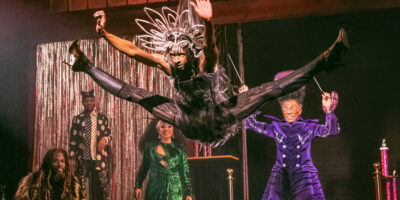
Bill Buell, Andy Grotelueschen, and company of The Seat of Our Pants

Micaela Diamond and Ruthie Ann Miles in The Seat of Our Pants

Shuler Hensley and Micaela Diamond in The Seat of Our Pants

Ruthie Ann Miles, Shuler Hensley, and company of The Seat of Our Pants

Amina Faye, Ruthie Ann Miles, and Damon Daunno in The Seat of Our Pants

: Micaela Diamond in The Seat of Our Pants

Damon Daunno in The Seat of Our Pants

Ruthie Ann Miles and company of The Seat of Our Pants

Andy Grotelueschen in The Seat of Our Pants

Shuler Hensley, Ruth E. Sternberg, Damon Daunno, and Micaela Diamond in The Seat of Our Pants
Michael Lepore, Micaela Diamond, Ruthie Ann Miles, Geena Quintos, and David Ryan Smith in The Seat of Our Pants

Shuler Hensley in The Seat of Our Pants

Amina Faye in The Seat of Our Pants

Ally Bonino in The Seat of Our Pants

Allison Ann Kelly and company of The Seat of Our Pants

Ruthie Ann Miles in The Seat of Our Pants

Damon Daunno and Shuler Hensley in The Seat of Our Pants