It's been an exciting week for Stephanie Umoh, who currently plays Angelica Schuyler in Lin-Manuel Miranda's Hamilton on Broadway, which celebrated its 10th anniversary August 6.
Umoh has a long history with the Pulitzer Prize-winning musical, having also played Angelica both in the national tour of Hamilton as well as an earlier stint at the Richard Rodgers Theatre in 2023. Her current Broadway co-stars include Trey Curtis as Alexander Hamilton and Morgan Anita Wood as Eliza Hamilton.
Texas native Umoh has also been seen on Broadway in Junk as well as the revivals of Ragtime and Falsettos. She played the Witch in the national tour of Stephen Sondheim and James Lapine's Into the Woods, while her Off-Broadway credits include Little Rock; Hallelujah, Baby!; and Falling for Eve. TV and film audiences may be familiar with Umoh's work in Blue Bloods, House of Cards, NY 22, and Big Words.
In the interview below for the Playbill series How Did I Get Here—spotlighting not only actors, but directors, designers, musicians, and others who work on and off the stage to create the magic that is live theatre—Umoh shares how Hamilton has made musical fans of nontraditional theatregoers, how audience reaction to the blockbuster hit varies across the country, and a mortifying song flub (it was in front of Audra McDonald).

Where did you train/study?
Stephanie Umoh: I studied and trained at The Boston Conservatory.
Was there a teacher who was particularly impactful/helpful? What made this instructor stand out?
This is a tough question for me because there were so many wonderful teachers that had a profound effect on me: Fran Charnes, Candace Brown, Bill Casey. My freshman and sophomore year acting teacher, Ken Baltin, was very special to me. He taught us Uta Hagen and Meisner. I would invite him to my plays and ask for feedback; he would always come. He was such a gentle teacher who never tried to intimidate you (unlike a lot of conservatory teachers). He really, truly cared. And so did Johnny Kuntz, my senior year acting emphasis teacher! His class was the most creative, open, and free I think I’ve ever been. He fostered a creative learning environment that encouraged you to let go and listen to your instincts. He is a stellar actor who works professionally throughout Boston, and we occasionally keep in touch to this day.
Do you have a favorite moment in Hamilton for Angelica? What makes that part particularly special?
I love Angelica’s strength, but I find her moments of vulnerability so interesting and fun to explore. All throughout "Satisfied," she wears a mask to appear one way socially, but the majority of the song takes place in her mind, where she takes the mask off and struggles with what to do. It is within the privacy of her mind where we see Angelica become vulnerable—where she admits, perhaps for the first time ever, that she is in love.
All of this is set in the Revolutionary era, men are going off to war, the stakes are high! With all of the sweeping movement and dancing happening around her on stage, Angelica is left alone on stage to say, “At least I keep his eyes in my life,” which I find tragically optimistic. And then once more at the end she is alone on stage to say, “I will never be satisfied,” which to me means “I will never be settled because I will never have Alexander.” In that very moment, she accepts it is her duty to marry for money and status, which I think leaves us heartbroken for her. Even though "Satisfied" can still be challenging and anxiety-inducing for me, it is still fun to do after all these years. It is riveting, it is grand, and it is utterly heartbreaking.

You've played the role on tour and on Broadway. Do you notice any difference in audience response around the country?
Absolutely! I think some of the bigger sports towns, where people are used to cheering at events, those audiences were quite responsive! Smaller towns in the Midwest, where people are more polite, audiences were quieter. The northeast also had quieter audiences, believe it or not. “Immigrants, we get the job done” gets a huge response in most places, but in others—crickets. So it was so interesting to see what people were absorbing or choosing not to hear.
What do you think the cultural impact of Hamilton is?
I think Hamilton has connected with audiences who don’t usually go to the theatre—and it’s turned many of them into musical fans. It’s amazing to see famous football and basketball players rapping every word of "My Shot" or "Wait for It," even making Hamilton videos on Instagram. I never thought I’d see the day…and yet, here we are! I also believe the show opens up an important conversation about race, American history, and who gets to tell that story. The cast reflects the diversity of what America looks like today, which is why I think the show continues to stay relevant 10 years later. Whether people choose to acknowledge it or not, I think that Hamilton has shifted audience perspectives and has forever changed the way we tell stories.

With Ragtime coming back to Broadway this season, can you share a favorite memory of starring in the 2009 revival?
Quick story. The night Audra [McDonald] came to see the show, I messed up the lyrics of "Daddy’s Son." I sang the first verse twice, or something like that. The funny thing is, I didn’t know she was in the audience until after bows! I was mortified when I heard she was at the show. How could she be at the one show where I screwed up the lyrics? Why is this my life? Anyway, she came backstage and was incredibly gracious and wonderful. I hugged her and said, "Audra, I messed up the lyrics to 'Daddy’s Son,' I can’t believe you were in the audience for that." She said she didn’t even notice, but I think she was just being kind. I think about that moment almost once a year.
Do you have any dream stage roles and/or actors you would like to work with?
I always dreamed I’d one day get to work with Audra McDonald. I’d love to work with her, but I also want to learn from her. I hope to one day work with Phylicia Rashad. I admire her as an actor and as a director.
Tell me about a time you almost gave up but didn’t.
I was cast as a principal in a high-profile show that was opening a sit-down company in Chicago. We were rehearsing in NYC and eventually would be moving to Chicago, where we would begin tech rehearsals and the run of the show. Towards the end of the rehearsal period in New York, I received a call from my agent that they would be replacing me with another actress.
As you can imagine, I was in utter shock. I had signed a lease on an apartment in Chicago, my family had flights and tickets for opening night, I had a sublet coming to rent my room in New York. It was a mess! On top of all that, I worked tirelessly on this role. It was the first time in a while that I felt completely aligned in a project. The role felt right for me, and I thought I had done some of my best work. I was never given a real reason why they let me go, no producer ever called me to explain. I was left to pick up the pieces on my own. It was the first time theatre had ever truly broken my heart. I entered a two-year depression and nearly left the business. My confidence was destroyed, I self-sabotaged my auditions, I didn’t care! I worked here and there, but my heart wasn’t in it. A friend helped pull me out of that slump, and soon after I was back on Broadway in Falsettos, but it was a very dark time for me. It was important for me to go through that, I can see that now. Ultimately, I think I dodged a bullet.

What do you wish you knew starting out that you know now?
This sounds so practical, but I wish I knew more about how to save money! When you’re 23 and on your first production contract, it can feel like life will always be that way. But you will quickly learn that sometimes years go by before another cushy contract comes into your life. You must learn how to save for hard times early on. Learn about taxes and write-offs. It will always benefit you as a young actor to become knowledgeable about contracts and union rules. The more you know, the better you can protect yourself. All of it can be overwhelming—start small.
What advice would you give your younger self or anyone starting out?
Don’t stop learning. Put your phone down and watch the world around you. Go for walks, read books. Watch your castmates rehearse. Listen and watch seasoned actors work in the room. Read plays. See theatre alone. There are wonderful things that happen to you when you experience art alone. There are also wonderful things that happen to you when you experience art shared with people you love. Do it all! Listen to music! If you live in NYC and money is an issue, there are a lot of free and weird stuff happening all over the city. Go to it. Meet non-theatre people. Things are so exciting and new for you—just stay open. The more well-rounded you are, the less you will need to rely on only theatre to fulfill you.
Is there a person or people you most respect in your field and why?
I have a lot of admiration and respect for my college classmate, colleague, and friend, Andrew Durand, who was recently nominated for a Tony Award for his role in Dead Outlaw. Andrew has always been an incredible actor to me, even back when we were 18 years old and in our small core class of 10. He has incredible instincts. But mostly, I’ve admired the way he has always stuck to his guns about the types of roles he wants to play in his career. The role has to be right for him, even if that means waiting years for the right one to come around. He used to always say he could never be in the long-running commercial shows—I really admire that! That’s the way I always saw myself in my acting career.

Jeffrey Seller and the company of Hamilton

Morgan Anita Wood and Denée Benton

Current and alumni company members of Hamilton

Renée Elise Goldsberry and Stephanie Umoh

Thomas Kail and current and alumni company members of Hamilton

Thomas Kail and current and alumni company members of Hamilton

Thomas Kail, Lin-Manuel Miranda, and current and alumni company members of Hamilton

Lin-Manuel Miranda and current and alumni company members of Hamilton

Lin-Manuel Miranda and current and alumni company members of Hamilton

Lin-Manuel Miranda and current and alumni company members of Hamilton

Current and alumni company members of Hamilton

Lin-Manuel Miranda and current and alumni company members of Hamilton

Current and alumni company members of Hamilton

Current and alumni company members of Hamilton

Current and alumni company members of Hamilton

Thayne Jasperson, Jasmine Cephas Jones, Phillipa Soo, and Jon Rua

Trey Curtis, Lin-Manuel Miranda, and current and alumni company members of Hamilton

Current and alumni company members of Hamilton

Current and alumni company members of Hamilton

Current and alumni company members of Hamilton

Current and alumni company members of Hamilton

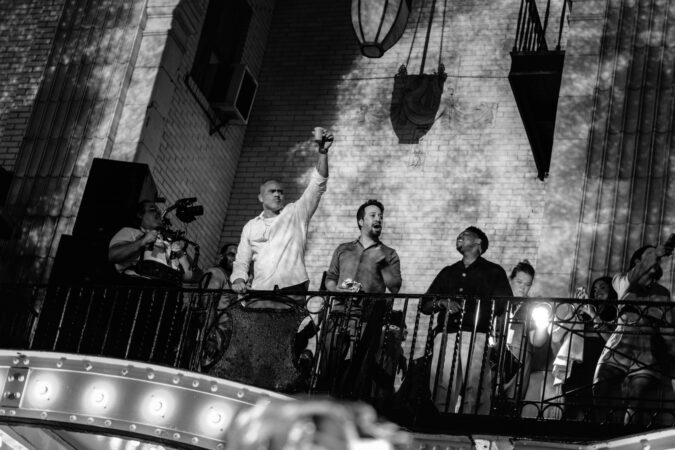
HamilTEN post-show block party

The Richard Rodgers Theatre

Lin-Manuel Miranda at the HamilTEN post-show block party

HamilTEN post-show block party

Phillipa Soo at the HamilTEN post-show block party

HamilTEN post-show block party

Ephraim Sykes at the HamilTEN post-show block party
Christopher Jackson, Lin-Manuel Miranda, and Ephraim Sykes at the HamilTEN post-show block party

Jasmine Cephas Jones, Renée Elise Goldsberry, and Hamilton alumni at the HamilTEN post-show block party

Jasmine Cephas Jones, Renée Elise Goldsberry, and Hamilton alumni at the HamilTEN post-show block party