


June Squibb still has new ground to break, thank you very much.
The Oscar nominee, now 96, has returned to Broadway this season with Marjorie Prime, running at the Hayes Theater through February 15, 2026. The role marks 65 years since she first trod the boards as the electrified stripper Electra in the original Broadway production of Gypsy. It’s an anniversary that brings up a lot of memories.
“This world has changed tremendously,” Squibb shares, her voice bright as she reflects shortly before her birthday. “But some things never change! People still love Gypsy.”
Squibb held onto the prized memories of her Broadway debut for decades, choosing to attend only one of the major Broadway revivals of the Jule Styne and Stephen Sondheim classic: Tyne Daly in 1989. “For many years, people talked to me about [playing Madame Rose], but it simply didn’t happen, for one reason or another, every time it came up. By ‘89, I was ready to see Tyne, who I thought was very good, but I didn’t see Angela [Lansbury] or Bernadette [Peters] or Patti [LuPone]. But I did see Audra [McDonald] at the Tonys, and I was fascinated. And I just kept thinking, ‘God, she's got balls and guts and what it takes to work herself into that kind of a frenzy in front of people.’ She certainly made a statement, and it was fascinating to me how different she was. How different everything is, now.”

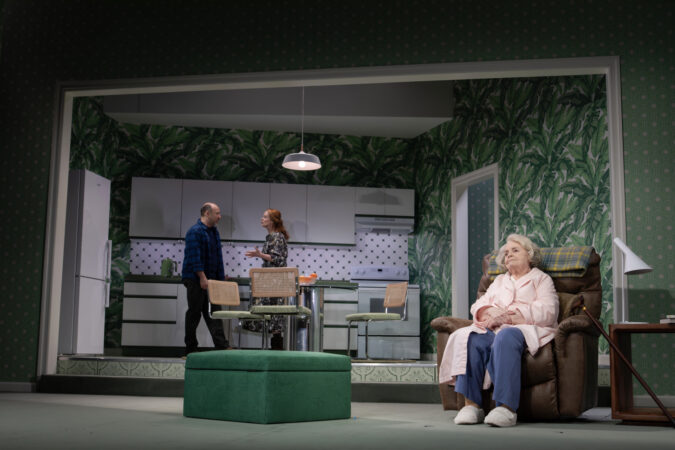
In her Broadway return, Squibb is stepping into the shoes of Marjorie, an 85-year-old woman with Alzheimer's. While Squibb is still as sharp as a tack, the act of playing a woman on the brink of losing her memory is a confronting thing.
“She’s losing her mind, but she’s very aware that she is. It isn’t blissful ignorance, or anything comforting like that: She knows what’s happening to her,” Squibb details, sighing. “There is grief in the fact that she is losing herself, she's losing memories. She knows there's something wrong, and she's fighting to save what she can. But in truth, you can't save it. I mean, if you have dementia, it's going to happen. You're going to start losing and losing more and more. And that’s the kind of loss you can’t undo.”
The play, which was a Pulitzer finalist when it premiered Off-Broadway in 2015, had what was considered a futuristic edge at the time: Marjorie is given a holographic copy of her deceased husband Walter as a memory and comfort tool. Played by Christopher Lowell (of Promising Young Woman), he is a near-exact physical representation of her late husband in his youth, with memories inputted by her daughter (Tony winner Cynthia Nixon) in order to create a tailor-made companion for Marjorie at the end of her life, just as she was physically beside him at the end of his. The hologram knows her habits, her quirks, her favorite memories, and her family's secrets. She, on some level, knows he is not actually Walter, but she cannot help but come to rely on him. What was sold as science fiction in 2015 is now prescient, with AI companions littering the internet, and chatbots and deepfake videos modeled after deceased loved ones becoming almost normalized by earlier adopters of the technology.
One question is unavoidable: Does having a shadow of a person around truly heal the bereaved, or does it simply prolong the inevitable?

“I’ve weathered my fair share of grief,” Squibb shares, her voice soft and warm. In 1999, her husband of 40 years, acting teacher Charles Kakatsakis, passed away. “I am a great believer in focusing on what's going to happen tomorrow, what's coming up. I've always been that way, looking forward to what's ahead. I never look back, per se. And I think that that is something that I do with grief, as well. I process it, but I always have tomorrow in my mind. I don't think I stay on it, to the point that a lot of people do. I'm sometimes surprised when someone goes, and someone has a reaction that goes on and on and on. And it's not that I don't feel it, or that I don’t feel like I’ve lost something. But I feel that we think of them and we talk about them. To me, that is the way to hold on to them.”
It's been a busy year for Squibb. The film Eleanor the Great, directed by Tony winner Scarlett Johansson, premiered earlier this year; Squibb played a woman morally unmoored by the death of her closest friend. The legend is astounded by the lengths people will go to to hold onto the past these days. “There are so many things I never imagined we would be dealing with: AI, holograms, videos of everything, so much of it just amazes me. It’s pushed the world off its axis.” As new technology confounds her, she continues to find comfort in the simple human act of making theatre.
“I’m thrilled that, even at 96, I still get to act. I am beyond thrilled to be working with Cynthia. I have loved her work for so many years, and it's so exciting to be sitting there across from her. And the same with Christopher and Danny [Burstein]. I feel I've been plucked and placed in the middle of Broadway royalty, and it is just lovely … Everything is so uncertain these days. Chaos and uncertainty is taking over. But I am certainly having a wonderful, wonderful time with them.”

Christopher Lowell and June Squibb in Marjorie Prime
Danny Burstein, Cynthia Nixon, and June Squibb in Marjorie Prime

Danny Burstein and Cynthia Nixon in Marjorie Prime

June Squibb in Marjorie Prime

June Squibb and Cynthia Nixon in Marjorie Prime

Christopher Lowell in Marjorie Prime


