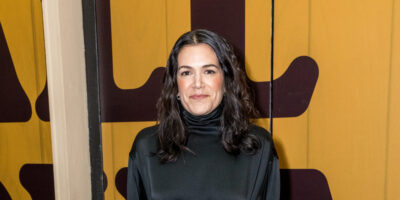
“Oh,” Cynthia Nixon says, approaching one of the framed caricatures on Sardi’s wall. “Kitty Carlisle! My mom worked on a TV show that she was on when I was a little girl, and she was my idol.” The tone of her voice tells me that Carlisle’s portrait’s presence on this press day is a bittersweet surprise. “I feel very blessed that she’s right here with me in my corner.”
The two-time Tony Award winner has come to Sardi’s this morning with the cast of Marjorie Prime, a Pulitzer Prize-nominated family drama about memory and grief that is beginning its limited Broadway run at the Hayes Theater. Nixon plays Tess, daughter of Marjorie (played by theatre legend June Squibb), who is reevaluating her fraught relationship with her mother in light of Marjorie’s growing dementia.
“We have a mother and daughter who are not close, that are trying to be close. But there is so much baggage between them,” Nixon explains. “That’s certainly what [Tess] is struggling with, not just taking beautiful care of her mother in the elderly phase of her life, but can [they] get some movement on these unspoken, painful things?”
Trying to aid in this journey of caretaking, and healing, is Tess’ husband, John, played by Tony winner Danny Burstein. It is John who introduces Tess to a new kind of technology, called “Prime,” an artificially intelligent hologram that is meant to mimic the appearance and voice of a deceased loved one. While referring to John as a “champion” of the Primes feels strong to Burstein, he has been reflecting on how artificial intelligence can be a salve for grieving families.
“John sees it as a tool to help his wife heal,” Burstein explains empathetically. “His wife has been through this very traumatic experience, and he wants to have a future with her.”
Though for these artists, the alleged benefits of artificial intelligence do not outweigh the potential for it to “stifle” the creativity that is innately human—not to mention that it could lead to the “replacement” of human beings, as Burstein fears. When the play initially premiered in 2014 at Los Angeles’ Mark Taper Forum (an Off-Broadway run immediately followed), playwright Jordan Harrison recalls how the invasive nature of the Prime technology was labeled, “a little bit fantastical”—hypothetical, and far off into the future.
“People would say to me, ‘What’s a chatbot?’” Harrison laughs. “If you’re a human being alive in 2025, you have some kind of relationship with AI or AI is trying to have a relationship with you. I’m excited to have audience members that are sophisticated about this subject.” The play was also adapted into a 2017 film starring Lois Smith and Jon Hamm.
In the story, Primes not only masquerade as a lost loved one, but also are meant to, as Harrison notes, be portrayed by actors so convincingly that the audience forgets they are not flesh and blood. For Christopher Lowell, who plays Walter Prime, that acting note pinpoints the insidiousness of what audiences are seeing online today—as it becomes harder to differentiate AI-generated images and videos from real ones.
"It's much more accurate to what we're dealing with," Lowell says. "Our inability to distinguish between what's AI-generated and what's real. An audience member in this play should be trying to determine for themselves, is this the person or is this generated from what the AI thinks this character wants to hear?"
For director Anne Kauffman, who was at the helm for 2015 Off-Broadway production, what is remarkable in revisiting the work is less how she and Harrison may have changed the text to prepare for Broadway and more how audience perspectives have evolved.
“There’s actually nothing in [the play] that we needed to change,” Kauffman says. “But the way that we approach the characters as Primes has changed quite a bit.”
“We should say, first and foremost,” Harrison interjects. “It’s a play about a family dealing with grief. It’s sci-fi for people who think they don’t like sci-fi. It leaves you with questions as you walk out, debating it hotly with your own family members.”
The Primes are meant to be conversation partners for loved ones left behind. The first Prime we meet is Walter, Marjorie’s late husband. The audience will encounter more Primes as the play progresses (though we won’t spoil them here, the title gives you a hint), implying an ever-expanding embrace of the technology. Upon introduction, dialogue with the Primes focuses on an essential like or dislike of the deceased person the Primes must understand to portray them accurately. When asked what would be most important to impress upon her hypothetical Prime, Nixon reflected on a time she experienced a different kind of grief.
"I would not have said this pre-COVID," she replies. "But I would say how important community is to me, both in terms of my family and friends, but also gathering with people in a theatre."
Lowell responds similarly, citing his love for "tactile, analog things." And as for his essential dislike? "A venomous hatred of pretty much all things AI."
For her part, Squibb (who just celebrated her 96th birthday November 6) says if Marjorie Prime has taught her anything, it’s that she’d rather live with a Prime than come back as one.
“If you’re a Prime,” Squibb says, “You’ve died! I would like to keep living.”
Squibb, who made her Broadway debut in the original production of Gypsy, has a career that spans more than 60 years. She is not daunted by the grueling eight-shows-per-week Broadway performance schedule (that she’s sitting for most of the play is a bonus), confidently saying she had “no trouble” when she joined Waitress in 2018. And while she hopes audience members leave having appreciated the play’s tender portrayal of love, she also holds the goal of reframing our perception of what an older person can accomplish.
“Marjorie constantly reminds you of what an older person is capable of,” Squibb says. “And we don’t look at that often enough.” It’s not just Marjorie, it’s also Squibb herself—an example of what it means to live and keep living.