


*
"I've always had the need to bear witness," playwright Quiara Alegría Hudes says. "Even as a child. To the things I saw, the world I lived in, what it means to be a person."
Hudes has had success doing just that. At 34, she has twice been a finalist for the Pulitzer Prize: in 2009 as librettist for the Tony-winning musical In the Heights and in 2007 for her play Elliot, a Soldier's Fugue.
In Elliot, three members of a Puerto Rican family — son (Elliot), father and grandfather — recall their wartime experiences in, respectively, Iraq, Vietnam and Korea.
In her new play, Water by the Spoonful, which premiered this fall at Hartford Stage, she continued Elliot's story. Like A Soldier's Fugue, it is set in Philadelphia, her hometown. "A lot of it is about addiction and recovery, a topic that felt close to me and close to the community in north Philadelphia I started writing about in Elliot. It's a topic I wanted to address for years, but I was nervous to address it in part because I don't particularly want to create more roles for Latino actors that are addicts or junkies or criminals. A few years ago I had the idea of making it about recovery. That really opened up a lot of doors for me creatively."
In A Soldier's Fugue, "Elliot's in his teens — he graduated from high school, enlisted in the Marines, and within six months of getting sent to Iraq got a leg wound, was honorably discharged and returned to Philadelphia. This play is a few years later. He has no prospects. He has a dead-end job. It's about life after the service and coming of age. Who is he going to be? What kind of life is he going to set up?"
 |
 |
|
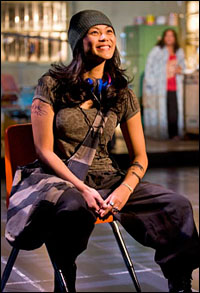
| Teresa Avia Lim in Water by the Spoonful |
||
| photo by T. Charles Erickson |
Hudes graduated from Yale and earned a master's in theatre at Brown; her mother is Puerto Rican and her father Jewish. "I was always the kind of brainy one in the family. I was the kid in the corner watching, listening, absorbing. I come from a family with a lot of fascinating stories. Half my family is from Puerto Rico — I'm the first generation born here. My mom's story of coming to Philadelphia, my grandmother's story of life in the islands — a life of poverty, humility, natural disasters. Really incredible stories that are very different from the life I grew up in.
"Half my family is Jewish, and their stories of Holocaust, coming to the United States and starting anew after tragedy, are stories I grew up hearing. I felt even then that the act of bearing witness is the most human way to deal with these stories. I decided to become a writer to do that act of bearing witness."
How does it feel to have been a Tony nominee and two-time Pulitzer finalist? "I think it's very fortunate icing on what is already a good cake. It gives me freedom. I don't feel the need to prove myself. And it certainly makes my mother very proud."


Evan-Zimmerman-for-MurphyMade.jpg)


