Classic Arts Features
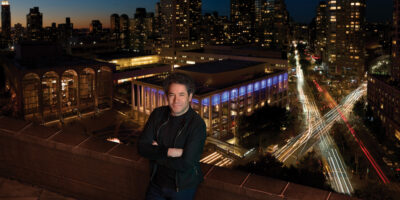
In His First Season at the NY Phil, Gustavo Dudamel Wants to Show How Music Can Unite Us
A spirit of adventure and a sense of connection imbue the New York Philharmonic’s 2026–27 season.
April 02, 2026 By John Hollahan

Pivotal moments are not always easy to recognize as they happen, often only coming into view after the fact. But the long-anticipated arrival of the New York Philharmonic’s next artistic leader, Gustavo Dudamel—one of the most talented, visionary, and widely celebrated musicians of our time—needs no hindsight to be recognized as a pivotal moment in the Orchestra’s 184-year history.
The 2026–27 season—which Dudamel and Hart President & CEO Matías Tarnopolsky announced in David Geffen Hall last month—marks the first chapter of the Philharmonic’s new era, with Dudamel officially occupying the position of the Tang Music & Artistic Director.
He says: “As I begin this new chapter with the New York Philharmonic, I feel that every step of my life—as a student, as a teacher, as a musician, as a citizen—has led me to this moment. This season is built on a single belief: that music, like this great city, can unite us across cultures, generations, and art forms, in a single, shared human experience. When we truly listen together, we can begin to imagine a better world. This season is an invitation to honor the past, embrace the present, and envision a future filled with more beauty—to remember not only who we are, but who we can become.”
A spirit of adventure guides the season as he and the New York Philharmonic traverse genres and media; explore music’s past, present, and future; and collaborate with some of today’s most compelling artistic voices. It all begins in the early fall as Dudamel leads World Premieres by two dynamic contemporary composers: a new work by Zosha Di Castri, co-commissioned with the Los Angeles Philharmonic, and Imágenes mestizas by Pulitzer Prize winner Tania León. The following month Dudamel welcomes to David Geffen Hall’s stage the first two soloists of his tenure, appearing on back-to-back concerts: acclaimed pianist Lang Lang, in Beethoven’s Emperor Concerto, and the inimitable Yo-Yo Ma, in Osvaldo Golijov’s Azul.
In March Dudamel collaborates with the season’s two Mary and James G. Wallach Artists-in-Residence, Marina Abramović and Gustavo Santaolalla. Abramović, the world-renowned Serbian performance artist, directs a staged production juxtaposing Stravinsky’s The Soldier’s Tale with Falla’s El Amor brujo. Santaolalla, the award-winning Argentine composer and multi-instrumentalist, appears as soloist in the World Premiere of his own El Payador perseguido, a multimedia performance featuring video and a libretto, adapted from and inspired by the texts of Atahualpa Yupanqui, by Alberto Arvelo, the longtime Dudamel collaborator who also directs. And in May Dudamel leads the fourth World Premiere of his inaugural season: Gonzalo Grau’s song cycle on texts by Venezuelan poet Rafael Cadenas, featuring the Grammy-winning soprano Kelley O’Connor.
The same spirit of adventure also sees Dudamel and the Philharmonic traversing physical locations, ranging from just a few blocks from home to across the Atlantic. In September Dudamel conducts a concert at Radio City Music Hall, fresh on the heels of the Orchestra’s successful debut there this past January. In November the Philharmonic heads to CarnegieHall, its former home, where Dudamel leadsPuccini’s Tosca, initiating a five-year partnership comprising operas in concert at the iconic New York City venue. Between those appearances, in October Dudamel conducts the Philharmonic’s ten-concert European tour, with stops in Paris, Barcelona, Madrid, Berlin, Hamburg, and Vienna. That marks not only Dudamel’s first tour with the Philharmonic, but also the Philharmonic’s first tour of Europe in almost a decade. Then, of course, there’s that other tour: the beloved Concerts in the Parks, led for the second time by Dudamel, which has been a pillar of the New York Philharmonic’s community engagement for more than 60 years.
In 2026–27 Dudamel and the Philharmonic deepen that engagement with the community—and with history—through a memorial concert in Lower Manhattan commemorating the 25th anniversary of 9/11, and performances of On the Transmigration of Souls, John Adams’s Pulitzer Prize–winning memory piece honoring the victims, which the Philharmonic commissioned in the wake of the attacks. In the spring the Orchestra shines a spotlight on Beethoven on the 200th anniversary of the great composer’s death. Dudamel leads performances of iconic Beethoven works, including the Ninth Symphony and the complete Egmont, featuring a new adaptation of the original Goethe play by acclaimed playwright Jeremy O. Harris. The Beethoven programming also includes arrangements of three string quartets by three of Dudamel’s predecessors on the Philharmonic podium—Mahler, Mitropoulos, and Bernstein—and welcomes back pianist Mitsuko Uchida for the first time since 2009. Dudamel concludes the subscription season with the Orchestra’s first-ever complete performances of MASS, Bernstein’s epic spiritual—and theatrical—work.
Indeed, all season long Dudamel and the New York Philharmonic will look to the past to see how they—and all of us—arrived at this pivotal moment. Still, as Kierkegaard wrote, “Life can only be understood backwards, but it must be lived forwards.” So, with an indefatigable spirit of adventure, may we all take this next step into the thrilling future—together!


More latest news
-
-

-

Schedule of Upcoming Off-Broadway Shows
Off-Broadway News -
In His First Season at the NY Phil, Gustavo Dudamel Wants to Show How Music Can Unite Us
Classic Arts Features -
-