Classic Arts Features
Barbara Hannigan Returns to the New York Philharmonic, This Time She's Conducting the Show
She will oversee Poulenc’s La Voix humaine in April.
April 02, 2026 By Karissa Krenz

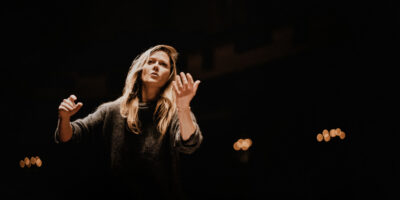
The first time you saw Barbara Hannigan at the New York Philharmonic, it was as a singer: she made her debut as Gepopo— dressed as a space-age chief of the political police—in the 2010 production of Ligeti’s Le Grand Macabre. Her appearances this month, however, combine her vocal and dramatic skills with one developed more recently, after conducting colleagues encouraged her to take up the baton. While she generally keeps those two passions separate, she’s brought them together for Poulenc’s La Voix humaine, in which she sings and leads the Orchestra as she makes her Philharmonic conducting debut, April 23–25.
“La Voix humaine lends itself to putting both of those skills together in one special package,” Hannigan explains. “I created it with the view that all of my gestures as conductor also have a theatrical quality that relates directly to what I’m saying as the character. In German we have this word Gesamtkunstwerk—a complete work of art.”
The idea came to her in the midst of singing it at Paris Opéra. “I had the feeling that this would be a piece that would lend itself very well to being a sing-conduct piece—and not very many pieces do. Because the issues in this piece, for the character, are all about control, fantasy, and isolation. It’s an extremely emotional piece.”
Hannigan’s extensive development process included video artist Denis Guéguin and live videographer Clemens Malinowski. For herself, she had to figure out, “How am I going to conduct this? How am I going to give the orchestra what they need while I’m playing the character and telling the story? I was developing the gesture that was necessary for the orchestra but in a way that also made theatrical sense.”
Live video is projected behind the Orchestra, which she is conducting while also singing and acting: a rare choreographic marvel. While facing the musicians she is also interacting with three hidden cameras that project her acting onto a big screen for the audience. “We could imagine it’s a FaceTime call,” she muses. “That’s the way we communicate nowadays most of the time.”
She explains that the video plays a key role: “Her heart is broken, and that reads really strongly when you’ve got these close-ups. And we wonder, are we seeing her imagined fantasy? Is the relationship real, is there really a lover? Or is what they’re hearing based on several relationships and several experiences?”
Since she introduced this production in 2021 she’s performed it across Europe and in Montreal — and now New York City, and she’s looking forward to the experience: “This is the American debut, so that’s really great to do with the New York Phil. I expect that we’re going to work really hard. And we’re going to have fun: it’s very engaging for the orchestra.”
The Poulenc shares the bill with Richard Strauss’s Metamorphosen. “People often ask me, why did you put these two pieces together? Both are about loss, and both have nostalgia and memory. The Strauss was written at the end of the Second World War, when Strauss was asking, ‘Oh, my God, look where we are. How did we get here? And what have we done? ’Metamorphosen has this immense sense of loss and nostalgia, and La Voix humaine is those same things but on a very personal level.”
The Poulenc was composed in 1958, the Strauss 13 years before that, but Hannigan feels they speak to today’s audiences. “Everything that artists do right now resonates in the context of, ‘What are we living?’ Everyone who comes to the concert hall brings their life experiences, and also what happened this week, what happened this morning, and they sit in a state of deep concentration and deep listening together. It is very, very important for all of these people to come together to listen.”


More latest news
-
-

-

Schedule of Upcoming Off-Broadway Shows
Off-Broadway News -

In His First Season at the NY Phil, Gustavo Dudamel Wants to Show How Music Can Unite Us
Classic Arts Features -
-