


Special Features
When a Stage Director Trades Broadway for the Olympics
Sammi Cannold was part of the team behind the 2026 Winter Olympics Opening Ceremony in Milan.
February 17, 2026 By Logan Culwell-Block
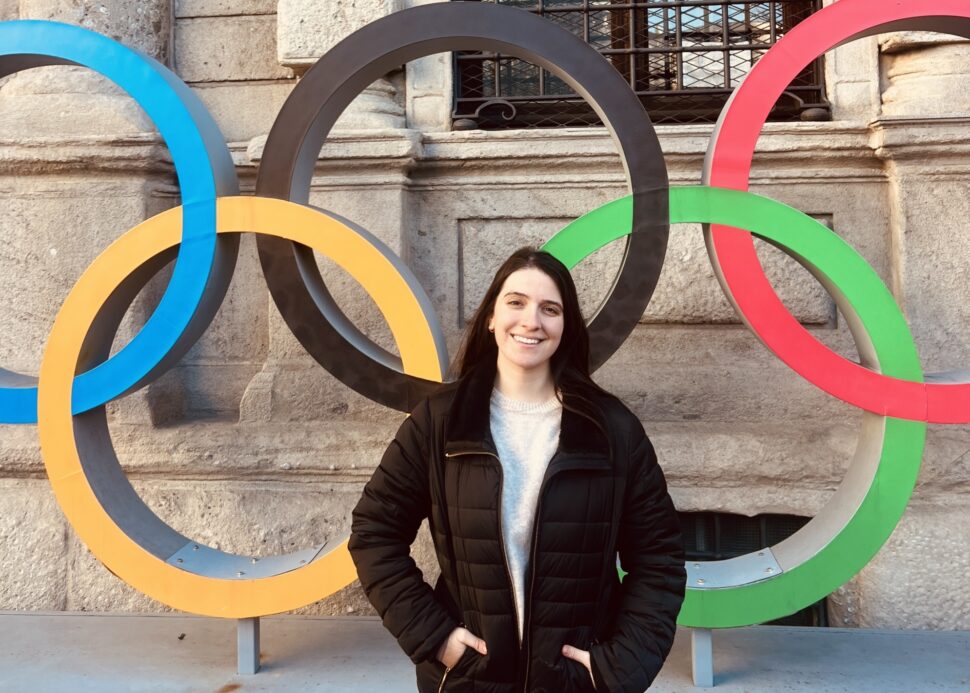
Directing a new musical on Broadway is not an easy task. Even leaving artistry aside, one has to wrangle hundreds of people and show elements, from cast to backstage crew to large and often mechanical sets and costumes and props—all of which need to be unified under a distinct and engaging directorial vision.
But the Broadway musical is nothing compared to the truly mind-meltingly huge logistics behind a slightly larger-scale event: the epic opening ceremony at the Olympics. Always a highlight, the hours-long event typically features performances featuring ensembles of hundreds, impressive technical set pieces, vocal performances, and lots, lots more—and it's all live with no do overs! This ceremony is a one and done, closing on opening night.
Thanks to an international TV broadcast, it also gets literally millions of eyeballs.
READ: Classical Music Takes Center Stage at Winter Olympics Opening Ceremony
Yes, reader, we're talking about sports—kind of. And that's because this year's Winter Olympics opening ceremony in Milan, Italy featured a familiar face on its directorial team: Sammi Cannold, who made her Broadway debut in 2023 at the helm of How to Dance in Ohio. You might also remember her as the director of other notable productions, such as Evita at New York City Center, American Repertory Theatre, and Shakespeare Theatre Company; a series of orchestral Rent concerts at orchestras and opera companies around the country; a 2016 Ragtime performed on Ellis Island; or the Kennedy Center's 2023 Sunset Boulevard starring Tony winner Stephanie J. Block.
Playbill caught up with Cannold just days after the February 6 ceremony was held, to find out where this unusual career trajectory came from—and what it's like being on the directing team for one of the highest stakes, biggest live productions out there. The conversation has been edited for length and clarity.
This Opening Ceremony, like so many before it, are just massive events, and take what I can only assume is a massive team of people to make happen. What was your role on the team?
Sammi Cannold: I was the creative coordinator, which was a role embedded within the Creative Direction team. I reported to the wonderful Italian creative director of the ceremony, Simone Ferrari, who—alongside the legendary Executive Creative Lead Marco Balich—oversaw the vision for the whole production.
Marco, Simone, and a team of incredible Italian artists had been developing the ceremony’s artistic concept for several years. I joined about four months before "show day," at which point, the vision was largely set and the focus shifted to execution at scale. With a cast of over 1,300 performers, many team members are needed to get the show on its feet.
An example that I feel best illustrates the way the job functioned is in relation to the five Olympic rings sequence. Simone and Creative Director Lulu Helbeck had a strong vision for when and how the rings would converge in the sky. I was asked to work with the aerial systems supplier, Skywalker (among others), to help determine the specific logistics required to make that vision physically possible—timing, trajectory, rigging constraints, safety protocols, and spatial geometry—and then help Simone and Lulu integrate those practicalities with the music and staging.
In my life as a freelance director on Broadway and beyond, I both create and execute ideas. On this job, my focus was almost exclusively on helping to execute, which I’m grateful for because I’d never worked on a ceremony prior and the Olympic Opening Ceremony is the most viewed show on the planet, so it was a gift to get to learn about how ceremonies are made without having artistic pressure on my shoulders.
I saw on your Instagram that this has been a long-held dream and goal. Where did your love of the Olympics come from?
When I was 8, I watched the Salt Lake City 2002 Olympic Opening Ceremony on TV and fell in love. I was already a theatre-obsessed kid, but had never seen anything like that ceremony. Of course, I was dazzled by the size and pageantry, but what really moved me was realizing how this theatrical event could symbolically strive to bring the world together mere months after 9/11. And I became obsessed with the idea that ceremonies could be a ritual to model global unity in a way that no other art form could be.
That obsession stuck and from the age of 8 onward, whenever anyone asked me what my dream job was, I would say "to work on an Olympic ceremony." I didn’t necessarily know what that meant or what the pathway would be—I just knew I wanted to be part of that kind of moment.
So, to get to work on Milano Cortina 2026 has been surreal and very meaningful.
What were the Olympic broadcasts, opening ceremonies or otherwise, that were especially important or influential to you?
The London 2012 Opening Ceremony was especially formative for me, because it was so unapologetically driven by narrative like theatre is. Ceremonies are often not heavily narrative-based because they must be understood without language so that they can be viewed in every country on the planet. But London 2012 proved that you don’t have to sacrifice storytelling to achieve universality.
That creative team told a very specific story—that of Britain’s evolution from pastoral landscapes to the Industrial Revolution to modern pop culture—and they did it almost entirely through visual language without relying on the English language.
How did you go about getting this gig?
In early 2024, I realized that if I wanted to chase this dream of working in ceremonies, I would have to deliberately pursue it—an opportunity to work in that field wasn’t going to drop in my lap. So, I researched the major companies producing ceremonies, identified Balich Wonder Studio as one of very few global leaders, asked my amazing agent Kevin if he could request a general meeting with Marco Balich. That initial zoom turned into an in-person meeting later that year.
From there, I met with several Balich team members who introduced me to other Balich team members, until I eventually met Simone Ferrari, the creative director of the Opening Ceremony. At the same time, I immersed myself in learning the specific language of ceremonies by shadowing on two pitches and taking a course taught by members of the Balich team. I realized that no matter what "level" I was at in theatre or in television, there was a lot I didn’t know about making a ceremony.
Then, in March 2025, Simone offered me a position on the Olympic Opening Ceremony team.
But the journey didn’t end there. There were visa complications and many steps required to getting approved to work in Italy as a foreigner. Ultimately, after a lot of creative problem–solving by all parties, I arrived in Milan in mid-October 2025.
I share this very roundabout series of events that led to the job because I think it’s important that people looking to work in adjacent industries, in addition to theatre, understand that it’s not as simple as responding to a job listing or making an easy lateral move. It requires significant effort no matter what level you’re at in your own field. But for me, it was unquestionably worth it.

It feels unusual to see someone from the Broadway sphere end up on such a different type of performance. Is that true, or is there more crossover than I'm aware of?
It is! Ceremonies world is actually very hard to break into even if you’re working at a high level in an adjacent industry. It’s understandably populated by a small group of very specialized artists who usually do all the big ceremonies. So, I feel very lucky that Balich gave me this opportunity after several years of knocking on doors. The crossovers from the Broadway sphere are usually designers—like Broadway and West End lighting designer Bruno Poet, who was the lighting designer of this year’s Opening Ceremony. And it makes a lot of sense. Directing looks so different in ceremonies world that I don’t think a theatre/television director like me could direct their own ceremony without first having a more junior job like the one I just had and/or being allowed to observe.
What about your stage work do you think best prepared you for this job?
Ceremonies are very musical. They are scored almost all the way through, and, unlike musical theatre, they are set to timecode. So, almost every event in the ceremony happens at an exact predetermined moment in the music. Because I direct musicals, can read music, and have developed a sense of musicality over the years, that skill-set was very helpful in understanding how to navigate the various moving parts of the ceremony, especially as one of my responsibilities was to coordinate with the music producer and composer when changes to the music arose.
What about this job is the most jarringly different compared to your stage work?
In ceremonies world, you pre-visualize everything. Because you get very little time in space and no previews process to perfect choices, you have to be able to "see" as much of the ceremony as possible ahead of time. So, our team had animated versions of every segment in the ceremony that could be viewed in 3D from different camera angles before they ever existed in real life. I’m personally not technologically savvy enough to create those animatics—my brilliant colleagues Alfred, Kamilla, and the amazing broadcast team masterminded that—but the tool was invaluable for and used by all departments aligning on the creative elements in the ceremony.
Watching the ceremony with you in mind, it struck me how unusual it is to have this event that is for a live audience, but also for cameras and millions of people watching at home. How does that affect the process of putting the show together?
You’re always thinking about the camera when you’re putting these shows together, which was something that I wasn’t used to from theatre. But thankfully, I was familiar with it from working on the Tony Awards and directing an episode of Grey’s Anatomy.
But what makes ceremonies uniquely challenging is that you’re designing simultaneously for two audiences: the millions watching on television and the tens of thousands in the stadium. We had 80,000 people in San Siro. So, each moment had to read as an emotionally legible image on camera and also function as a massive live spectacle in real space.
The other component of that is that there’s a creative director for the ceremony, but then there’s also a broadcast director who is in charge of calling the camera shots among much else. Those two people have to work really closely together to ensure that what’s being put on stage is well represented on camera.
For me, that relationship between theatre, television, and live event is what makes ceremonies the most complex and challenging of the mediums I’ve gotten to work in.

What were you doing on the night of? Do you just watch and hope it all goes well, or did you have a role during the show?
In theatre, opening night for a director entails a lot of letting go. You sit in the house, hope it all goes well, and resist the urge to interfere.
On the night of the Opening Ceremony, I was one of the team members actively directing performers in real time. Several of us were on headsets speaking into performers’ in-ear monitors during the show. The performers knew their blocking, of course—but in a live global broadcast, timing is both hard for performers to track and can shift in big and small ways. Camera shots change. Pacing adjusts. And sometimes the staging needs to recalibrate.
For example, in the ceremony’s finale, when Italian astronaut Samantha Cristoforetti and our young performer Gaia were weaving their way around the dancers representing the solar system, I was in their ears telling them when to slow down, when to hold, when to move. I was watching timecodes and the broadcast monitor, ensuring their pacing aligned with the camera language being called live.
It’s quite pressurized and delicate, because what you’re instructing performers to do is playing out in front of millions of viewers. But it was also exhilarating. In a strange way, it felt like what I imagine performing feels like—just through a headset instead of on stage.
And I have to say, colleagues like our mass choreographers Dimitra and Tamara were doing this for hundreds of performers at once for the entire show. That level of live coordination is extraordinary to me. They’re absolute heroes.
What do you think would most surprise people about the behind-the-scenes process of putting a massive show like that together?
I think what would surprise people most is how mathematical it is.
From the outside, it looks like pure spectacle and emotion. But behind the scenes, it’s geometry, timecode, safety protocols, wind calculations, the positioning of 35 cameras, traffic flow for hundreds of performers, etc. You’re mapping inches and seconds constantly.
Every poetic moment is sitting on top of spreadsheets and engineering drawings, which is also true in theatre, but way more-so in ceremonies. The art only works because the math works.
I think people also might be surprised to learn how international these teams are. I didn’t ever expect to be offered a job on an Olympic ceremony like this one outside of the U.S., because I figured that the Italian Opening Ceremony team would be entirely made up of Italians. And while it was majority Italian, on my team alone, there was a Peruvian, an Australian, a Russian, and me in addition to two Italians. Another example is that our incredible show caller, Carola, was calling the show in English but often speaking with team members on comms in Italian. It was pretty incredible to observe.

How many squares of caffeinated chocolate did you allow yourself a day?
I’m laughing so hard—I love this question very much! Three was the maximum. Those chocolates (called AWAKE) are the only reason I was able to stay awake (fitting name), especially considering I was doing my Italian time zone Olympics work by day, but then coming home and also doing an American time-zone work day on Zoom thereafter. My obsession with these chocolates has gone so deep that AWAKE is letting me be a "brand ambassador," which is one of the great honors of my young life.
Now that you've achieved this dream, what are the next big ticket items on your vision board?
I’m excited to live in theatre world for the next few months. I’m working on three new musicals, a revival, and a play that I’m very excited to make front burner this winter and spring.
In the future, I would love and be so honored to direct my own ceremony and am having a few conversations now to that end. In particular, I would be especially excited to direct a Paralympic or Special Olympics ceremony, especially because my work on How to Dance in Ohio with the disability community has reaffirmed for me how critical those events are. And then, one day, I’d like to be the lead director of an Olympic Opening Ceremony, but I have a ways to go before I’m qualified for that.
From calling cues for performers, I also became quite enamored with the idea that perhaps in the future, I could learn how to direct on the broadcast side as well. From working on the Tony Awards, I’ve gotten to sit in "the truck" and am in awe of what directors like Glenn Weiss and Simon Straffurth (who was the broadcast director for the Opening Ceremony) do. But I have a lot to learn in that regard before I could take on my own broadcast.
When I work in industries adjacent to theatre like episodic television or now ceremonies, my friends often ask me if I’m "leaving theatre," and the answer is absolutely not—never. My dream is to continue to work across multiple adjacent industries, because I’ve found that—happily, they serve each other. Working on a project the scale of the Olympic Opening Ceremony made me a better theatre director, just as working in episodic TV gave me an understanding of camera language that was critical to working in ceremonies. I believe it’s all symbiotic.


