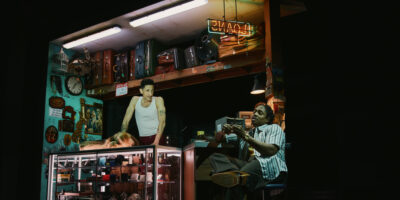
The Lincoln Center Immersive series begins this fall with its first campus installation: Collective Body was created and directed by Sarah Silverblatt-Buser, a dancer, choreographer, and educator who has long been fascinated by the role of artists and how best to use the cutting-edge technologies at their disposal.
An interactive Virtual Reality (VR) experience and a Lincoln Center commission, Collective Body (October 22-November 1 at the Kenneth C. Griffin Sidewalk Studio in David Geffen Hall) is set in the middle of a raging desert storm in New Mexico—where Silverblatt-Buser grew up—and uses movement to allow participants to relive how they first engaged with the world around them. The immersive journey begins with the self’s early tentativeness to initial encounters and, finally, moving together with others.
Collective Body—produced by Atlas V and ONX Onassis and co-produced by Silverblatt-Buser’s company Body of Ways—had been percolating for some time. Silverblatt-Buser tried on her first VR headset in 2013 and, during the 2020 COVID lockdown, incarnated Edgar Degas’ famous “Little Dancer” sculpture in an Augmented Reality (AR) installation at the Musée d’Orsay in Paris, which was also her first experience with motion-capture. “That triggered a lot of ideas in my mind,” she explains, “and the idea for Collective Body was ‘how do our movements speak beyond our form?’ After seeing my movement in another body (in the Degas AR piece) was really wild. It made me think that, if we are living in virtual spaces and are no longer in our bodies, what would it mean if only these avatars were represented by our movements and the archival self that lives in our bodies?"
Thinking back to the initial stages of the pandemic, when lockdowns often meant little physical movement and potentially traumatic isolation, was pivotal to the genesis of Collective Body, according to Silverblatt-Buser. “During COVID, I know many people experienced what I read about in Bessel van der Kolk’s book The Body Keeps the Score—how many different experiences, from the traumatic to the ecstatic, live in our physical being,” she says. “That made me think about the role of our body in this virtual future— how much of our individual past and our generational past it contains. But I wanted to flip the hierarchy between the rational and intuitive self: What if the movement of the body is centered in how we need and experience each other?"
Having premiered at the Venice Biennale in August, Collective Body will be installed in the Griffin Sidewalk Studio. “(The studio) will transform into a space that will echo the experience of the VR headset,” Silverblatt-Buser explains. “When someone enters, they will be moved to the New Mexico desert during a storm—which lets us play with the elements. I will first lead people into their bodies, then they put their headsets on, and bit by bit they will start moving, first with their hands, then their feet: And they will discover themselves as avatars created by their movement and eventually join together with others as the collective body.”
Silverblatt-Buser, aware that not every participant will be an expert in VR or a natural dancer, says that “Collective Body demystifies dance and movement. When I first thought about this piece, I thought about my parents, who have never used VR headsets, and my gamer friends, who never move from the sofa—but also my dancer friends, who can do amazing things whenever they move. It’s accessible in the best sense of the term: I love super niche, avant-garde dance but I also love a great dance party and celebrating life. By the end, everybody is dancing together.”
In February at the David Rubenstein Atrium, the Lincoln Center Immersive series continues with another commission, Sarah Ticho’s Soul Paint, an enveloping world that melds art and science and allows singular introspection and global connection, comprising 3-D drawing, interacting avatars, video game inputs, and narration by actor Rosario Dawson.
Jordana Leigh, Vice President, Artistic Programming at Lincoln Center, is thrilled with this season’s commissions. “We are diving deep into immersive programming because we feel it’s a very important way for the performing arts to tell stories,” she says. “Technology is catching up to artists’ visions—not the other way around—which allows artists to further their work, make new connections, and tell their stories in ways that have a deeper impact."
Visit LincolnCenter.org.