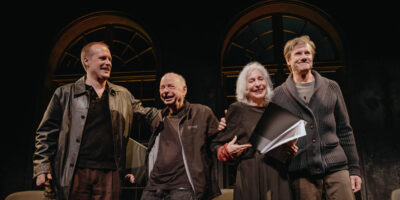
Ghostlight Records releases the debut studio cast album of Zak Zadek's new indie-rock musical Deathless November 7—stream or download it here. The album includes performances by Jeremy Jordan, Nicolette Robinson, Maia Reficco, Sara Kays, and Kevin Atwater, plus orchestrations and additional production by Justin Goldner and Zadek. Doug Schadt produced, with Jonathan Brielle and Kurt Deutsch serving as executive producers.
To celebrate the release, Zadek has taken us through the entire album track by track to share the context for each moment of the show, plus the musical inspirations behind the songs and more.
Zack Zadek here—l am the writer of Deathless. I grew up not just listening to cast albums, but utterly obsessed with them. They were the gateway drug to so many of my favorite musicals—shows that were on Broadway before my time, shows Off-Broadway that I desperately wished my parents would take me to see, shows that I had seen (or was in a local production of) that I could then obsessively study the music and lyrics to. I was that kid growing up who had a meticulous ranking of Godspell and Les Miz recordings written down on my computer—a level of nerdiness only rewarded at my theatre camp. I became enthralled with so many musicals that I could only encounter through their albums—comparing the Broadway and London versions of Parade, piecing together the intricacies and motifs of Myths and Hymns, trying to follow how The Frogs evolved on its journey to a full production.
But there was always one category of cast recording that felt the most mysterious to me—the studio album. From Aida, to Randy Newman’s Faust, to the original Chess concept album, the idea that a score could be introduced to the world as an album before its official premiere was a thrilling one. How much storytelling can be tracked through just the score alone? How could the tools of the studio be used to not just capture a specific production, but instead build the world of the show in the listener’s mind? As a composer-lyricist myself, I always hoped that the first recorded music I would release would be a complete score recorded in full, to give the listener that kind of full narrative experience.
Deathless is a show that has been in development for some time (musicals take a while, in case you haven’t heard!), and in putting this breakdown together I find myself thinking of so many discrete moments of the process of making it. There’s the moment and place each song was first written, the first time it was touched by a performer or collaborator and came to life, and then the very specific process of making the album that you can currently listen to—one which feels like its own container over the past 2+ years of recording. But above all else—for a musical that you (most likely) haven’t seen for yourself yet, or even read the script—I hope this breakdown can simultaneously offer you a window into the process of making it, as well as a little guide to the story and characters.
There is nothing better than a cast album, and I feel incredibly excited that Deathless represents my first. I hope you’ll sit down and go on the road trip from start to finish. And now, let’s go together…
1. "Live Forever"
(Written in Zack’s Apartment - Gowanus, NY)
Let’s get the basics out of the way: Deathless takes place in a version of America where the cure for natural death and aging has been widely released as a small blue pill. When the show begins, a nationwide entitlement policy has just come into effect: “Everyone Gets One,” meaning each person is being issued one of these pills, should they choose to take it. It’s not really “the future,” more like an alternate version of our present. But while this is the world in which our story takes place, it’s not really our story itself—so as an opening number, I wanted to drop you into the world and get you up to speed as quickly as possible.
Meet Hayley Serling—played on the album by a recording artist who sort of…is Hayley: Sara Kays—she’s 19, she lives in Kansas City, and in this song, she’s watching TV and trying to sort out her complicated feelings about this enormous decision she has to make. And while a part of her is trying to tune it out and not even think about it, unfortunately for Hayley (but essential for us!), the news keeps reporting on this huge development. When I first thought of Hayley in my head she was always like Hayley Williams from Paramore, so the name stuck. And Serling I thought I came up with, but someone pointed out that it’s an homage to Rod Serling, of The Twilight Zone—one of my favorite pieces of art ever. Sometimes your influences sneak up on you!
Speaking of screen influences, I’m obsessed with high-concept storytelling with this kind of world building—TV shows like The Leftovers and Lost (Damon Lindelof will forever be one of my core influences), films like Her, stories that are essentially a character study within a specific container are hugely impactful on lots of my work, and Deathless specifically. So I got to live my verisimilitude dreams on this album when three journalists who I watch all the time agreed to cameo as themselves across the album: Chuck Todd (former host of NBC’s Meet the Press), Michael Steele (from MSNBC), and Joanna Stern (the lead tech journalist at the Wall Street Journal, whose videos I’ve watched religiously for years).
2. "Niagara"
(Written at NYU - New York, NY)
“Niagara” starts our story in earnest. Hayley is convincing her father Kevin to go on their annual family road trip to Niagara Falls to lay her mother Michelle’s ashes to rest, and makes a deal with him: She will take the pill with him once they get there, something Kevin is incredibly anxious for them to do. Michelle missed the pill by a matter of months—and making sense of this dissonance is the engine of Hayley’s journey, and of our story.
Musically I’ve always been interested in how intimate this score could, at times, be. The soul of Deathless is driven by acoustic guitar, and this kind of interlocking, lo-fi fingerpicking is in some ways the core of the sound and where the more reflective moments for Hayley live. Bon Iver’s For Emma, Forever Ago, Sufjan Stevens’ Carrie & Lowell, Fleet Foxes—these are albums and artists that influenced what I wanted the score to feel like. One of the pleasures of this album process specifically was getting to use the studio to (hopefully) really achieve this kind of indie-folk record. On stage it’s hard to have a character feel like they are whispering a song in your ear, but that’s one of the beautiful aspects of this kind of recording. Sara—who is first and foremost a recording artist—was so comfortable with this kind of singing, which was part of the fun of the project.
A major theme is introduced for the first time in “Niagara,” which I often refer to as the Life and Death theme. It’s on the bridge: “Maybe we’ll try / To finally say goodbye”—this theme will be presented in many different ways through the score, both vocally and instrumentally, but we hear it here for the first time, as Hayley sings about trying to make sense of her loss in contrast to the promise of eternity.
I wrote the earliest material for Deathless while I was still a student at NYU, and it’s wild to remember how far the journey of the show has gone. I remember working on it in a tiny practice room off of Washington Square Park while a girl loudly practiced trombone next door. Time is so central to the show—and it’s true, it really does fly!
3. "Gone I"
(Written in an ocean cottage - Branford, CT)
In the show we’re not just tracking one road trip, we’re tracking two: Hayley, Kevin, and her best friend Justin in the present as they drive to Niagara Falls; and the same route one year earlier, the last trip they took as a family when Michelle was still alive. Road trips are so connected to geography, and it’s that geography that triggers the specific memories for Hayley as we encounter them along the way.
“Gone I” is the first song we hear on that past road-trip, and this song sounds very different because of it. Obviously Michelle is still alive (played here by the truly radiant Nicolette Robinson), Hayley is a far less mature 18-year-old who doesn’t want to be here at all, and Kevin is in full Dad mode (the singular Jeremy Jordan). And after sitting with Hayley for the first two songs, we get to hear the family dynamic of what the Serlings were like come into focus.
I wrote this song in a tiny cottage on the Connecticut shore that’s owned by producer and friend Greg Nobile, who invited me to write for a few weeks by the ocean when we were both in our twenties and he only had a single Tony. Now we’re both in our thirties and he has a hundred Tonys, but that cottage proved incredibly formative for this musical.
The instrumentation is completely different for that one-year-ago trip. Here a full woodwind and string section join us. Recording these players live in the studio was one of the absolute highlights of making this album. The whole show was co-orchestrated by Justin Goldner, core collaborator on the project, and he gets full credit for these orchestral arrangements across the album.
Musically we are doing a lot of mixed meter stuff in this. We live most of the song between 5/8 and 6/8 (and, eventually, 7/8 and 8/8). The nerdy idea behind this is Michelle is with us, but she isn’t, just like that elusive beat. Each time you think you can catch it—oops, it’s gone.
“Gone I” also introduces our next major, major theme: affectionately called, the Gone theme. It’s on the chorus: “Gone, gone, gone, gone, gone.” We’ll hear that phrase mean different things in different contexts across the album, but here Hayley is just exuberant that they’ve hit the road on this roadt rip across the country.
4. "On We Go"
(Written at the Rev Theatre - Auburn, NY)
Looking back, I didn’t realize the show needed “On We Go” until surprisingly late in the writing process—It was one of the last songs I wrote for the score. But once most of the show was written, I realized that there were so many moments and songs that explored the complexity of living forever, the potential risks of living forever, but not how amazing it could be! Because, come on…there would certainly be plenty of positives to taking the pill. “On We Go” and “Live Forever” are sister songs. They offer two different takes on the premise.
Justin (played on the album by an artist who lives and breathes this exact musical genre, Kevin Atwater) and Hayley are at a motel for the night on the way to Niagara, and they both get super stoned and start fantasizing about what their friendship will be like over the next couple 100 years or so. Besides being a goofball, Justin has already taken the pill, so deep down he’s probably trying to convince Hayley go through with taking the pill as they both party it up at the EconoLodge.
Doug Schadt who produced the album has been a friend of mine for many years, and he’s probably best known for producing our classmate Maggie Rogers’ debut single “Alaska.” We wanted to craft that exact kind of upbeat jam production that still lives across the indie-folk spectrum. After our team took a look at the finished album, we all decided “On We Go” was the perfect lead single for this project. It introduces you to the allure of what this world could be like. And listen close, you might hear Doug and I singing on this track…
I wrote this song at a residency in Western New York (a lot of this writing was generously facilitated by residencies) which coincided with my first actual trip to Niagara Falls. And let me tell you—Niagara Falls is truly incredible. Highly recommend you go.
5. "For A Moment I"
(Written at NYU - New York, NY)
A common song beat when discussing musical theatre structure is the “I Want” song, but a similarly important pillar is the “theme stated” song—and here it is for our show. Hayley suffers from horrible panic attacks, and Michelle soothes a particularly bad one on our past road trip (in the same hotel that Justin/Hayley sing “On We Go”—as i said, geography is the connective tissue across time!). All things pass, including an experience as rough as this one for Hayley.
We made this album across a lot of time and geography ourselves—the old upright piano I’m playing on this was recorded in Williamsburg, Brooklyn; the guitars and strings were recorded in South Jersey; and Nicolette recorded her vocals to this song (and all of her songs, for that matter) in Los Angeles. It’s wild in hindsight to think of all the places this show and album have taken me physically. I can think back to the practice room at NYU this song was written in, or the North Hollywood studio Nicolette, Doug, and I spent the day recording this song in years later—and it’s connected across time and geography in a manner very similar to our characters’ experience.
6. "The License Plate Game"
(Written at TheatreWorks Silicon Valley - Palo Alto, CA)
Another set of sister songs across time: “The License Plate Game” and “Gone I”—our two “road trip” songs. “Gone I” was the one in the past, “The License Plate Game” is the one in the present. Deathless takes some cues from the high-concept TV shows I referenced earlier, but it’s influenced by equal parts by some indie road trip films: Little Miss Sunshine, Planes Trains and Automobiles, The Descendants. There is such an amazing aesthetic and cannon to the American road trip story, and this song is the most overt conversation with them.
I love a narrative song where the structure itself is key to the characters growth edge or dramatic progression. In “The License Plate Game,” the structure of the song is straightforward enough: car games. We start with the titular License Plate Game, then move on to I Spy, and finally The Alphabet Game—all three being classic pass-the-time car games. But within each of them, the “game” of the song is Hayley and Justin getting Kevin to talk and think more and more about Michelle, even though his grief has manifested by not even wanting to think about her. Each game is a discreet musical and lyrical idea: by the time they get to The Alphabet Game our characters are moving through the alphabet both with things that they see out the windows, but also images they remember about Michelle.
One of the first professional theatres to take a chance on this show—or on me as a writer at all—was TheatreWorks Silicon Valley, where I had a residency right after college to finish writing this musical (where I met many writer friends who I’m still close with like David and Irene Sankoff, Kirsten Gunther, Mindi Dickstein). I’m notoriously a night owl writer—they gave us 24/7 building access, and was in the huge rehearsal hall at 1:30 AM working on the “I Spy” section of this song until I fell asleep in the theatre. I love writing in empty theateres at night!
Much like the concept albums above featured legendary artists, I’m incredibly proud that only on Deathlesscan you hear a trio with Broadway’s legendary leading man Jeremy Jordan, singer-songwriter darling Kevin Atwater, and indie-pop artist Sara Kays all on one album, let alone one song. Basically just my favorite artists all doing their specific thing together at the same time. As a huge fan of all three of them, I feel selfishly very lucky to have that!
The end of this track is that Life and Death theme again on the piano as we’ve successfully gotten Kevin to think about the loss…
7. "Sisters"
(Written at TheatreWorks Silicon Valley - Palo Alto, CA)
Deathless is a one-act musical, but it’s in a three-act structure—and here we begin our structural Act Two with a curveball: we’re stopping at Hayley’s sister Sam’s house in Ann Arbor. Oops.
I’m an only child, but many people close to me have varied and complicated relationships with their siblings, and there was something very funny to me about Hayley thinking of this forced encounter with her adult sister as a showdown with her mortal enemy (“who looks a little bit like me”). And I’m obsessed with these kinds of relatively small interpersonal conflicts playing out against a big high concept like living forever. One of the lyrics I’m most proud of in the show: “Listen to them talking, how she spins the conversation / So Samantha is the center of each story, of every laugh / Even if I cured, I think I’d kill myself, and they can write / ‘Murdered by her sister’ on my epitaph.”
Just as it’s a plot shift, it’s a musical one as well, much more aggressive and rock infused. We spent a lot of time in the studio trying to figure out what the right sonics for this song would be alongside the rest of the album. In the end, we decided a super aggressive treatment of the live strings was the way to capture this, and I’m very proud of how that approach ended up sounding, sort of a weird intersection of Punch Brothers and “Eleanor Rigby.”
The bridge of “Live Forever” is back here as Hayley tries to “put another record on” and drown out her sister in her headphones, as it collides with the Gone theme. You can just will somebody out of your mind with enough loud music, right?
8. "Feels Like Home"
(Written at Zack’s Apartment - Brooklyn, NY)
This was interestingly the last song written for the show, and it is heard for the first time ever here on this album. I feel very lucky to have had incredible collaborators every step of the way on this musical. One of them is Tina Landau, who directed our developmental production at Goodspeed shortly before the pandemic. Tina and I had extensive conversations about one particular moment in the past between Hayley and Michelle as Michelle tries to reassure Hayley that she can go off to her freshman year of college, even though Michelle is getting sick. While we always suspected this moment should be musicalized, it wasn’t until the middle of the pandemic that I had an idea for what the song should be and how it could work. But that’s what good collaborators do: plant the seed of an idea in each other’s minds.
Nicolette and Sara have such unique voices, but they also sound quite similar in some ways, something I thought was incredible for our mother and daughter dynamic on the album. The production of this track again is very Doug, upbeat propulsion while still keeping us fully grounded in organic sounds.
The bridge of this is the full Life and Death theme again, but this time with a version of the lyric just as it’s heard in “Niagara.” Something Justin Goldner and I discussed in the orchestration of this moment was how this presentation of the idea is like the full technicolor version of the muted idea we heard in “Niagara,” as if this is the raw emotional idea that’s been bleached through time. And the song itself ends with the same “lets go” from “Niagara,” connecting Hayley back to the present as this memory fades away.
9. "Martin Luther King Jr. Day"
(Written in Zack’s Childhood Home - Long Island, NY)
One of the things I thought about early on in the conception of the premise was how much our language is built around an idea that forever is impossible. “It takes forever” and “it’ll last an eternity” are all phrases that we use colloquially with the understanding that everything is actually finite. It got me thinking… what else do we say we’ll do forever? And I realized that marriage is a vow very specifically taken “until death.” What would that kind of commitment look like in a world where death might not ever come?
Justin serves as our comedic foil for much of the show, but we begin to get the sense that it is covering something under the surface. Towards the mid-point of the show, Kevin asks Justin about his experience taking the pill with his parents, and assumes that it must have been a universally positive experience for Justin and his family, which is when Justin shares his experience of taking the pill. On the record, Kevin Atwater really breaks your heart open with his restrained performance, and Justin Goldner and I decided to use a rubber bridge acoustic (made famous by Phoebe Bridgers) to offer a completely distinct color for this intimate and sensory story.
I love titles that don’t give away the full nature of the song, and this one turns out to be the name of the federal holiday that the story takes place on. There was something evocative to me about this happening in the middle January, as the depths of winter stretch ahead as far as you can imagine. I’ve always been obsessed with bottle episodes in TV shows, where we track a specific character in a self-contained story for an hour. Martin Luther King Jr. Day is a bottle episode of a song to me in how it functions. It informs our main action, but through the lens of this experience we go on with Justin.
This was the only song I wrote in my parents’ house on Long island, and while they are happily married, perhaps there was something about being in my childhood home that informed the parent-child relationship at the heart of the song. At the very end, Justin restates the “when you live forever” from “Live Forever,” this time of course with very different context.
10. "Gone II"
(Written at Goodspeed Musicals - East Haddam, CT)
Deathless had its first developmental production at Goodspeed, which will always be a hugely important theatre in the life of the piece. While I did extensive revisions across the book and score during my time there, only one song was actually written in full at Goodspeed: “Gone II.”
There was much debate on whether or not this track should be included on the album at all, but in the end, we were all very glad it was. While it’s largely not a vocal track, it functions as the climax and twist of our plot… so spoiler alert!
Hayley learns that on the Niagara trip one year ago, Michelle did get the option to take the pill and prolong her life but opted not to take it, as it would have meant remaining in a sickened state forever. This is a huge moment for Hayley, as she grapples with multiple realizations all at once, including that her family has been lying to her for the past year. All of this happens as we track the pill’s widespread release in America, which our newscasters do a remarkably convincing job of (I still can’t get over hearing Chuck Todd explain how “Everyone Gets One”).
Musically, this was maybe the most intricate production process in itself. The music is written to be a mix of minimalist build in the style of Steve Reich, John Adams, etc.; but that gives way to a massive modern film score sound in the vein of Hans Zimmer, Ludwig Göransson, etc. (yes, this is our Chris Nolan climax, if you will). We layered an insane amount of analog synths that Doug owns in the studio: several vintage Junos, Moogs, Prophets, as well as orchestral parts that we recorded live to really give it that huge filmic sound. The track ends with a chaotic representation of “the void,” as Hayley and Kevin confront the pain of Michelle’s choice.
“Gone II” is mastered to deposit us straight from the abject chaos into…
11. "A Life"
(Written at TheatreWorks Silicon Valley - Palo Alto, CA)
“A Life” is, in many ways, the centerpiece of the score and by extension, the album. It features Kevin experiencing a memory of his own for the first time in the show, tracking his entire relationship with Michelle as they meet in college, fall in love, start a family, deal with her diagnosis, and ultimately say goodbye. It turns out that Kevin has been blaming himself for Michelle’s choice not to take the pill and live forever. This song is his reckoning and ultimately, catharsis.
Dramatically I wanted to try and pull off a similar move as the opening montage of the Pixar movie Up, but instead of framing the story we’re about to see, it fills in the gaps of the story we’ve been watching. A great deal of this action happens after the explosive moment in the middle of the song through movement and staging during the refrain “I was so young” and through the instrumental section that takes us to the end of the track. So, on our album, you will have to imagine the sequence in your mind! Hopefully there are enough musical cues to point you to the various emotional beats of the sequence.
Speaking of explosive moments, this entire track is a departure from everything we’ve heard up until now. This is the breaking point for Kevin and for the Serling family writ large, so we move from intimate acoustic guitars to full on explosive orchestral indie rock. The track “Your Ex Lover Is Dead” by the Canadian band Stars was a model for how I wanted this music to feel—a raw, uncontainable, massive emotional release. And when Hayley sings the Gone theme about Michelle, it’s exactly what Kevin has needed to hear for the past year.
And Jeremy Jordan. I mean, what can you say about what Jeremy did on this track? I was in tears in the studio—we were all in tears. He is a singular talent. Nothing more to say.
12. "Up and Away"
(Written at Pearl Studios - New York, NY)
“Up and Away” was the first song I wrote for Deathless, in a tiny piano room at Pearl Studios in college.
Before I start writing any new full musical, I look for the story and character moment that feels like most low hanging fruit to find my way into. I think of this process as collecting the paints on the palette with which the rest of the show can be written. Sometimes this exercise is fruitful to discover that I shouldn’t be writing a particular musical at all! But I knew from the moment the premise of Deathless came into focus that there should be two sisters: The younger one who isn’t sure whether or not to live forever, and the older one who took it day one and decided to live her best life.
There is something so interesting to me about the potential for a younger sibling to become an older sibling given the circumstances of the show, but more importantly, Sam and Hayley’s relationship elucidates a central aspect of the piece: The pill would solve some problems, create other new ones, and not change some things at all.
We hear from Hayley across so much of the score, and it’s her perspective of Sam that we as listeners are inside of. So I wanted to save the other perspective for the very end of the show, which is why Sam hardly sings until her big moment. “Up and Away” has become the most well-known song from Deathless (and probably, of mine in general) since I wrote it, largely because some of the most nuanced singing actresses have put their spins on it: Megann Fahy, Natalie Weiss, Alexandra Socha, Betsy Wolfe, all with their own unique take on Sam’s story.
I’m beyond honored to have Maia Reficco’s take as the definitive recorded version. Maia brought such a devastating vulnerability to “Up and Away,” one that really lets us hear Sam’s earnest desire to just live in the bliss of running away from life’s complexity until it pulls her back in. As we approached making this record, we decided to give “Up and Away” an updated feel from how you might have heard it in the past, one that is more in line with the sonic world of Deathless as its now come to be.
13. "Axis Mundi"
(Written at MacDowell - Peterborough, NH)
Axis Mundi is a Latin phrase that literally means “world axis,” or the intersection of worlds, the place where the sacred and the profane meet. Different belief systems offer different ideas on where an Axis Mundi might be: For a Christian, it might be a church. For a theatre lover, perhaps it’s a Broadway theatre. For the Serling family, it is Niagara Falls.
The music on this track is the Loss theme, which is transitionally across the whole score in the stage show, but on the album, only comes up here and on one other track (can you name which one?).
A formative residency for Deathless was at the MacDowell Colony in New Hampshire shortly after graduating college. I wrote this theme very late at night in a cabin, and felt like I might be discovering a new Axis Mundi of my own in the woods of New Hampshire.
14. "For A Moment II"
(Can’t remember where and when)
I’ve always hoped that the finale of Deathless would feel a bit like the rumpus in Where the Wild Things Are, a joyous, raucous, cathartic communal experience for our characters.
Many themes and motifs in Deathless present one way the first time and change and shift through the context of the show. Once at Niagara in the present, Hayley gets the opportunity to have one final conversation at the Falls with her mother, who even though is gone, is still very much there. I knew for a show that had a sci-fi high concept at the center, the ending wanted to be much more spiritual, which is where our journey leads.
When Michelle sings “For A Moment I,” she is talking about how Hayley’s panic attack will pass. Here in “For A Moment II,” she highlights the essential truth of life, that as a whole, it all will pass, but the limited time we spend together is what defines and shapes its meaning.
So many themes come into final collusion here: “For A Moment” itself, the Gone theme as Kevin is finally able to put these two ideas together (“She’s gone gone gone gone gone / For a moment I’m with you”), and the Life and Death theme, which ends our show and our album with its most stripped presentation on the piano as Hayley and Kevin decide to…spoiler alert….
Throw their pills over the side of the falls, effectively making the same decision that Michelle herself made, but for very different reasons.
As all of our characters and themes come together for one final time, so too does our album cast, who sing on a lyric together for the first and last time here on this final track. Deathless is a show about a specific group of people finding each other through the complexity of love and grief, and it seemed fitting that they should only truly sing together at the very end, once they have found their way to each other for this tiny piece of eternity.
And there we have it! Thank you for going on this journey of Deathless with me. Life is ephemeral, theatre is ephemeral—but an album like this is slightly more permanent, and I hope that the album will bring you as much joy as it brought us to make it for you.