


How Did I Get Here
Jen Schriever on the Art of Lighting Flying Vampires in The Lost Boys
The Tony-nominated designer believes theatre is "a vital kind of medicine for humanity."
April 10, 2026 By Andrew Gans

Two-time Tony-nominated lighting designer Jen Schriever is back on Broadway this spring, co-designing the lighting for the eagerly awaited new musical The Lost Boys, alongside the show's two-time Tony-winning director, Michael Arden.
READ: The Lost Boys Promises a True Broadway Spectacle
Arden invited Schriever—Tony-nominated for her work in Death of a Salesman (2023) and A Strange Loop (2022)—to collaborate after working together on The Preacher’s Wife at Alliance Theatre. The musical adaptation of Joel Schumacher's 1987 cult classic vampire film, which officially opens April 26 at the Palace, features a book by David Hornsby and Chris Hoch and music by The Rescues.
The Lost Boys, utilizing vampirism to explore a teenager's coming of age, is set in California and features LJ Benet as Michael Emerson, Ali Louis Bourzgui
as David, Benjamin Pajak as Sam Emerson, Shoshana Bean as Lucy Emerson,
Maria Wirries as Star, Paul Alexander Nolan as Max, Jennifer Duka as
Alan Frog, Miguel Gil as Edgar Frog, Brian Flores as Marko, Sean
Grandillo as Dwayne, and Dean Maupin as Paul.
Schriever's numerous Broadway credits as a lighting designer also include the fall revival of Art, the 2025 revival of Glengarry Glen Ross, Eureka Day, Mother Play, the 2022 revival of 1776, Birthday Candles, Lackawanna Blues, Grand Horizons, What the Constitution Means to Me, The Lifespan of a Fact, Eclipsed, Ghetto Klown, and over 20 additional credits as an associate or assistant lighting designer. Among her Off-Broadway credits are Antigone (This Play I Read in High School), The Other Americans, Strategic Love Play, Spain, Shhh, Power Strip, Usual Girls, Strange Interlude, Emmet Otter’s Jug-Band Christmas, and Selling Kabul.
The ever-busy designer has also worked in the West End, in regional theatre, and opera. Schriever is an Obie winner for Sustained Excellence in Lighting Design, and she also received an Obie Award Special Citation as part of the creative team and ensemble of A Strange Loop.
In the interview below for the Playbill series How Did I Get Here—spotlighting not only actors, but directors, designers, musicians, and others who work on and off the stage to create the magic that is live theatre—Schriever shares the joy of working with director (and co-lighting designer) Arden, why she feels especially vulnerable the first day of technical rehearsals, and how motherhood smooths out any bumps in a theatrical career.

Where did you train/study?
Jen Schriever: After
three years of a post-high school side quest (a year-long stint at
Emerson in Boston, a summer as a props assistant in the Finger Lakes,
and two years in Tucson, Arizona, when I’d never been west of the
Mississippi, where I somehow convinced the Arizona Theatre Company to
hire me at 19 years old as a young electrician), I earned my BFA at SUNY
Purchase.
Was there a teacher who was particularly impactful/helpful? What made this instructor stand out?
I
have two major influences. Jared Saltzman was my high school mentor at
Ridgewood High School in New Jersey. He introduced me to lighting
design in the first place, and showed me it could actually be a career.
Brian MacDevitt was a teacher of mine at Purchase, and two decades later,
I consider him to still be my mentor. He taught me how to really see as
a designer, how to show up for my teammates as a collaborator, and how
to build a team you absolutely love working with.
Can you detail the responsibilities of a lighting designer before and after a show opens?
The
list is long, but at its core, the job is this: We shape the atmosphere
and visual language of a production through light. Practically
speaking, before we’re in the theatre, we make a plan for the right
lights to be in the right places, so we have the toolkit to support that
visual language. Once the light plot is drafted (in budget!) and
installed in the theatre, we work at a sort of unbelievably insane pace
in the theatre crafting all of the many lighting cues that make up the
show. That means shaping the visual composition of each scene to support
the tone, mood, staging, scenery, musicality, and storytelling of every
moment.
Once the show opens, it leaves the designer’s hands and is cared for by the incredible crew, who keep it running perfectly every night.
You're designing the lighting for The Lost Boys with Michael Arden. What was the process like working with Michael, who is also directing the musical?
I
also wondered what it would be like to co-light a musical with the
director, and now that we’re deep in the tech process, I can firmly say
the first word that comes to mind is: fun. Michael is a very visual
director, with an unusual insight into how all the technical elements
support the desired stage picture, especially with lighting. Together,
we spent a lot of time in pre-production planning all the sneaky ways
light could enter this incredible labyrinth of a Dane Laffrey set,
sharing images and ideas often. Now, in the theatre, we’re easily
riffing off each other’s ideas in a way I find inspiring and sometimes
uncanny. Michael will often say the exact idea I was about to suggest,
or vice versa. Also, the show is being staged so thoughtfully for the
tools we’re using to light the space. It’s been incredibly satisfying to
work with him in this capacity, and I’m so happy to be his teammate and
collaborate in this way.

What were the particular challenges for the lighting design for The Lost Boys?
Well,
our set is massive, and the Palace Theatre is massive. Very little in
the show is parallel to anything else, including the edge of the stage,
and much of it moves throughout the show. So, the first challenge was
simply finding places to put the lights. There isn’t a single over-stage
position that is symmetrical, so installing all the places we hide
lights has been a real adventure for our electrics team.
We also have actors flying, and, of course, we want to keep the mechanics of that out of the audience’s mind so they can be transported by the story. A lot of technology goes into creating something that will hopefully feel artful, surprising, and magical.
Do you have any other projects in the works?
I’m looking forward to lighting Iceboy at the Goodman in Chicago and Death Note at the Barbican in London this summer, both new musicals.
Tell me about a time you almost gave up but didn’t.
Every
first day of tech, for every show. Only sort of kidding. Lighting is
the only visual design element that you can’t truly render until you’re
making it all together in the room. The first day of tech is a really
vulnerable day where you’re learning the room and your tools and the set
while everyone watches. It can feel brutal.
What do you consider your big break?
Have
I had a big break? Am I broken in? I’m not sure I can identify a
single “big break.” My career has felt like a series of amazing
opportunities that came from people trusting me and inviting me into the
room. Honestly, almost every show feels like a big break.
Is there a person or people you most respect in your field and why?
This
list is massive, and could be its own essay. But I’ll say my associate, Aaron Tacy, is high up on the list. He is such a trusted collaborator
and friend. He is patient and thorough and has an incredible brain for
art, technology, and humanity … It’s an incredible trifecta of qualities
to have. He’s organized and helps keep me on task when we have so many
balls in the air and is easy to laugh with at dinner break. Associates
bridge the gap between design idea and implementation in a highly
specialized way that is almost impossible to define. It’s so unique.
Aaron is one of the best.

Excluding The Lost Boys, what show's lighting design are you particularly proud of?
I’m proud of so many projects, but three pop into my head immediately: Les Pêcheurs de Perles at the Met, A Strange Loop on Broadway, and Strange Interlude at
Irondale in Brooklyn, which I also did with Dane Laffrey. It was a wild
six-hour production of the nine act Eugene O’Neill play performed solo by
David Greenspan, on a set that was a massive diorama box, where the
audience moved around the space and the performance ended on the set’s
roof. It was incredible.
Tell me about a job/opportunity you really wanted but didn’t get. How did you get over that disappointment?
Oh man, there’s a list of shows I really wanted that I almost got
and didn’t land. It can be a real head trip trying to figure out “why
not me,” and left feeling super envious of the person who did get the
job. Younger me used to really obsess and despair about not getting a
job I really wanted. However, the last decade has been totally reframed
by being a mom to a nine-year-old, Henry, which is the most easy and joyful
job I’ve ever had. While I deeply love lighting design, and at this
point I don’t know how to do anything else, being Henry’s mom is better
than losing any job. It really softens any professional blows.
What advice would you give your younger self or anyone starting out?
Be
kind and stay curious. Take care to try to fully flesh out your
ideas. Don’t give up (on the artistic vision). Avoid getting jaded.
Prioritize being in rooms with people whose work you love, but also
trust you’ll find your way to the right places at the right times.
In
such difficult times in this country and around the world, how do you
think theatre can play a positive role, either for yourself and/or
the community at large?
On
top of war and so much worldwide human suffering, and at a moment when
so much of contemporary life happens through screens and with AI-generated content poisoning the digital space, live performance feels
more important than ever. When hundreds of people come together by
choice to sit and witness something live and in person, sharing an
experience with strangers—laughing and crying together—I believe that’s
a vital kind of medicine for humanity.
What is your proudest achievement as a lighting designer?
That I can make a living doing what I love, help support my family, and be a mom at the same time. I am so beyond lucky.
Photos: The Lost Boys on Broadway
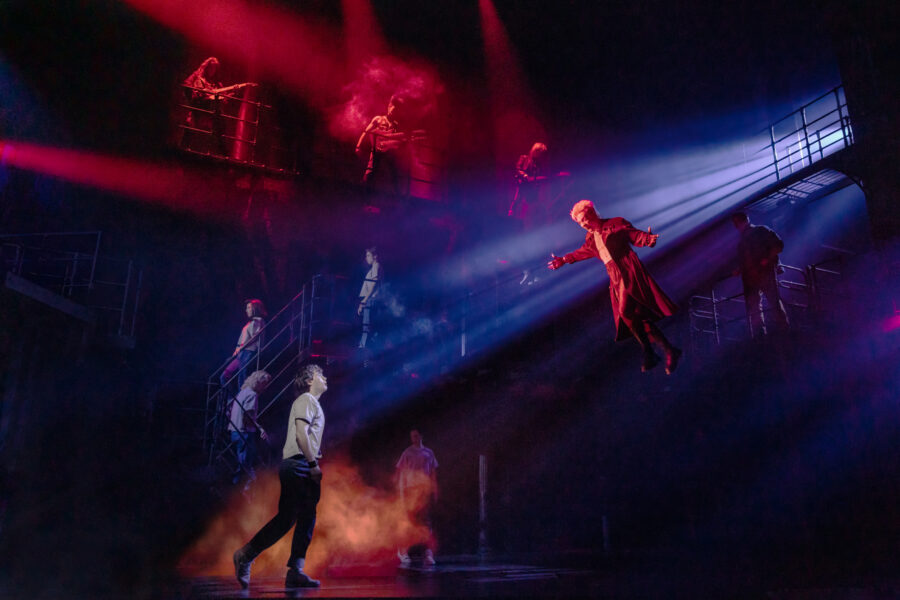
LJ Benet, Ali Louis Bourzgui, and company of The Lost Boys
By: Matthew Murphy

Shoshana Bean, Benjamin Pajak, and LJ Benet in The Lost Boys
By: Matthew Murphy

LJ Benet and Maria Wirries in The Lost Boys
By: Matthew Murphy

LJ Benet and Ali Louis Bourzgui in The Lost Boys
By: Matthew Murphy

Company of The Lost Boys
By: Matthew Murphy


More latest news
-
-

Jen Schriever on the Art of Lighting Flying Vampires in The Lost Boys
How Did I Get Here -

MCC Theater Reveals Judith Champion PlayLabs Reading Series Lineup
Readings and Workshops -

Jack Merrill's The Save, About Surviving John Wayne Gacy, Sets NYC Readings
Readings and Workshops -
Merchant's House Museum to Present Whitman in Love This Pride Month
Off-Broadway News -
Guys & Dolls, Susannah, More in Lyric Opera of Chicago's 2025-26 Season
Classic Arts News
