


Special Features
In Heartbreak Hotel, Breakups Feel Like Psychosis—And Kind of Are
After going through a traumatic breakup, Karin McCracken wrote a play. She's since brought it to London and now Off-Broadway.
April 08, 2026 By Logan Culwell-Block

Heartbreak Hotel is a play about relationships and, as you might assume from its title, heartbreak. It's not the first theatrical work to tackle that subject, nor will it be the last. But its playwright and star Karin McCracken knew she had a unique way in when she endeavored to created the show with director Eleanor Bishop; the duo is jointly New Zealand theatre group EBKM.
"There's heaps of stuff about heartbreak out there," she tells Playbill, "but the stuff that I wanted to watch, which was stuff that felt authentic but didn't make me feel suicidal, stuff that might make me laugh—that was actually pretty rare." McCracken didn't choose her subject matter out of nowhere. Heartbreak Hotel is, in some ways, a theatrical expression of how McCracken got through a particularly bad break-up in real life. She calls the play "semi-autobiographical," which is to say you shouldn't expect to see any specific narrative similarities between her real life and her stage character. But the emotional journey she goes on is deeply steeped in McCracken's real experience.
Heartbreak Hotel is currently making its U.S. premiere Off-Broadway at DR2 Theatre (through April 19) after sell-out runs at Edinburgh Fringe and London's Soho Theatre. The play, at hair-pin turns as funny and relatable as it is devastating, sees McCracken playing an unnamed protagonist that we meet mid-way through an especially protracted process of getting over an ex, an experience that leaves her feeling like she might actually be going crazy. McCracken alternates back and forth from scenes between her character and various men (all played by Simon Leary) to soliloquies that dig into the literal science of what happens to our bodies when we go through moments of intense loss. Turns out those paralysis-like feelings we get in those moments, that inability to think about anything else—there are biological reasons we feel that way. Our bodies have trauma responses that can take us back to some of our basest animal instincts. And when you're accustomed to being at least mostly in control of your emotions, it can feel almost like a kind of psychosis—because it is.
For McCracken, learning this was the first step to being able to get past it. And Heartbreak Hotel looks to give that gift to its audiences, too.
Playbill caught up with McCracken over Zoom to talk about the play, the real-life traumas that inspired it, and why it's important for all of us to recognize that getting past some of life's worst trials means being willing to look them square in the face. The conversation has been edited for length and clarity.

Tell me where this play came from.
Karin McCracken: It’s partly autobiographical. I have to be careful how I frame this, because a lot of it is my experience of being heartbroken. But the stuff around the relationship is in part true to my experience, and part fictionalized. It’s not cleanly one or the other. What is autobiographical is the bare fact of me being heartbroken after a relationship for a long time, actually longer than what’s depicted in the play, which is so depressing. I think there’s a thing with heartbreak. The first few years, I was still functional. I still had a job, I was still doing stuff. But it just felt like it wasn’t right. I got to a point where I realized this couldn’t just be my experience. It has to be a broader phenomenon.
What I found so interesting and honestly recognized in it was the way you talk about heartbreak almost like it’s psychosis. You talk in the play about some of the science behind the emotional experience of a breakup, and hearing you say that.... I just wished I could have known that the last time I was in that place.
Psychosis—yes, that’s right. I felt nuts, because my body was responding in such a disproportionate way, or an unhelpful way. I was constantly getting sick, like with the flu, and other fucking viruses. I went to the doctor thinking I had cardiac disease. They go, “Oh, we think you’re sad.” I did feel kind of nuts, because no one could find a thing that was wrong with me, which made it feel like it was my fault. And I find the science reassuring. Some people don’t. People’s reactions to that are different. But knowing that my body is going to respond to a major separation from someone as if I’m in a life-or-death situation is helpful for me, because I can be kinder to myself knowing that.
It’s so funny hearing you say that, because I feel like you hear stories like that, doctors writing off specifically women’s experiences like that as merely “feeling sad.” But in the context of what was happening to you and what you learned, I also think that you were sad, and maybe that’s something we all should be taking more seriously.
You’ve hit the nail right on the head. That is exactly right. A doctor saying to you, “you’re having chest pain because you are really emotionally distressed.” We can no longer accept that as a minimization. That is the doctor doing their job in many cases, and our response should be that it’s really serious. And then you figure out how to get through that.
What was your process learning all of that for yourself, and turning it into this play?
I come from a research background. I have a law degree, which is so often a strength and a weakness of mine. I just went digging, digging in JSTOR, at scientific articles that I, like, barely understood. And then I asked people who knew more about it to explain it to me—Just a lot of research. And at the same time, I was writing these scenes, separate chunks of work. But I knew from early on making this that I wanted to include the science in the play. I wanted to write something that was soothing for an audience, but still contemporary performance, kind of experimental, maybe more experimental than you would imagine walking in. I wanted it to be formally interesting, formally slightly surprising. So part of that was the science. Part of that is that it’s non-linear—I knew it couldn’t unfold chronologically. Because for me, that was the key to getting through, that I finally had to confront what had happened in the relationship, instead of just chewing on me being sad. It became a shacking together of the bits and pieces and finding ways for them to live together. It was an iterative approach to some extent.

Obviously turning the experience into a dramatic work was how you were going to tackle things because you’re a theatre artist, but it does seem like it was uniquely well-suited to what you’re talking about. You have these scientific monologues, which have this important, factual information. And you’re also telling a dramatic story, so it gives equal importance to the emotion of it. That felt unique to me, and something that theatre uniquely offers.
I think that’s right. It’s why theatre is an essential and useful artform. It’s why I was drawn to theatre as the form for talking about heartbreak. Eleanor and I had done another theatre show called Yes Yes Yes, which is a show for young people about consent and healthy relationships. We were commissioned to make it for teenagers, and I had previously done consent education in high schools. I’d seen the value of that work but also the limitations of it, because it’s actually inappropriate to get too emotional with students in a classroom, and that material is emotional. Talking about the body is important. But schools don’t want you to be talking about the body. Doing the show in a theatre, and suddenly that’s all fair game. You can engage emotionally. People can be upset, and that can be good. You can talk about the body, you can talk about pleasure, you can talk about sex—and it’s okay. That’s been a core understanding for me as a dramatist ever since. I knew that being able to look people in the eye in a theatre would be the most effective way to discuss this.
Obviously there are so many works about love and relationships and heartbreak. Did you know when you started this project that you had something novel to say about it? Were you concerned about being just another play about relationships?
Totally, yes. I would never be as obnoxious to say that I knew straight away that we had something that was different. What I would say is that as someone who had been heartbroken for a long time… there’s heaps of stuff about heartbreak out there. But the stuff that I wanted to watch, which was stuff that felt authentic but didn’t make me feel suicidal, stuff that might make me laugh—that was actually pretty rare. I knew I hadn’t seen anything on stage that was going to approach it in the way that I wanted to approach it. But whether or not that added up to something particularly novel or interesting, I couldn’t know that. You just have to hold your nerve.
Did you write the play after you had processed your own personal situation, or was writing the play part of that process?
Writing the first draft I was doing a lot of crying, which was good. It was helpful. Writing the big argument scene that happens closer to the end of the play, really getting inside the ex’s head in the play, putting myself in the position that that character is in—I found that extraordinarily helpful and healing. Suddenly I had so much more empathy for that position in a relationship than I had from my place. It made me realize that it’s a really complicated dynamic. And it wasn’t something that was just happening to me, and it wasn’t something I was inflicting on someone else. It was a thing, a dynamic that happens between two people.
But there was lots of crying. And then you work through the drafts and it gets further and further away from you, and it gets easier and less raw. I found it really helpful, now that I reflect on it.
And what is it like performing it, revisiting all of this so often?
It’s the same thing as the writing. The more you perform it… it’s not that it gets further away. It’s that you get closer to other things in the performance. My relationship with the audience is so fulfilling for me in the show, talking to them the way that I do. And I’m performing with Simon, who is such a wonderful actor, but also one of my closest friends. So we’re having a lot of fun on stage, and we’re having a lot of fun off stage.
Has the ex who inspired this been able to see the play?
Yes. And it was a really challenging show, and then it felt like a weight had been lifted. The funnier thing is that other exes have come to see the show, and they all go in thinking it’s going to be about them. And then they leave, and I can see it on their face. They’re like, “That was not about me at all.” They look almost gutted. I hope that people in the audience still feel it all. You want to be hyper specific, because that’s where people connect.

So beyond the big journey you go on in this play, what are the smaller things you do when you’re feeling the sadness?
I’m, like many of my generation, partial to a glass of wine. That would probably be something I’d be reaching for, for better or for worse. Healthier options-wise, I’ve been getting into hobbyist painting, like terrible watercolors. I’m not being humble here—awful stuff. But just the process of color, it really does it for me. Simon and I also live together back in New Zealand. If I’m really feeling low, I will ask him to rub my feel. He’s a great roommate. He’s the nicest man alive.
Do you wish that you had known what you know now when this relationship started, or are you glad you went on the journey you did?
It was a major moment in my life, like the major event of my 20s into my 30s, the scene of the most pain I’ve experienced, the most lack of clarity and lack of certainty. But without that, I wouldn’t be here, and I don’t think my life would look the way that it looks now. And I really like my life. I am so grateful for that.
And you turned it into this thing that you’ve now performed internationally and has been a great gig.
Yes. And I get so much joy out of performing it and sharing it with people. Sometimes the gnarliest thing is to shed the ankle weights, because the ankle weights feel super safe. You can’t know what you’ll do being really sad and scared until you’re really sad and scared. I think if I had been less sad and scared, I don’t think I would have made a big swing for a full-time career in the arts. All in all, it has turned out to be a very good use of the pain.
Visit HeartbreakHotelPlay.com.
Photos: Heartbreak Hotel Off-Broadway

Karin McCracken in Heartbreak Hotel
By: Evan Zimmerman

Simon Leary and Karin McCracken in Heartbreak Hotel
By: Evan Zimmerman

Karin McCracken in Heartbreak Hotel
By: Evan Zimmerman

Simon Leary and Karin McCracken in Heartbreak Hotel
By: Evan Zimmerman

Karin McCracken and Simon Leary in Heartbreak Hotel
By: Evan Zimmerman

Karin McCracken in Heartbreak Hotel
By: Evan Zimmerman



More latest news
-
Jeremy-Daniel.jpg)
Get a 1st Look at The Balusters on Broadway
Production Photos -

In Heartbreak Hotel, Breakups Feel Like Psychosis—And Kind of Are
Special Features -

-

-
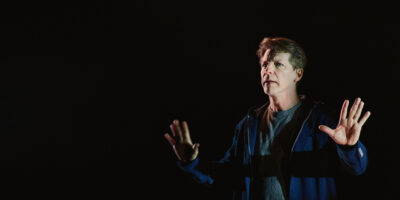
Sean Hayes Solo Play The Unknown Recoups Off-Broadway
Off-Broadway News -
Jeremy-Daniel.jpg)
