Off-Broadway News
He’s a Playwright, His Mother’s a Physicist—And They’re Performing a Show Together
Shayok Misha Chowdhury and Bulbul Chakraborty created Rheology so they could spend more time together.
April 16, 2026 By Diep Tran

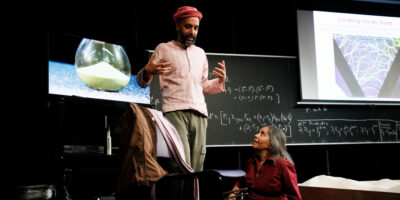
You might think that when playwright Shayok Misha Chowdhury asked his mother to be in his play, it would be a hard ask. But actually, it was pretty easy. “Everyone's always like, ‘How did you rope your mom into doing this?’ It really was like, can we make a physics meets theatre thing that interests the two of us?” He then turns to his mom, Bulbul Chakraborty, who’s sitting next to him, “and you were really game.”
Chakraborty, who is a physics professor at Brandeis University, nods, remarking: “I didn't think I would be able to do it, but then it kind of surprised me that I could, and it didn't kill me,” she softly chuckles.
It didn’t kill her; she won an award for it. Chowdhury and Chakraborty premiered their play Rheology last year at the Bushwick Starr in Brooklyn. After rave reviews, and Chakraborty winning an Obie Award for her performance—the mother-son son duo are now bringing Rheology back, at Off-Broadway’s Playwrights Horizons through May 15.
Jokes Chowdhury: “I think [Playwrights Horizons] has more seats than we had at the Starr. Slowly we're working our way up, then Broadway!” Chakraborty quickly shakes her head, her eyes wide with fright.
Though she’s given lectures for decades, performing on a stage was never a goal for Chakraborty, who came to the U.S. from India in 1974 on a student visa. She eventually met her husband, Partha Chowdhury, also a physicist and professor; Shayok is their only child.

When he decided to pursue theatre, his parents didn’t try to dissuade him. “I got an undergraduate degree at Stanford and then an MFA at Columbia in theatre,” says Chowdhury. “My sense was always that that was quite reassuring to my parents as academics. They were kind of fine with me following whatever path. I think it would have been very different if I'd chosen not to go to college or not to go to grad school.”
Chimes in Chakraborty, “My husband and I talked many times about the fact that we didn't know what this professional career would look like. We knew how to advise someone to navigate an academic career in the sciences and being in academia. I knew that the sciences and the creative arts had very different trajectories.”
So Chowdhury’s success in the past few years with his work has been of great comfort to his mother. He was named a 2024 Pulitzer finalist for his play Public Obscenities, and he just received a Lucille Lortel nomination for his work directing Prince Faggot, which got a lengthy Off-Broadway run last year. Says Chakraborty, looking at her son fondly: “This probably means, keeping our fingers crossed, there is a solid ground that he's standing on.”
Though Rheology takes its title from a physics term (Chakraborty in the play calls it “the science of how matter responds to external stresses”), it’s actually an exploration of a loving mother and son relationship. In the play, Chowdhury says—half joking, half serious—he cannot stand the thought of his mother one day dying and so, “What I have done is forced her to be in a show with me, so we can spend more time together. Because as long as we’re doing this show she is literally, contractually obligated to be alive.” Not to spoil the turns, but the play goes from a physics lecture to a quietly beautiful meditation on mortality and family.
In 2020, Chowdhury received a HERE Arts Center residency to develop something with his mother. Then during the pandemic, the playwright moved back in with his parents in Massachusetts for five months, though he admitted they didn’t work much on that play then: “We were already spending time together. So we didn't really need to be making this piece together.”
But then, after the theatre industry resumed, he felt surprisingly sad at the thought of not seeing his parents every day. Coupled with the 2023 death of Chakraborty’s brother (who was the inspiration for Public Obscenities), mortality became the uncomfortable topic in the room; his mother is now 72. “We spent so much time together during COVID,” explains Chowdhury. “And then suddenly we weren't spending that kind of time together anymore. And it was like, how much time do we really have left together? And if we do this show, then we will be forced to spend time together again.” (Chakraborty chimes in with “yes” as her son is speaking.) “Using the fact of this project to create more time for ourselves in this lifetime, then that became, ‘Maybe that's what the show is about.’”

Granted, even though the two were both glad to spend more time together, making the show wasn’t a smooth process. For one, it required them to reverse their typical dynamic, since Chowdhury was directing the piece. As he exclaims: “When was the last time my mom was in a room and that she wasn't in charge of?”
Agrees Chakraborty, saying lightly as her son smiles: “I'm not a very patient person. That’s actually something that this process made me become better at.” She’s also been surprised to learn that she, who always considered herself a very serious lecturer, can make people laugh.
Rheology begins with Chakraborty giving a lecture about the unique qualities of sand, how it can behave as both a liquid and a solid, depending on what kind of pressure is placed on it. It’s a lecture the physicist has given numerous times before. While the typical assumption that science and theatre go together like oil and water, Rheology shows just how much the two disciplines have in common. Notes Chowdhury: “There is a similar experience of, like, creativity and wonder in what my mother is engaged in—even if I didn't understand the mechanics, I sort of understood a parallel feeling of obsession.”
Chakraborty agrees, saying excitedly, “Often non-scientists think of scientists as being either magicians or technicians. The fact that there is a creative obsession is not so well known…For me, the obsession is about creating things.”
So, six-and-a-half years after they first had the idea to work together, the play that Chakraborty and Chowdhury set out to create has expanded beyond their initial hypothesis. It’s gotten them awards, notoriety (they’re going to perform it at REDCAT in Los Angeles after this Off-Broadway run), and brought them closer together. What began as a gift of time together has become a gift of mutual understanding.
When asked what the two have learned about each other through working on Rheology, they look at each other. There’s a playful pause, as if they’re egging each other to go first.
Chakraborty answers first, saying confidently, as if she’s thought about this before: “I have learned how you function as a professional, not just directing me, but how you work with designers. It’s interesting to me that you have a picture in your head, and then you're trying to talk to the designers and they are translating the picture in your head to something that happens. It kind of reminds me of theories that I have had in my head, and I'll go and talk to my experimental colleagues and say, ‘This is what I'm thinking about. Is this something that you’ve measured?’ But also, I think, you're not a little kid, you're not just my son. You are you. It's amazing to see what your world is and how you work with your colleagues.”
In response, Chowdhury looks to the ground, sheepishly, before admitting, “I’m trying to think….” He pauses, then says, slowly: “I do think of you primarily as my mother. The piece itself reflects a coming to an awareness of the fact that you are not just my mom, you were a person that existed before me.” He then pauses again, looking at his mother, touching her arm—self-conscious at having to say all of this out loud. “It makes me aware of the fact that my hypersensitivities, the things that annoy me about you, then seeing you interact with my collaborators and how everyone gets along with you. Like, there's a, I don't know…. Getting to see you through my colleagues’ eyes has made me realize how flawed our view of each other might be.”
He then turns to me, happily, “To get to be colleagues, to get to collaborate, is a thing I never would have expected. When do you actually get to really work with your mom in that way?”
Photos: Rheology at Playwrights Horizons

Bulbul Chakraborty in Rheology
By: Maria Baranova

Bulbul Chakraborty in Rheology
By: Maria Baranova

Bulbul Chakraborty in Rheology
By: Maria Baranova

Shayok Misha Chowdhury and Bulbul Chakraborty in Rheology
By: Maria Baranova

Shayok Misha Chowdhury in Rheology
By: Maria Baranova

Shayok Misha Chowdhury in Rheology
By: Maria Baranova

Band member in Rheology
By: Maria Baranova

Shayok Misha Chowdhury in Rheology
By: Maria Baranova

Bulbul Chakraborty in Rheology
By: Maria Baranova


Shows mentioned in this article


More latest news
-
Schedule of Upcoming and Announced Broadway Shows
Broadway News -
The Full Monty to Return to Broadway
Broadway News -
-

-

Cat Cohen's Broad Strokes Will Have Limited Off-Broadway Run
Off-Broadway News -