

Special Features
From Shuffle Along to A Strange Loop: Black Broadway History Is on Display at the New York Public Library for the Performing Arts
Get a close look at Syncopated Stages: Black Disruptions to the Great White Way, which features over 250 objects.
February 05, 2026 By Doug Reside

While the nickname “the Great White Way” historically refers to the dazzling electric lights of Broadway, the phrase often also suggests the way many histories of New York theater center white artists. In the current exhibition, Syncopated Stages: Black Disruptions to the Great White Way (on display until February 21, 2026), The New York Public Library for the Performing Arts at Lincoln Center explores how Black artists shaped the New York musical theatre stage over the past three centuries.
This exhibition was curated by Michael D. Dinwiddie, an award-winning playwright, composer, and scholar of Black theater, using the archives of the Billy Rose Theatre Division. The show includes objects from 1825 to the present day, with interviews with current Broadway stars and material from Michael R. Jackson’s 2019 Pulitzer Prize-winning musical, A Strange Loop, and George C. Wolfe’s revival of Gypsy with Audra McDonald.
Dinwiddie passed away on July 4, 2025, before Syncopated Stages opened, and a panel of advisors that had been working on the show since its conception helped to finish the exhibition. The advisory panel includes Britt Dixon, Caseen Gaines, Michael McElroy, A.J. Muhammad, Arminda Thomas, and Ben West.
Get a sample of the exhibit below, and scroll down for more information on each item. These images are just a small fraction of the over 250 objects in the exhibition that document Black genius on Broadway.
On February 9, Black Theatre United will celebrate Black History Month with a one-night-only talkback about Syncopated Stages led by BTU Founder and Vice President Michael McElroy, who will discuss the significance of the exhibit, the curatorial process, and the historical impact of the works on display. The talkback is free, though advance registration is required by clicking here.
Visit NYPL.org for more information about the exhibit.
Photos: Explore Black Musical Theater History Through the Library for the Performing Arts Archive

Pencil rendering of a scenic design for the musical Street Scene. Design by Jo Mielziner (1947)
By: The New York Public Library for the Performing Arts

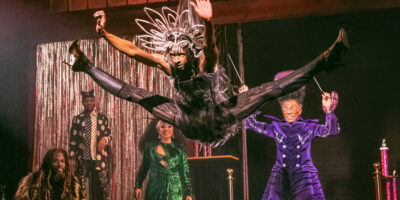
Usher costume from the original Broadway production of A Strange Loop. Design by Montana Levi Blanco (2022)
By: Jonathan Blanc / NYPL

Costume design for Buddy in Jelly's Last Jam. Design by Toni-Leslie James (1991)
By: The New York Public Library for the Performing Arts

Program for the performance of Don’t Bother Me, I Can’t Cope at the Library for the Performing Arts two years before its Broadway run (1970)
By: Design by The New York Public Library for the Performing Arts

Chapbook for The Wiz. Design by Ken Harper (1970s)
By: Jonathan Blanc / NYPL

Costume for André De Shields in Ain’t Misbehavin’: The New Fats Waller Musical Show. Design by Mary Bassel (1978)
By: Jonathan Blanc / NYPL

Thalmus Rasulala (then known as Jack Crowder), Emily Yancy, Pearl Bailey, and Winston DeWitt Hemsley in the 1967 cast of the original Broadway production of Hello, Dolly!
By: Friedman-Abeles

Costume and shoes for Lisa La Touche in Shuffle Along, 2016. Costume design by Ann Roth. Shoes by LaDuca Shoes.
By: Jonathan Blanc / NYPL

Scenic design for Shuffle Along. Design by Perry Watkins (1945)
By: The New York Public Library for the Performing Arts

Bubbling Brown Sugar tour program. Designed by George Breslow Associates, NYC (1977)
By: The New York Public Library for the Performing Arts

Advertisement for Out of Bondage. Lithograph by J.E. Baker (1876)
By: The New York Public Library for the Performing Arts

Portrait of Aida Overton Walker (1910)
By: The New York Public Library for the Performing Arts
Out of Bondage

One of the earliest musicals featured in the exhibition is 1876’s Out of Bondage, a piece commissioned for and regularly performed by the Hyers Sisters, Anna Madah and Emma Louise. In the years immediately after the end of the Civil War, from 1871 until about 1893, the sisters toured the United States in various musicals and variety shows.

In the first decade of the 20th century, many of the most popular musicals on Broadway were written by Black composers and writers, including Will Marion Cook, Paul Laurence Dunbar, Bob Cole, J. Rosamund Johnson, Bert Williams, and George Walker. Many of these men were married to women who appeared in their shows and likely helped to shape the work for which their husbands are credited. Aida Overton, shown here, met her husband George Walker as a teenager when both were appearing in touring acts. The couple appeared together in many musicals, and Aida also provided the musical staging for Abyssinia and Bandanna Land (in which George also appeared). When her husband died in 1910, Overton Walker continued to perform and, in the last years of her life, earned renown as a male impersonator.

In the 1920s and 1930s, many Black performers got their start in the nightclubs that flourished both in Harlem and in midtown. The 1977 musical Bubbling Brown Sugar celebrated the music of this period, and the souvenir program produced for the national tour included a map showing the locations of many of these stages and highlighting how densely packed Harlem was with performance venues during this period.
Shuffle Along, 1945

In 1939, scenic designer Perry Watkins became the first Black scenic designer in the professional union after designing the sets for the Broadway play Mamba’s Daughters by Dorothy and DuBose Heyward, who had also written the play on which the opera Porgy and Bess was based. In 1945, he designed the sets for a USO production of the 1921 hit Shuffle Along to entertain the troops in the final months of World War II.
Shuffle Along costumes

In 1921, at the 63rd Street Music Hall (near what is now the site of The New York Public Library for the Performing Arts) the musical Shuffle Along, written and performed by Black artists, became the hit of the season. Composer Eubie Blake and lyricist Noble Sissle worked with bookwriters Aubrey Lyles and Flournoy Miller, to expand a comedy sketch by Lyles and Miller into a full-length piece that helped to renew popular interest in Black musicals after many of the creators from the first ten years of the century had died. In 2015, director and playwright George C. Wolfe created a painstakingly researched musical that told the story of the making of the show and recreated many of the costumes from the original production. One of these costumes, designed by Ann Roth and worn by Lisa La Touche, is on display in the exhibition.

In 1946, several musicals created by Black artists opened on Broadway, including St. Louis Woman (with a book by Arna Bontemps and Countee Cullen), Bal Nègre (directed and choreographed by Katherine Dunham), and Beggar’s Holiday (produced by Perry Watkins with a score by Duke Ellington). Also that year, Street Scene, an adaptation of Elmer Rice’s play of the same name with music by Kurt Weill and lyrics by Langston Hughes, opened in Philadelphia, later transferring to Broadway in January of 1947. Street Scene was Hughes’s second Broadway show and the first of the four musicals he wrote that appeared on Broadway. This scenic design by Jo Mielziner (who also designed the sets for South Pacific, Carousel, and Guys and Dolls among many other musicals) suggests what audiences would have seen on stage in 1947.

In 1967, David Merrick, the producer of Hello, Dolly!, recast his hit musical with an all-Black company led by House of Flowers star Pearl Bailey. Even on its opening night, though, the musical owed much of its success to Black talent. Merrick retitled the show from its clumsy original title Dolly, A Damned Exasperating Woman, to Hello, Dolly! after Louis Armstrong’s cover of that song became a hit and introduced the show to audiences across the nation. Additionally, although unknown to the public in the 1960s, the original Dolly Levi, Carol Channing, was the granddaughter of a Black woman.
The Wiz Chapbook

In the early 1970s, radio disc jockey Ken Harper, inspired by the success of the Black recasting of Hello, Dolly!, sought to develop a reimagining of another traditionally white story: The Wizard of Oz. He created a small, hand-colored “chapbook” to interest potential investors in his project.
For the exhibition, we recreated the full “chapbook” and placed it on one of the walls for visitors to study up close.
Ain't Misbehavin' jacket

Throughout the 20th-century, jukebox musicals, which interpolate an existing catalog of songs into a newly written story, often provided a space for music written by Black composers to be performed by Black actors, even at times when Broadway was otherwise an unwelcoming space for Black talent. Arranging pop songs into a theatrical score was often the work of a handful of Black artists: Luther Henderson, Linda Twine, and, later, Joseph Joubert (Motown), Shelton Becton (Lady Day at Emerson's Bar and Grill), Daryl Waters (After Midnight), and Zane Mark (Holler if Ya Hear Me). Our exhibition, Syncopated Stages, celebrates the often-overlooked work of these artists with an entire room dedicated to the jukebox musical (complete with a free and functioning jukebox). Artifacts from many of these shows are also on display, including André De Shields’s own show jacket for Ain’t Misbehavin’.
Don't Bother Me, I Can't Cope Program

After achieving success as a songwriter for the 1961 pop hit, “Pink Shoelaces,” and as an actor in California and New York, Micki Grant met Vinnette Carroll, the director of the Urban Arts Corps, a small Manhattan-based theater company. Carroll conceived a small musical revue with songs by Grant titled Don’t Bother Me, I Can’t Cope, which had a very early production at the Library for the Performing Arts in October of 1970. In 1972, the show was produced on Broadway—Carroll directed, and Grant was in the cast. It ran for over two years and earned four Tony nominations. Grant went on to write two more Broadway musicals and many more musicals for the Urban Arts Corps and other Off- and Off-Off-Broadway companies.
Jelly's Last Jam costume design

The work of producer, director, and playwright George C. Wolfe could easily fill an entire exhibition, but Syncopated Stages showcases a few highlights of his musical theater creations, including his first Broadway credit, Jelly’s Last Jam. The musical tells the story of jazz musician, Jelly Roll Morton. In the musical, HE is forced to review his life and behavior while in a kind of purgatory after his death. The exhibition includes several costume designs by Black costume designer Toni-Leslie James, who also started her Broadway career with this musical before going on to design costumes for the Broadway premiere of Tony Kushner’s play Angels in America, a production also directed by Wolfe.
A Strange Loop costume

Michael R. Jackson’s semi-autobiographical musical A Strange Loop tells the story of a young, gay Black man attempting to write a musical about his own life experiences. Throughout the musical, the protagonist, Usher, grapples with his ambivalent memories of and relationship with the church in which he was raised. Toward the end of the show, Usher imagines a gospel-inspired production number in which a choir sings what Usher was taught in his church and by his family: “AIDS is God’s punishment” for gay sex. The exhibition features a banner from this number as well as the costume Usher wears when ushering for The Lion King.
Doug Reside is the Billy Rose Theatre Division Curator at the Library for the Performing Arts.



Shows mentioned in this article


Read more stories about
More latest news
-

Schedule of Upcoming and Announced Broadway Shows
Broadway News -

What’s Currently Playing on Broadway
Insider Info -
-
John Patrick Shanley's The Pushover Extends World Premiere Off-Broadway
Off-Broadway News -
-

Schedule of Upcoming London Shows
International News
