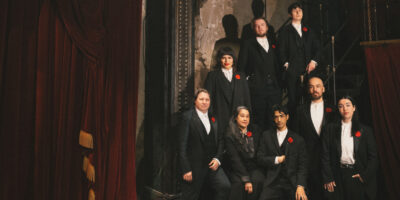
Nadine Sierra stars in one of opera’s ultimate soprano roles, the sleepwalker at the heart of Bellini’s La Sonnambula, on stage October 6 through November 1. In his first Met production, Rolando Villazón—the renowned singer who has embarked on a parallel career as a stage director—brings new vigor to Bellini’s poignant drama, probing the psyche of the opera’s heroine and the suffocating community she can escape only in her dreams.
Following a streak of Met triumphs that has included the title role of Donizetti’s Lucia di Lammermoor, Violetta in Verdi’s La Traviata, Juliette in Gounod’s Roméo et Juliette, and Gilda in Verdi’s Rigoletto, Nadine Sierra summits another peak of the soprano repertoire this season as Amina, the sleepwalking heroine of Vincenzo Bellini’s 1831 masterpiece La Sonnambula. Widely regarded as one of the most demanding roles in all of opera—calling for ethereal high notes, crystalline coloratura, and a bewitching stage presence—Amina is at her most captivating and soul-stirring in two sleepwalking episodes, during which Sierra will lay bare the heroine’s distressed inner psyche: a tempest of fear, passion, and longing.
For centuries, scientists, physicians, and philosophers have wrestled with the mystery of sleepwalking, which was often explained as an affliction of the soul or as the work of supernatural forces. In the 18th century, the German thinker Carl Reichenbach linked it to his theory of the “Odic force”—a mystical energy named after the Norse god Odin—while in 1917, Sigmund Freud suggested that it was the body acting out repressed desires from the dream world. Literature and theater, too, have long mined the image of the sleepwalker: In Act V of Shakespeare’s Macbeth, wandering the castle in a trance, Lady Macbeth relives the murders of King Duncan, Banquo, and Lady Macduff. “All the perfumes of Arabia will not sweeten this little hand,” she laments, while her doctor concludes that she requires spiritual, not medical, treatment.
It is little wonder, then, that the sleepwalker—poised between reality and dream, reason and intuition—emerged as a rich and complex motif in Western art, especially in the 19th century. Vienna Secession painter Maximilian Pirner depicted a woman precariously perched on her balcony in his 1878 The Sleepwalker. American writer Charles Brockden Brown frequently used sleepwalking as a way to explore his characters’ psychological turmoil. And in 1827, French dramatist Eugène Scribe and choreographerJean-Pierre Aumer produced the ballet-pantomime La Somnambule, ou l’Arrivée d’un Nouveau Seigneur, which inspired Bellini’s La Sonnambula.
In the Met’s new production, the the mythology of somnambulism and the opera’s dramatic sleepwalking scenes provide director Rolando Villazón the perfect vehicle to plumb the psychological depths of the drama’s leading lady. Amina, the emotional core of La Sonnambula, is engaged to Elvino, a fellow villager. Unbeknownst to him, Amina is a sleepwalker, and her semi-conscious nighttime wanderings through town have led the villagers to believe they are haunted by a phantom. But when Amina innocently sleepwalks into the room of the visiting Count Rodolfo, her virtue is called into question, and Elvino calls off the engagement. The truth is revealed, however, in a final act of sleepwalking witnessed by the entire town—along with the worldly Rodolfo’s scientific explanation of the phenomenon—restoring Amina’s honor and leading to a joyful reconciliation with Elvino.

“I want an Amina who doesn’t belong despite her best efforts to fit in,” Villazón says, now directing his 14th production while continuing his already remarkable career as a singer both on the Met stage and at leading opera houses around the world. “She is an unmarried outsider adopted by a widow, making for an entire household without a man. This poses a danger to this community.” The community, in Villazón’s vision, is conservative and parochial, with specific rules, stringent values, and very particular moral codes. “Unable to fully express herself,” he says, “Amina sleepwalks, entering a subconscious state in which she finds complete freedom—and making her even more incredibly dangerous to this strictly regulated world.”
Even for one of the world’s finest sopranos, Amina poses forbidding challenges. Sierra says that mastering the role—which combines showstopping virtuosity with the ability to embody a sweeping emotional arc—required “facing inner doubts about my artistry, my singing, and my capabilities.” Once she had overcome those hesitations, however, she found that the role was a perfect fit. “Amina feels so comfortable and natural for my voice,” says Sierra. “There have also been periods in my life where I have felt that certain relationships or the realities of the world around me aren’t easy to handle, and there can be mental consequences. I try to put some of that into my portrayal.”
Sharing the stage with Sierra as Elvino is rising star tenor Xabier Anduaga, who returns to the Met after a standout 2023 debut as Nemorino in Donizetti’s L’Elisir d’Amore.
Sierra is looking forward to reuniting with one of her favorite stage partners, having performed Sonnambula with Anduaga twice before, in Madrid and Barcelona. “We’re kindred spirits. We admire each other, we laugh all the time, and we also support each other on the stage,” she says. Singing Lisa, Amina’s rival for Elvino’s love, is soprano Sydney Mancasola, and completing the principal cast is bass Alexander Vinogradov as the cosmopolitan (and flirtatious) Count Rodolfo. Leading Italian maestro Riccardo Frizza takes the podium.

Villazón’s choice of a two-tiered set, designed by Johannes Leiacker, immediately immerses the audience in the village’s confining atmosphere: A snow-capped background representing the Swiss Alps towers over a town square hemmed in by tall walls with closed doors, a solitary ladder the only means of egress. “The square gives a sense of claustrophobia,” the director says. “You cannot leave this place.” The costumes, too, by designer Brigitte Reiffenstuel, emphasize the conservatism of the community with plain attire in muted grays, blacks, and blues. Even children at play are tightly regulated. “They are told how to play, how to jump, how to laugh,” Villazón explains.“They can express happiness, but it has to fit within the bounds of their society.”
The chorus also plays an important role in the drama—a noteworthy feature of La Sonnambula compared with Bellini’s other operas. Taking the part of the villagers, the chorus behaves similarly to that of Greek theater, commenting on the action and providing context and emotional depth. In La Sonnambula, though, the chorus is a mercurial group, and Villazón maximizes their narrative potential. “I give each of them a character,” he says. “It’s not a mass of people; it’s individuals coming together to tell this story.” They joyfully cheer Amina’s engagement to Elvino at the beginning of Act I only to shun her by intermission, and then gleefully celebrate her once more in the opera’s triumphant finale. “The presence of the chorus in La Sonnambula is humongous, and I’m really looking forward to working with the marvelous Met Chorus.”
Bellini reaches his peak during Amina’s two sleepwalking scenes—both tremendous displays of the composer’s compositional style and opportunities for the star soprano to show off her virtuosity. These gripping scenes reveal Amina’s deep inner conflict between the desire to belong and the need to be her authentic self. Invoking Freud, Villazón explains that “her sleepwalking bypasses the superego and allows her to be the woman she truly wants to be.” The director uses these episodes—Amina’s innocent nighttime intrusion into Rodolfo’s room in Act I and her daring crossing of an unstable bridge in Act II—to explore the soprano’s subconscious yearning for freedom beyond the village’s suffocating constraints.
To further illustrate Amina’s repressed desire to flee the village, Villazón introduces a spectral double, a spirit he refers to as the “call of the wild.” Throughout the sleepwalking scenes, the spirit calls to Amina from the upper level of the set, beckoning her toward the outside world. In Villazón’s concept, Rodolfo also represents life beyond the village and a worldview in which science trumps superstition, evident in his arrival byway of the ladder and his explanation of the nature of sleepwalking in Act II.
The scenario posed by Villazón’s new production serves as a poignant reminder of our current world, the ever-widening rift between fact and pseudoscience, and our increasingly arduous struggle to separate what is grounded in truth from what is based on fallacy or malicious invention. “In this community, science is the enemy,” Villazón says. “Books and education are enemies.” As the village’s regressive ethos comes into focus, so do the opera’s contemporary parallels. When Rodolfo presents the truth about Amina’s condition, Elvino and the villagers quickly and unthinkingly dismiss it as fake news: “We can’t believe such tales. Someone sleeping while walking! It’s not so, it can’t be.” In this staging as in the world today, the demonization of difference and determined belief in falsehoods drive individuals apart and society into darkness.
In Villazón’s thought-provoking vision, La Sonnambula emerges as a meditation on freedom, belonging, self-belief, and enlightenment. “Will Amina free herself,” asks Villazón, “or will she conform?” It is a question that leaves us pondering not only what Amina’s choice might be when she awakens, but also what we ourselves might discover when we do.

Xabier Anduaga and Nadine Sierra in La Sonnambula at the Metropolitan Opera

Xabier Anduaga and Nadine Sierra in La Sonnambula at the Metropolitan Opera

Nadine Sierra, Sydney Mancasola, and Xabier Anduaga in La Sonnambula at the Metropolitan Opera

A scene from La Sonnambula at the Metropolitan Opera

Xabier Anduaga and Nadine Sierra in La Sonnambula at the Metropolitan Opera

Nadine Sierra in La Sonnambula at the Metropolitan Opera

Nadine Sierra in La Sonnambula at the Metropolitan Opera

Nadine Sierra in La Sonnambula at the Metropolitan Opera

Nadine Sierra in La Sonnambula at the Metropolitan Opera

A scene from La Sonnambula at the Metropolitan Opera

Nadine Sierra in La Sonnambula at the Metropolitan Opera

Nadine Sierra and Niara Hardister in La Sonnambula at the Metropolitan Opera

Nadine Sierra, Alexander Vinogradov, and Sydney Mancasola in La Sonnambula at the Metropolitan Opera

A scene from La Sonnambula at the Metropolitan Opera

Nicholas Newton and Sydney Mancasola in La Sonnambula at the Metropolitan Opera

Alexander Vinogradov in La Sonnambula at the Metropolitan Opera

Sydney Mancasola in La Sonnambula at the Metropolitan Opera