Chicago News
David Byrne Created an Immersive Show, Inspired By His Own Life
Theater of the Mind asks audiences to explore a 15,000-square-foot warehouse.
March 27, 2026 By Emily McClanathan

With the proliferation of AI-generated content in recent years, it feels increasingly difficult to trust the evidence of one’s own eyes and ears, as altered images and deepfake videos compete with trustworthy sources of information. Perhaps it’s as good a time as any to examine how human senses and memories really work, and the surprising ways in which they shape individual identities. Theater of the Mind, an immersive theatrical experience that opened in Chicago March 11 and runs through July 12, dives into these questions with an approach that combines neuroscientific research and interactive storytelling.
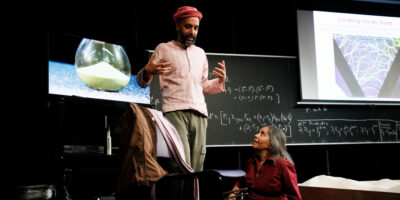
David Byrne—the Academy, Grammy, and Tony Award-winning artist best known as the front man of the new wave band Talking Heads—co-created the project with writer Mala Gaonkar. Over several years, they workshopped various formats until landing on the concept that a small group of audience members would move through the experience together, with a solo actor as their guide. Following the production’s 2022 world premiere in Denver, directed by Andrew Scoville, Chicago’s Goodman Theatre programmed Theater of the Mind as part of its 2025–26 centennial season, with hopes for a long run. Performances takes place in a 15,000-square-foot, custom-renovated space on the first floor of the Reid Murdoch Building, a former warehouse that was constructed in 1914 and is a designated Chicago Landmark.
Byrne’s initial interest in questions of perception and identity was sparked by reading about “Being Barbie,” a Swedish experiment in which humans, assisted by virtual reality, could feel a sense of embodiment within a small doll. Meanwhile, in her career as an investor in health technologies, Gaonkar was fascinated by new economic and psychological research into how people make decisions. When a mutual friend brought them together, Byrne and Gaonkar began to brainstorm how to bridge these fields in a way that wouldn’t feel like a science lecture but rather, an accessible experience for the general public.

Their development process involved consulting with over a dozen research labs to identify experiments in which audience members could participate in real time, each intended to demonstrate the malleability of what people see, feel, taste, smell, and hear. “All of the senses are going to be exposed as unreliable narrators, and we’re going to, together, try to understand what the implications and the freedom of that is,” says Scoville, who returns as director for the show’s Chicago run.
Of course, a series of experiments alone doesn’t constitute a piece of theatre; there also has to be a story to draw people in. “We had to find a balance between the facilitation and exposition—look here, put your hand here, stand over there—and an emotionally engaging story,” Bryne shared in an email. “There had to be a narrative reason why you had to stand there or look over there. We discovered that the experiences were all telling us over and over, if we’re made of our memories and our memories are subject to revision and change, doesn’t that mean we ourselves are not who we thought we are?”
Theater of the Mind follows key moments in the life of one character, played by an actor-guide, beginning at the individual’s funeral and moving in reverse chronology. This character is named David, and several scenes are inspired by Byrne’s own life, but the material is not strictly autobiographical. David will be played by actors of various ages, genders, and ethnicities, and the plot is meant to be somewhat universal. Scoville says that the goal is “not trying to understand how this person’s mind works, it’s trying to understand how the mind works.”
Ultimately, the show’s creators hope that its scientific aspects will prompt audiences to reflect on broader ideas, such as that nothing is fixed and change is always possible. “It’s a big question. Who are we? What are we made of in terms of our sense of self?,” suggests Gaonkar. “Almost no story makes sense without, in some way, the characters interrogating those kinds of very deep questions. Malleability is very much what we wanted to tap into and what I think all great fiction taps into.” Echoing this sentiment, Byrne points to a quote from a monologue that Gaonkar penned for the character of the guide: “We’re not stuck.” In other words, says Byrne, “We have the possibility of change.”


More latest news
-
Proof Opens on Broadway April 16
Broadway News -

-
Schedule of Upcoming and Announced Broadway Shows
Broadway News -
The Full Monty to Return to Broadway
Broadway News -
-