Lincoln Center’s Visionary Artist for the 2025–26 season is yet another astonishing artist—like Terence Blanchard and Rubén Blades, the first two honorees—who embodies the transformative power of the arts organizations on campus.
Composer Jeanine Tesori has had her share of accolades, winning Tonys for her scores for the Broadway musicals Kimberly Akimbo and Fun Home, the latter also a Pulitzer finalist for Drama along with Soft Power. She’s also had Broadway hits like Thoroughly Modern Millie and Shrek the Musical, and she was the first woman to have a commissioned opera staged at the Met with last season’s Grounded. Returning to Lincoln Center for a season-long celebration of her work is also a homecoming. “A lot of pivotal events have happened to me at Lincoln Center,” Tesori says. “When I first moved here at 17, I would walk around the campus, go by the fountain and think about who is here and what they do. Now I’ve returned—and it’s sort of astonishing to me about what can happen."
Video: How Jeanine Tesori Became the Most-Awarded Female Composer in Broadway History
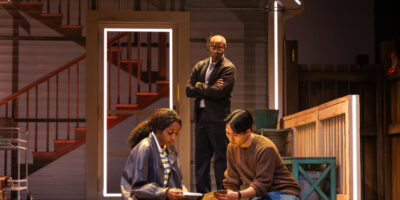
Among the events planned for this season include a concert version of Blue, the opera Tesori composed to Tazewell Thompson’s libretto that explores the eternally complex subject of race through a contemporary lens (November 15, David Geffen Hall). “We are inviting cross-genre singers so it’s not primarily opera singers in the cast,” Tesori explains. “Singers on Broadway are not just Broadway singers—they have deep musical connections: folk, opera, church music, soul, pop. [This performance] is a celebration of that diversity."
There will also be a performance of the musical Violet (March 20, Alice Tully Hall), which premiered Off-Broadway in 1997 and starred Sutton Foster in its 2014 Broadway premiere, although Tesori says that there is a Lincoln Center connection as well: The first workshop of Violet was at one of The Juilliard School’s theatres in the early ’90s. Deaf Broadway, which uses American Sign Language to make classic musical theatre works more accessible, will tell this story of a disfigured young woman trying to find her place in a world as an outsider. The musical will have special resonance in this context, and Tesori freely admits that “it was their idea [to perform it], which is another artistic lesson: A lot of ideas are generated by others, not me.”
Shanta Thake, Lincoln Center’s Executive Vice President and Ehrenkranz Chief Artistic Officer, also notes that Tesori’s story is one of continued connections among artists and institutions. “There’s a deep curiosity that she’s had for both creation and curation,” Thake explains. “She’s still curious about her own work and who gets to participate in it—pigeonholing artists is something she’s really interested in exploding.”
As an example, Tesori is also an Arnhold Creative Associate at Juilliard this season, and as part of the school’s second annual Fall Festival, she hosted Juilliard at Joe’s Pub: Songs From the Tesori Sessions, featuring several Juilliard drama students (September 17). The Visionary Artist season also features a community choir series that will include opportunities for audiences to participate as well as a conversation series, the first of which, entitled Reimaging Justice, will explore institutional racism related to the opera Blue (November 7, David Geffen Hall).
Also scheduled (date TBA) is a screening of West Side Story, directed by Steven Spielberg, in collaboration with Film at Lincoln Center. Tesori’s experience as supervising vocal producer working with Spielberg on the film was quite memorable. “The thing I loved about working with him is that, for all his confidence as a director, he was willing to say ‘I really don’t know’ at times,” she explains.
“And since the crew was all from film and the cast was all from theatre, it was really like the Jets and the Sharks on the set.”
Being honored as this season’s Visionary Artist means a lot to Tesori. “Looking at what I value and what I strive to be, music for me is a means to another end,” she says. “I feel it is sacred because it brings people together. It brings in communities that perhaps haven’t met yet, perhaps unlikely partnerships that are on this campus."